Answer Engine Optimization (AEO) is the practice of optimizing your brand, content, and digital presence so that AI-powered answer engines — like ChatGPT, Google AI Overviews, Perplexity, and Gemini — cite or mention your business when users ask relevant questions.
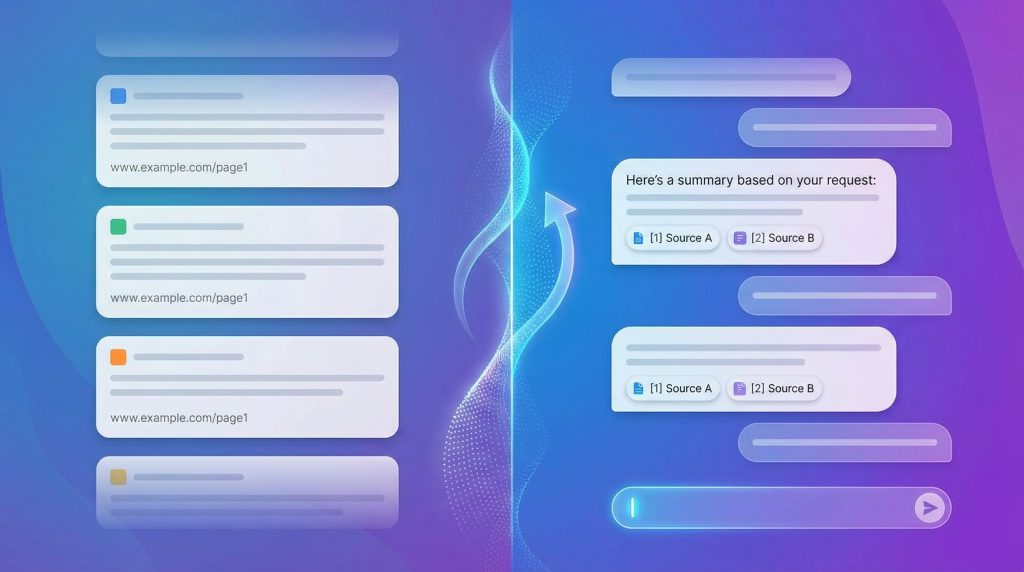
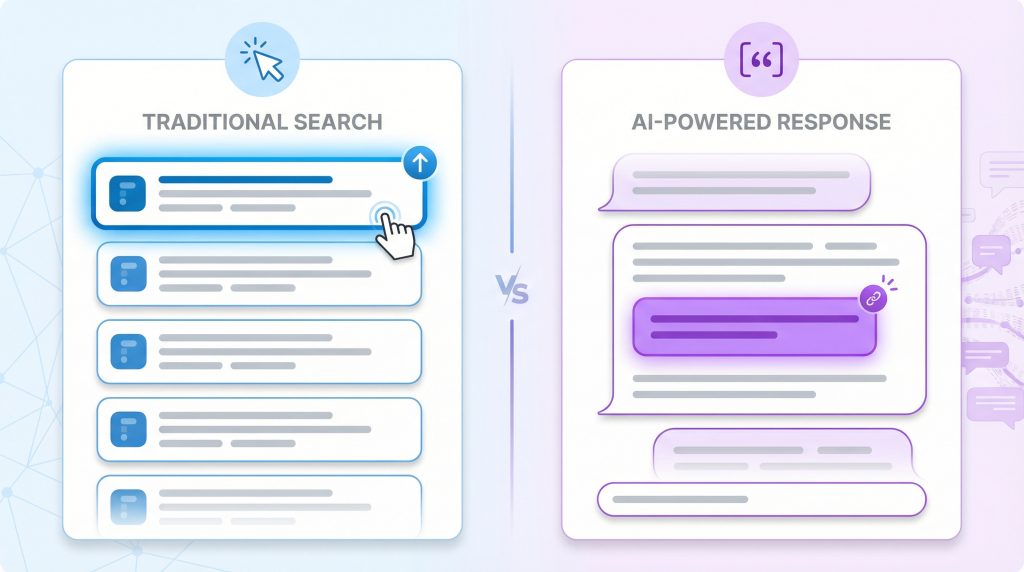
AEO stands for Answer Engine Optimization. It emerged as a distinct discipline in 2024 and 2025, as generative AI assistants began handling the kind of research and discovery questions that used to belong to Google. Instead of returning ten blue links, these engines return a single synthesized answer — often with a handful of brand names embedded inside it. The brands that get named earn the attention. The brands that don’t are invisible, no matter where they rank in traditional search.
The basic idea behind AEO is simple. In SEO, you optimize to rank on a page of results. In AEO, you optimize to be named inside the answer itself. The mechanics are different, the metrics are different, and the work is different — but the goal is the same: be the brand a buyer encounters when they’re looking for what you sell.
Why AEO matters in 2026
The shift from search engines to answer engines is no longer a forecast. It’s a measurable change in how people find things.
ChatGPT crossed one billion weekly active users in 2025, making it one of the fastest-growing consumer products in history. More than 60% of consumers now begin product research with an AI assistant instead of a traditional search engine, according to recent industry surveys. Perplexity, Gemini, Claude, and Microsoft Copilot have all carved out meaningful share alongside it.
Gartner has projected that traditional search engine volume will drop by roughly 25% by 2026 as users migrate to AI agents and virtual assistants for discovery tasks. That projection is now arriving on schedule.
What makes this consequential for brands is the “zero-click” pattern that AI engines reinforce. When a user asks ChatGPT for the best CRM for a small consulting firm, they get an answer with three or four named products. They don’t have to click anywhere. They don’t see a SERP. If your brand isn’t in that answer, you don’t exist in the conversation — even if you rank first on Google for “best CRM for small business.”
The flip side is the upside. Being cited inside an AI answer functions as implicit endorsement. Users tend to trust AI recommendations more readily than ads or sponsored placements, because the AI appears to have evaluated options on their behalf. A single citation in an AI answer can outperform a paid placement in raw conversion terms.
For brands that ignore AEO, the risk is straightforward: a growing share of buyer demand simply routes around them. For brands that move early, the upside is a defensible position in a channel where most competitors haven’t yet shown up.
AEO vs SEO vs GEO — what’s the difference?
SEO
AEO
GEO
Optimizes for
Search engine rankings
Being cited in AI answers
Being cited in AI answers
Core unit
Keywords
Prompts / questions
Prompts / questions
Primary metric
Position on SERP
Mention rate, citation rate
Mention rate, citation rate
Engines targeted
Google, Bing
ChatGPT, Perplexity, Gemini, Claude
Same as AEO
User outcome
Click to website
Answer read, may not click
Answer read, may not click
Maturity
25+ years
Emerged 2024–2025
Emerged 2024–2025
AEO and GEO are, in practice, the same discipline with different names. GEO — Generative Engine Optimization — was coined first, drawn from academic work on optimizing content for large language models. AEO — Answer Engine Optimization — emerged shortly after, framed around the answer-engine user experience rather than the underlying generative model. Some practitioners try to draw a distinction (GEO refers to generative AI broadly, AEO to answer-format outputs specifically), but the day-to-day work is identical. If you’d like the longer breakdown, see how AEO compares to SEO in detail in our dedicated comparison piece, or read our complete guide to generative engine optimization for the GEO framing.
SEO is still relevant, but it’s no longer sufficient on its own. AI engines frequently retrieve from content that ranks well in Google, so traditional SEO continues to feed the funnel. But ranking first in Google doesn’t guarantee you’ll be mentioned in the AI-generated answer above the blue links. That’s a separate optimization layer with its own signals — and the teams that win in 2026 are doing both, not picking one.
The simplest way to think about it: SEO gets you on the page. AEO gets you in the answer.
How AEO actually works
To optimize for answer engines, it helps to understand what they’re actually doing behind the scenes.
AI engines use retrieval-augmented generation (RAG). When a user asks a question, the model doesn’t only rely on its training data. It issues live searches against the web or a curated index, retrieves a small set of relevant sources, and then synthesizes an answer drawing on those sources. The brands and citations that appear in the final answer trace back to the documents the model retrieved. AEO is, fundamentally, the practice of becoming one of those retrieved documents — or being mentioned within one.
AI engines decide which sources to cite based on multiple signals. The known factors include:
Topical depth and content authority on the question being asked
Schema markup such as Article, FAQ, HowTo, and Organization
Freshness and recency of the content
Mentions and citations on trusted third-party sources — Reddit threads, G2 reviews, niche industry publications, Wikipedia
Direct alignment between the content’s phrasing and how the user’s prompt is constructed
These overlap with classic SEO signals, but the weighting differs. AI engines lean heavily on community sources (Reddit in particular has become an outsized influence on ChatGPT and Google AI Overviews) and on structured, citation-friendly formatting.
The levers AEO practitioners actually pull:
Map the prompts. Identify the questions your buyers ask AI in your category — not keywords, full prompts. Tools like Geoptie’s GEO Keyword Finder surface these directly.
Produce citation-friendly content. Each piece should answer one prompt comprehensively, with the structure (headers, lists, FAQs, schema) that makes it easy for an AI engine to pull a clean citation.
Build authority signals off-site. Show up on the third-party sources that AI engines already retrieve from — relevant subreddits, G2 and Capterra, industry blogs, podcasts, expert roundups.
Tighten technical fundamentals. Clean HTML, fast page loads, indexable content, schema markup. AI engines can’t cite what they can’t parse.
Audit and measure continuously. Mention rates shift week to week as models update. A snapshot is useless; a trend line is the actual asset.
AEO is not keyword stuffing for AI. The practice that wins long-term is the same one that wins in regular SEO: produce content that genuinely answers questions better than the alternatives, with the structure and signals that AI models reward. Brands trying to game models with synthetic content or manipulated citations tend to lose ground as those models update.
How to implement AEO — a 5-step starter framework
Audit your current AI visibility. Before you optimize anything, find out where you stand. Run a free GEO audit to see how often your brand appears across ChatGPT, Perplexity, Claude, and Gemini for prompts in your category. This becomes your baseline.
Identify the prompts your buyers actually use. Move beyond keyword lists. The right question isn’t “what do people search for” — it’s “what do people ask AI when they’re researching this category.” Geoptie’s GEO Keyword Finder helps surface the prompts that matter.
Create content that targets those prompts. Each piece of content should answer one priority prompt directly and comprehensively. Use clear headers, lists, FAQ blocks, and schema. Aim to be the most useful, well-structured answer on the open web for that question.
Build authority signals. AI engines cite sources they already trust. Build presence on those sources: contribute to relevant Reddit threads, get listed on G2 and other review platforms, earn mentions in industry publications, and participate in expert roundups. You can use a content optimization checker to validate that each new piece hits the structural signals AI engines reward.
Track and measure. AI visibility moves week to week. Without measurement, optimization is blind. Use a dedicated platform to track mention rate, citation rate, and share of voice over time. Our roundup of the best AI visibility tools for tracking this walks through the options.
Common AEO mistakes to avoid
Treating AEO like keyword SEO. AI answers questions, not keywords. Optimize for the full prompt, not the term.
Tracking only one engine. ChatGPT is the largest, but Perplexity, Gemini, and Claude each have distinct citation behaviors and source preferences. Track at least three or four engines to get a representative picture.
Ignoring source citations. Knowing which third-party sites AI engines retrieve from is often more valuable than knowing your own mention rate. The leverage is in being cited by those sources.
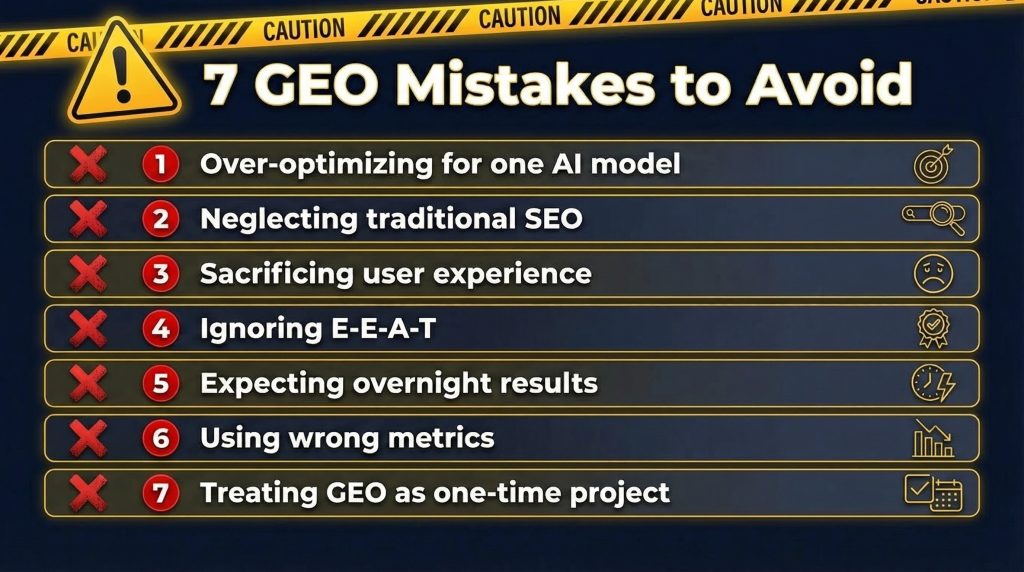
Optimizing once and forgetting. AI models update constantly. Visibility that’s strong today can erode in two weeks. Treat AEO as an ongoing practice, not a launch.
Skipping measurement. Without a baseline, you can’t tell if anything is working. Audit first, then optimize, then re-audit. A walkthrough of the full optimization process lives in our content checklist for AI.
Frequently asked questions
What does AEO stand for?
AEO stands for Answer Engine Optimization. It refers to the practice of optimizing content, brand presence, and authority signals so that AI-powered answer engines like ChatGPT, Perplexity, Gemini, and Google AI Overviews cite or mention your business when users ask related questions. It’s a sibling discipline to SEO, focused on AI-generated answers rather than traditional search rankings.
Is AEO the same as GEO?
In practice, yes. GEO (Generative Engine Optimization) and AEO (Answer Engine Optimization) describe the same discipline with different names. GEO was coined first and is rooted in academic work on generative models. AEO emerged shortly after, framed around the answer-engine user experience. Some practitioners draw subtle distinctions between them, but the day-to-day work — auditing AI visibility, mapping prompts, producing citation-friendly content, building authority signals — is essentially identical.
How is AEO different from SEO?
SEO optimizes for ranking high in Google’s blue-link results. AEO optimizes for being cited inside AI-generated answers from engines like ChatGPT and Perplexity. Both matter, but they target different engines, different user behaviors, and different success metrics. SEO’s core metric is SERP position. AEO’s core metric is mention or citation rate. The best practitioners do both, since AI engines often retrieve from content that ranks well in Google.
Do I need AEO if my SEO is already working?
Increasingly, yes. Strong Google rankings no longer guarantee you’ll be mentioned in the AI-generated answer that appears above the blue links. You can rank first for a query and still be entirely absent from the ChatGPT or Perplexity answer to that same question. As more buyers shift to AI assistants for category research, ignoring AEO leaves a growing share of demand uncaptured — even for brands with excellent SEO foundations.
Which AI engines should I optimize for?
At minimum: ChatGPT, Google AI Overviews, Perplexity, and Gemini. Add Claude, Grok, Microsoft Copilot, and Meta AI if your audience uses them. Tracking at least four engines gives you a representative picture, since each engine has different retrieval behaviors and source preferences. Focusing on only one engine — usually ChatGPT — misses meaningful variation in how your brand appears across the broader answer-engine landscape.
How long does AEO take to show results?
Typically two to eight weeks from publishing optimized content to seeing measurable changes in AI citations. That’s faster than traditional SEO, where results often take months, but it still requires consistency. Brands that publish citation-worthy content weekly see results faster than those who publish monthly. Authority signals — Reddit presence, G2 listings, third-party mentions — tend to compound over a longer horizon, usually three to six months.
What’s the best AEO tool?
The right tool depends on your budget, the engines you need to track, and whether you also need content optimization and prompt research alongside visibility tracking. Free options exist for getting started, and enterprise platforms can run several hundred dollars per month. Our detailed comparison of the best AI search visibility tools breaks down the leading platforms by use case and budget.
How much does AEO cost?
AEO tooling ranges from free (basic audits, including Geoptie’s free GEO audit) to roughly $499 per month for enterprise platforms. Content production and authority-building work add to the total, similar to traditional SEO budgets. Most small teams can start meaningfully for under $100 per month in tooling, with content and outreach effort layered on top. The biggest cost is usually the time required for consistent content production, not the software.
Start with your own AI visibility
The fastest way to understand AEO is to see your own brand’s visibility across the major AI engines. Run a free GEO audit on Geoptie — it takes under two minutes and shows you exactly where your brand stands across ChatGPT, Perplexity, Gemini, and more. From there, the gaps in your AI presence — and the prompts where you should be showing up but aren’t — become the roadmap for everything else.
ChatGPT has over 700 million weekly active users. Traffic referred from ChatGPT converts at roughly five times the rate of traditional organic search. And more than 80% of searches in 2026 end without a click — users get their answer directly from AI.
But here’s what most marketers don’t understand: ChatGPT doesn’t rank websites the way Google does. There’s no position #1. There’s no list of ten blue links. You’re either cited in the AI-generated response, or you’re invisible. There is no middle ground.
This guide breaks down exactly how ChatGPT decides which brands and sources to cite, what content gets selected, and gives you a step-by-step process for getting your brand recommended in ChatGPT responses. It’s based on published research analyzing thousands of AI citations — not guesswork.
And unlike most guides on this topic, we’ll give you a free tool to check where you stand right now: our free ChatGPT rank tracker lets you enter your brand and keywords and see exactly how ChatGPT currently responds to queries in your space.
Let’s get into it.
How ChatGPT Actually Selects Sources
ChatGPT doesn’t produce a ranked list of websites. It synthesizes an answer from multiple sources and decides which ones deserve citation. Understanding the mechanics behind this is the first step to influencing the outcome.
ChatGPT operates across three distinct retrieval layers, and your brand needs presence across all three to be reliably cited.
Layer 1: Training data
ChatGPT’s base model was trained on a massive corpus of web content. Brands with strong editorial presence, Wikipedia pages, press coverage, and consistent mentions across the web during the training window are embedded in the model’s understanding of the world. This is why established brands get recommended even for brand-new queries — the model already recognizes them as entities in their category.
You can’t retroactively influence the training data for current models. But future model updates continuously incorporate newer web content, which means the authority you build today feeds into tomorrow’s training data.
Layer 2: Live web retrieval
When ChatGPT searches the web in real time (through its browsing mode or SearchGPT), it uses Bing’s index as its primary source. This is a critical detail that most brands miss entirely: if your pages aren’t indexed in Bing, ChatGPT’s web search mode literally cannot find you.
During live retrieval, ChatGPT evaluates candidate pages based on domain authority, content freshness, structural clarity, and direct relevance to the query. It then selects 2-7 sources to cite in its response — far fewer than Google’s ten blue links, which makes the competition for citation slots fierce.
Layer 3: Third-party citation co-occurrence
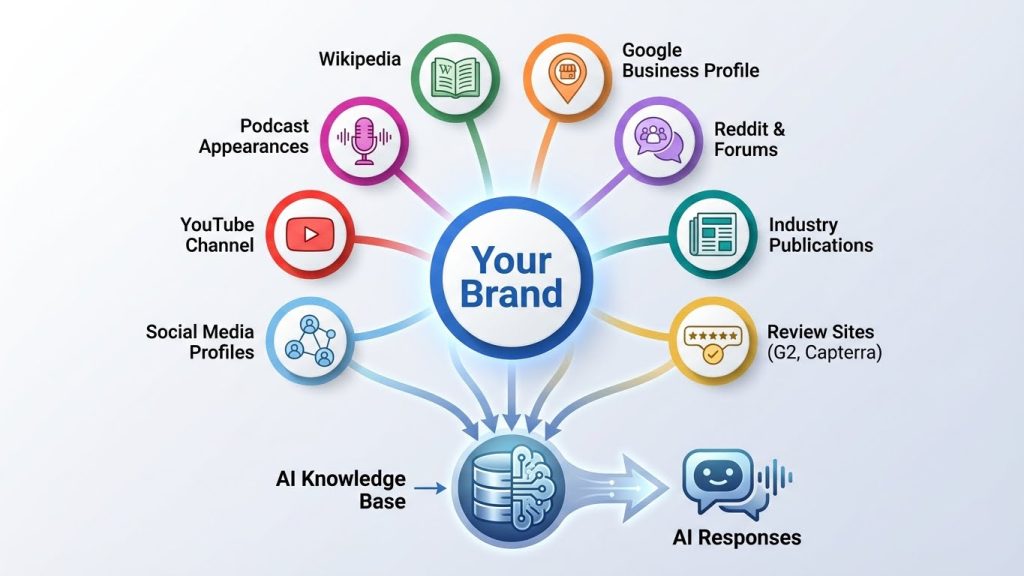
This is the most underrated layer and the one that separates brands that get cited from those that don’t. ChatGPT doesn’t just read your website — it reads what everyone else says about you. If your brand is consistently mentioned alongside your category across review sites, Reddit threads, comparison articles, and industry publications, the model builds confidence that you’re a legitimate recommendation.
Research from Ahrefs found that 80% of pages ChatGPT cites don’t even rank in Google’s top 100 for the same query. This proves that ChatGPT’s citation logic operates independently of traditional search rankings. What matters is the breadth and consistency of your brand’s presence across the web.
A 2026 analysis by OtterlyAI of over one million AI citations confirmed the importance of third-party sources: community-driven platforms like Reddit and Quora captured 52.5% of citations across ChatGPT, Perplexity, and Google AI Overviews combined. Wikipedia alone accounts for 47.9% of ChatGPT’s top citations — more than most brand domains will ever achieve.
The implication is clear: your own website content is necessary but not sufficient. The web around you matters just as much.
Not all content is created equal in ChatGPT’s eyes. Research across multiple citation studies reveals clear patterns in what gets selected and what gets skipped.
Content that earns citations
Specific data and statistics. The Princeton GEO research paper found that adding statistics was the single most effective optimization for generative engine visibility. “Conversion rates improved 47% after implementing personalization” will always beat “personalization works well.” AI models need verifiable claims they can confidently attribute.
Comprehensive, structured guides. Pages that cover a topic thoroughly from multiple angles — definitions, how-tos, comparisons, use cases — are more likely to be cited than thin listicles or surface-level overviews. ChatGPT is assembling a complete answer, so it gravitates toward sources that provide complete information.
Clear entity definitions. ChatGPT needs to understand what your brand IS and what category it belongs to. Pages that clearly state “X is a [category] tool that does [specific thing] for [specific audience]” give the model the semantic clarity it needs to recommend you confidently.
Fresh content. Research from ConvertMate analyzing over 10,000 domains found that content updated within 30 days receives 3.2 times more citations than older material. Perplexity shows an even stronger freshness bias, heavily favoring content published within the last 12 months.
Third-party mentions. Review sites, comparison articles, Reddit discussions, and expert roundups that mention your brand are among the most-cited source types. ChatGPT trusts external validation far more than self-promotion.
FAQ-structured content. Pages with clear question-and-answer formatting give ChatGPT ready-made extractable chunks. When a user’s query matches one of your FAQ questions, the model can pull your answer directly.
Content that gets ignored
Self-promotional blog posts. ChatGPT rarely cites vendor blogs directly — approximately 1% of the time, according to cross-platform citation research. Other AI engines cite vendor blogs slightly more (around 7%), but none of them treat your own marketing content as a primary source.
Pages blocked from AI crawlers. If your robots.txt blocks GPTBot or OAI-SearchBot, ChatGPT’s live retrieval can’t access your content. This is more common than you’d think — many sites added these blocks reflexively when AI crawlers first appeared.
Outdated content. Anything over 12 months old gets progressively deprioritized, especially by platforms with real-time retrieval. If your last content update was in 2024, you’re already falling behind.
Keyword-stuffed content. The Princeton study showed that keyword stuffing — a classic SEO tactic — actually hurt visibility in generative search contexts. AI models evaluate semantic clarity, not keyword density.
Pages not indexed in Bing. Since ChatGPT’s web search uses Bing’s index, content that only appears in Google’s index is invisible to ChatGPT’s live retrieval layer.
Before optimizing anything, you need to know where you stand. Open ChatGPT and ask the questions your target customers would ask about your category. Run 10-15 prompts covering your core use cases.
For each prompt, document: Does ChatGPT mention your brand? What competitors does it recommend instead? What sources does it cite? Does it describe your brand accurately, or does it get details wrong?
This baseline reveals your starting point and highlights the biggest gaps. Many brands discover they’re completely absent from their category’s AI responses — which is both alarming and a clear signal of where to focus.
You can automate this process with our free ChatGPT rank tracker. Enter your brand name and target keywords, and see exactly how ChatGPT responds to queries in your space. No signup required.
Step 2: Get indexed in Bing
ChatGPT’s live web search runs on Bing’s index. If your site isn’t properly indexed there, an entire retrieval layer can’t find you.
Go to Bing Webmaster Tools, add your site, and submit your XML sitemap. Verify your ownership. This takes about five minutes and is the single most overlooked technical requirement for ChatGPT visibility.
Most brands focus exclusively on Google Search Console and never check Bing. Don’t make that mistake. Verify that your key pages are indexed and that Bing isn’t flagging any crawl errors.
Step 3: Unblock AI crawlers
Check your robots.txt file for any rules blocking AI-specific crawlers. The ones that matter most for ChatGPT are GPTBot, OAI-SearchBot, and ChatGPT-User. If any of these are disallowed, ChatGPT’s live retrieval cannot access your content.
While you’re at it, make sure you’re also allowing ClaudeBot (for Anthropic’s Claude), PerplexityBot, and Google-Extended (for Gemini). Blocking AI crawlers eliminates your citation possibility while offering minimal protection — AI models have already been trained on massive internet datasets that likely include your content.
Consider creating an llms.txt file for your site. This newer standard (similar to robots.txt) lets you specify which content you want AI models to prioritize, provide context about your brand, and guide how models understand your site’s structure.
Our GEO readiness checklist covers all 120+ technical and content factors for AI crawlability, including a complete robots.txt review.
Step 4: Build your entity identity
ChatGPT doesn’t just index pages — it builds a knowledge graph of entities. Your brand needs to exist as a clearly defined entity with consistent attributes: what you are, what category you belong to, who you serve, and what makes you different.
Start with technical entity signals. Implement Organization schema (JSON-LD) on your homepage with your full company name, description, logo, founding date, and social profiles. Add Product or SoftwareApplication schema on your product pages. Use SameAs properties to connect your brand entity across platforms (LinkedIn, Twitter, Crunchbase, Wikipedia if applicable).
Then ensure your About page clearly defines your product in plain language. Something like: “[Brand] is a [category] platform that helps [audience] do [specific outcome].” This definition should be consistent everywhere — your homepage, your About page, your social profiles, your directory listings. Inconsistent descriptions confuse the model and reduce citation confidence.
If your brand meets Wikipedia’s notability guidelines, pursue a Wikipedia page. Wikipedia accounts for nearly half of ChatGPT’s most-cited sources. Even a brief entry dramatically increases your entity recognition within the model.
Step 5: Create citation-worthy content on your site
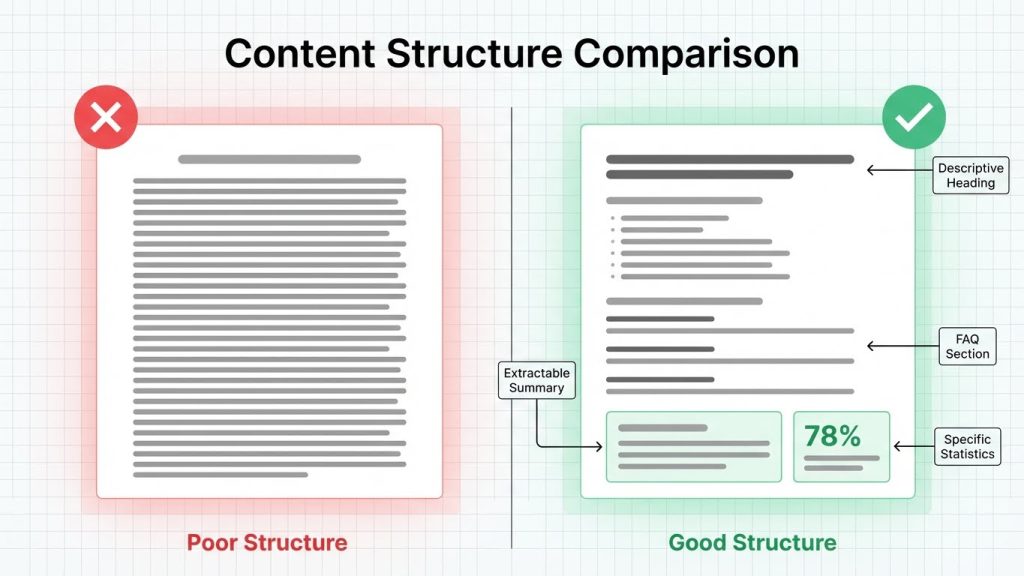
Structure every important page to be extractable. Use question-based H2 headings that match how people ask ChatGPT (e.g., “What is [topic]?” or “How does [process] work?”). Put a direct, complete answer in the first one to two sentences under each heading. Keep paragraphs to two to four sentences. Add comprehensive FAQ sections with five to ten real questions at the bottom of key pages.
Include specific statistics, named sources, and original data wherever possible. The Princeton GEO research identified three content additions that most improved generative engine visibility: statistics, source citations, and direct quotations from experts. All three give AI models verifiable, attributable claims they can confidently use.
Focus especially on “category hub” content. The SearchEngineLand study of 8,000 AI citations found that detailed comparison pages and “best of” guides — ones that fairly cover competitors and demonstrate genuine expertise — are the most-cited content type from brand-owned domains. Writing honest comparisons builds E-E-A-T signals that both Google and AI engines reward.
Step 6: Build third-party citation density
This is the most important step in the entire playbook, and the one most brands neglect.
ChatGPT builds recommendation confidence from how consistently and broadly your brand appears across trusted external sources. Your own site optimization matters, but third-party mentions are what push you over the citation threshold.
Here’s a prioritized action list:
This week: Get listed on G2, Capterra, TrustRadius, Product Hunt, and any other review platforms relevant to your category. Complete your profiles fully. Ask existing customers for reviews. These platforms are among the most-cited sources across all AI engines.
This month: Pitch guest posts to three to five authoritative industry blogs. Focus on publications that already appear in ChatGPT citations for your category — you can identify these by checking what sources ChatGPT cites when answering queries about your competitors.
Ongoing: Get active on Reddit in your industry’s subreddits. Reddit accounts for 46.5% of Perplexity citations and is heavily weighted by other AI engines including ChatGPT. Don’t spam links. Provide genuinely useful answers, build karma, and mention your brand naturally when it’s relevant.
Ongoing: Respond to journalist queries through HARO, Connectively, or similar platforms. Press mentions in authoritative publications carry significant weight in AI citation decisions. Position your founder or team leads as expert sources on your topic.
Ongoing: Seek podcast interviews and webinar appearances that get published with transcripts online. Each of these creates another web page where your brand is mentioned in context by a third party.
The benchmark to aim for: your brand name should appear on at least 15-20 unique trusted domains in your category context. The more domains mentioning you consistently with the same category framing, the more confident the model becomes in recommending you.
Step 7: Optimize for freshness
AI engines heavily penalize stale content. A page that was authoritative six months ago can lose citation eligibility simply because it hasn’t been updated.
Set a monthly refresh calendar for your top 10 most important pages. Update statistics with current-year data. Add new sections that address emerging questions. Include a visible “Last updated: [month] [year]” date on every page — AI engines check for this as a freshness signal.
Publish regular new content that keeps your overall site fresh. This doesn’t mean churning out daily blog posts — one high-quality, data-backed article per week or every two weeks is enough. The goal is to signal to AI retrieval systems that your site is active, current, and maintaining its expertise.
The 30-day rule applies: content updated within the last 30 days receives 3.2x more citations. Make your top pages part of that refresh cycle.
Step 8: Monitor, measure, and iterate
Track your ChatGPT visibility on a weekly basis. Monitor which prompts cite your brand and which don’t. When you spot a gap — a query where competitors get cited but you don’t — that gap tells you exactly what content to create or which third-party source to pursue.
Set up referral traffic tracking in Google Analytics for chatgpt.com. Filter your traffic sources to see visits originating from ChatGPT. This number is still small for most brands but growing rapidly, and these visitors convert at significantly higher rates than traditional organic traffic.
Key metrics to track: number of prompts where your brand appears, citation frequency over time, share of voice compared to competitors, sentiment accuracy (is ChatGPT describing you correctly?), and referral traffic from chatgpt.com.
Track your rankings across all AI platforms with our free rank tracker. We also offer dedicated trackers for ChatGPT and Perplexity specifically.
ChatGPT vs Other AI Engines: Key Differences
The foundational work described above — structured content, entity clarity, third-party mentions, freshness — applies across all AI platforms. But each engine has its own source preferences worth understanding.
ChatGPT relies on Bing’s index for live retrieval and weights entity recognition and brand consistency heavily. It rarely cites vendor blogs directly and favors Wikipedia as its top citation source. Building broad third-party mention density is the primary lever.
Perplexity performs real-time web search and has the strongest freshness bias of any AI engine. Reddit dominates its citations at 46.5%, and it’s more willing to cite newer, smaller sites than ChatGPT. If you’re a newer brand, Perplexity is often where you’ll see citation traction first.
Google AI Overviews show the strongest correlation with traditional Google rankings. Research shows that 40-76% of AI Overview citations also appear in the top 10 organic results. If you rank well in Google, you’re likely to be cited in AI Overviews. Traditional SEO fundamentals matter most here.
Claude has less public data on citation patterns but follows a similar logic to ChatGPT: authoritative, well-structured, comprehensive content with strong third-party validation gets cited.
The takeaway: optimize once, benefit everywhere. A brand that builds genuine topical authority, maintains fresh content, and earns consistent third-party mentions will perform well across all AI engines — not just ChatGPT.
Focusing only on your own site. On-site content optimization is necessary but not sufficient. If you’re not building third-party mentions simultaneously, your citation ceiling is low.
Ignoring Bing. Many brands check Google Search Console religiously but never verify their Bing index status. Since ChatGPT’s web retrieval runs on Bing, this blind spot directly limits your visibility.
Blocking AI crawlers. Some sites added GPTBot blocks when AI crawlers first appeared. If you haven’t reviewed your robots.txt recently, check it now. The cost of blocking far outweighs any perceived benefit.
Publishing once and never updating. AI engines reward freshness. Content that isn’t updated within 30 days loses citation eligibility progressively. Set a refresh cadence for your most important pages.
Treating this as “just more SEO.” The tactics overlap with traditional SEO, but the mechanics are fundamentally different. SEO optimizes for position on a ranked list. ChatGPT optimization builds citation confidence across a knowledge graph. The mental model matters because it changes what you prioritize.
Expecting overnight results. Measurable citation improvements typically begin within 8-12 weeks of targeted optimization. Sustained AI search presence takes 3-6 months to build. The brands seeing results today started building citation density 6-12 months ago.
What to Expect: A Realistic Timeline
Week 1-2: Fix technical requirements. Get indexed in Bing, unblock AI crawlers, implement schema markup, create llms.txt. These changes have immediate effect on your eligibility for live retrieval.
Month 1-2: Optimize on-site content and begin third-party listing efforts. Submit to review platforms, publish your first guest posts, start building Reddit presence. You may begin appearing in long-tail, specific queries during this phase.
Month 2-4: Citation density compounds. As more third-party sources mention your brand consistently, the model’s confidence grows. You’ll start appearing in broader category queries, not just niche ones.
Month 4-6: Flywheel effects kick in. Brands that invested early and stayed consistent see more citations per query, increasing dark funnel traffic (people who discover you through AI but arrive at your site through direct or branded search), and rising branded search volume.
The compounding nature of AI citations means that early investment pays disproportionate returns. Every citation reinforces your entity authority, making the next citation more likely. The brands losing ground in 2026 are the ones who assumed this could wait.
Start Now
The window for early-mover advantage in ChatGPT visibility is still open, but it’s narrowing as more brands invest in AI search optimization. The foundational work — entity clarity, content structure, third-party mentions, freshness — compounds over time. Starting today puts you months ahead of competitors who are still debating whether AI search matters.
Then work through the 8-step playbook above systematically. Fix the technical basics in week one, optimize your content in weeks two through four, and build citation density as an ongoing practice.
AI search optimization is the practice of making your content discoverable, citable, and recommendable by AI-powered search engines like ChatGPT, Perplexity, Google AI Overviews, Claude, and Gemini. It’s the reason some brands get mentioned every time someone asks an AI assistant for a recommendation — and others don’t exist in AI’s world at all.
The numbers make the urgency clear. ChatGPT now has over 800 million weekly active users. Google AI Overviews appear in up to 25% of all searches. According to Search Engine Land, 37% of consumers now start their searches with AI rather than Google. And here’s the part most marketers miss: AI search traffic converts at rates 4-5x higher than traditional organic search, according to data from both Ahrefs and Semrush.
Yet most businesses have no idea whether AI recommends them or not. This guide gives you a concrete, step-by-step process to fix that — with free tools you can use at each step to check your progress.
How AI Search Engines Actually Work
Before optimizing for AI search, you need to understand what happens behind the scenes when someone asks ChatGPT “what’s the best project management tool” or searches Google and gets an AI Overview.
Every AI search engine follows a three-step process: query expansion, retrieval, and selection.
Query expansion happens first. When you type a question, the AI doesn’t just match your keywords — it interprets your intent and expands your query into multiple sub-queries. A question like “best CRM for small business” might get expanded into sub-queries about pricing, ease of use, integrations, and scalability. This is why conversational, long-tail queries are the sweet spot for AI search optimization. The AI is looking for content that answers the full intent, not just the surface keywords.
Retrieval comes next. The AI searches for relevant sources using some form of retrieval-augmented generation (RAG). Different platforms use different source indexes — ChatGPT uses Bing’s index plus real-time web browsing, Perplexity performs live web searches, and Google AI Overviews pull from Google’s own index. But the core mechanic is the same: the AI gathers a set of potentially relevant pages, then evaluates which ones to actually use.
Selection and citation is the final step — and the one where most brands lose. The AI picks only 2-7 sources to include in its response. That’s far fewer than Google’s traditional ten blue links. The selection criteria aren’t publicly documented, but multiple studies have reverse-engineered what matters most.
SE Ranking’s study on Google AI Mode found that organic traffic to a site’s homepage is the single strongest predictor of whether a site gets cited. High-traffic homepages get roughly twice as many AI citations as low-traffic ones. The number of referring domains is the second strongest factor. In simpler terms: the same signals that make you authoritative in traditional search also make you citable in AI search.
This is a critical insight. AI search optimization doesn’t replace SEO — it builds on top of it. If your traditional organic presence is weak, your AI visibility will be too.
Not all content is created equal in the eyes of AI search engines. Research across thousands of AI citations reveals clear patterns in what gets selected and what gets ignored.
Content that earns citations
Direct answers positioned early. AI engines scan for extractable chunks of text. If the first 1-2 sentences under a heading directly answer a question, the AI can grab that and use it. Content that opens with background context or throat-clearing gets skipped in favor of pages that answer immediately.
Specific data and statistics. The Princeton research paper that established Generative Engine Optimization as a field tested nine content optimization methods. Statistics addition was the single strongest performer. “Personalization improved conversions by 47%” gets cited. “Personalization works well” does not.
Clear content structure. Pages organized with question-based headings, short paragraphs (2-4 sentences), and content chunked into 100-300 token blocks with one idea each. AI engines need to be able to extract a section and have it make sense as a standalone passage.
Author credentials and trust signals. Expert bylines with professional titles, original research, cited sources within the content, and up-to-date information. AI systems scan for these E-E-A-T signals (Experience, Expertise, Authoritativeness, Trustworthiness) when deciding which source to trust.
Pages that already rank well organically. Studies from Authoritas, Optimizely, and Rich Sanger have shown that 40-76% of citations in Google AI Overviews also come from pages in the top 10 organic search results. Strong traditional rankings are a prerequisite, not a nice-to-have.
Comparison and decision-stage content. “Best X” lists, versus comparisons, and buying guides get cited disproportionately often because they directly match the types of questions people ask AI.
Content that gets ignored
Dense, unstructured text without clear headings or logical organization. AI engines can’t easily parse walls of text.
Vague claims without evidence. If your competitors’ pages include data points and yours just makes assertions, the AI will cite them.
Outdated content. Perplexity in particular heavily favors content published or updated within the past 12 months. A page from 2023 with no update signals will lose to a 2026 page covering the same topic.
Pages blocked from AI crawlers. Some sites inadvertently block GPTBot, PerplexityBot, or ClaudeBot in their robots.txt — making their content invisible to those platforms entirely.
Keyword-stuffed content. The Princeton GEO study found that traditional keyword stuffing actually hurt performance in generative contexts. AI engines penalize content that reads like it was written for algorithms rather than humans.
How each platform differs
Not all AI engines cite the same way. Understanding the differences helps you prioritize.
Google AI Overviews have the strongest correlation with traditional Google rankings. If you’re in the top 10 organically, you’re a candidate for citation. Reddit (21%) and YouTube (18.8%) are among its most-cited third-party sources.
Perplexity does real-time web retrieval and heavily weights freshness. Reddit accounts for a remarkable 46.5% of Perplexity’s citations. It also shows only 25% source overlap between queries — meaning newer, fresher content has a genuine chance against established players.
ChatGPT favors recognized brands and authoritative entities. It rarely cites vendor blogs directly (around 1% of citations) but frequently cites major publications, review sites, and industry resources. Brand recognition matters more here than anywhere else.
Claude follows patterns similar to ChatGPT, prioritizing well-sourced, comprehensive content with clear entity relationships.
Before optimizing anything, establish your baseline. Go to ChatGPT, Perplexity, and Google and ask questions relevant to your industry. Ask for recommendations in your category. Ask how your brand compares to competitors. Ask about problems your product solves.
Document everything: where you appear, where competitors appear instead, what sources get cited, and what language the AI uses to describe your category. This audit reveals your starting point and highlights the biggest gaps.
Don’t limit yourself to branded queries. Test category queries (“best CRM software”), problem queries (“how to reduce customer churn”), comparison queries (“Salesforce vs HubSpot”), and use-case queries (“CRM for small sales teams”). The full landscape of how AI currently perceives your space is more revealing than any single query.
Step 2: Ensure technical accessibility for AI crawlers
AI engines can only cite content they can access. Several technical prerequisites need to be in place.
Check your robots.txt file. Make sure you’re not blocking GPTBot (ChatGPT’s crawler), PerplexityBot, ClaudeBot, or Google-Extended. This is more common than you’d expect — many sites copy robots.txt templates that block AI crawlers by default.
Consider implementing an llms.txt file. This is a newer standard, similar to robots.txt but designed specifically for AI crawlers. It lets you specify which content you want AI models to prioritize and provides context about your brand and site structure.
Optimize page load speed. AI retrieval systems operate under time constraints. If your pages take too long to load, retrieval systems may skip them entirely in favor of faster-loading alternatives.
Implement structured data markup. JSON-LD schema helps AI engines understand your content at a structural level. The most impactful schema types for AI visibility are Article schema (defines the who, what, and when of your content), FAQ schema (maps questions directly to answers), HowTo schema (captures step-by-step processes), Product and Review schema (essential for appearing in product recommendation queries), and Organization schema (helps AI engines recognize your brand as an entity).
AI engines don’t read your page top-to-bottom like a human visitor. They scan for extractable, self-contained chunks of information. Restructuring your content to match this behavior is one of the highest-impact changes you can make.
Use question-based headings. Frame your H2s and H3s as the actual questions people ask AI: “What is X?”, “How does Y work?”, “Why does Z matter?” This directly maps to the queries AI engines process.
Lead with the answer. Under each heading, put a complete, direct answer in the first 1-2 sentences. Then expand with context, examples, and nuance. This inverted-pyramid structure gives AI engines an easy extraction point while still providing depth for human readers.
Keep paragraphs short. Two to four sentences per paragraph. Each paragraph should contain one clear idea. AI engines chunk content at paragraph boundaries — a 10-sentence paragraph forces the AI to either take too much or too little.
Add FAQ sections. These are goldmines for AI extraction. Structure them with clear question headings and concise 40-60 word answers. FAQ schema markup on these sections doubles the benefit — it helps both AI engines and traditional search features like People Also Ask.
Include comparison tables. When covering multiple options, tools, or approaches, HTML comparison tables are among the most extractable content formats. AI engines can parse table structures and pull specific comparisons into responses.
Step 4: Build topical authority through content clusters
A single optimized page will rarely outperform a site that covers a topic comprehensively from multiple angles. AI engines assess topical authority — how deeply and consistently you demonstrate expertise across a subject area.
Build content clusters with a pillar page at the center surrounded by supporting content that interlinks:
Pillar content covers the broad topic comprehensively. For example, if your domain is project management, your pillar page might be “The Complete Guide to Project Management in 2026.”
Supporting content addresses specific sub-topics, questions, and angles: comparison pages (“Asana vs Monday.com”), how-to guides (“How to Set Up a Kanban Board”), use-case content (“Project Management for Remote Teams”), and tools content (“Best Free Project Management Tools”).
Internal linking connects everything. Each supporting page links back to the pillar and to related supporting pages. This helps AI engines understand the relationships between your content and recognize your site as an authority on the topic.
The key insight is that AI engines don’t evaluate pages in isolation. They evaluate your entire content ecosystem on a topic. Five interlinked pages covering different facets of the same subject will collectively earn more citations than five disconnected pages on unrelated topics.
Step 5: Earn third-party mentions and citations
This is where AI search optimization diverges most sharply from traditional SEO. In traditional search, authority comes primarily from backlinks. In AI search, authority comes from being mentioned, discussed, and recommended across the web — especially on sources that AI engines already trust.
The SearchEngineLand analysis of 8,000 AI citations found that brands with high visibility scores had broad mention ecosystems spanning their own content, review sites, news coverage, forums, and social media.
Industry publications and blogs. Get featured in articles, roundups, and expert interviews on authoritative sites in your space. AI engines cite these frequently.
Review platforms. Maintain active, well-optimized profiles on G2, Capterra, TrustPilot, and industry-specific review sites. These are high-trust sources AI engines pull from when users ask for recommendations.
Reddit and forum presence. Perplexity gets 46.5% of its citations from Reddit. Google AI Overviews cite Reddit in roughly 21% of responses. Genuine participation in relevant subreddits and communities — not link-dropping, but actually being helpful — builds the kind of authentic third-party presence AI engines value.
YouTube. YouTube is among the most-cited sources across AI platforms, particularly for Google AI Overviews. Video content that covers your topic area creates an additional citation surface.
Guest contributions and thought leadership. Bylined articles, podcast appearances, and conference talks create mention touchpoints that AI engines pick up as authority signals. Each genuine mention on a credible platform reinforces your brand as a recognized entity.
The goal isn’t just backlinks (though those help too). The goal is entity recognition — making AI engines understand that your brand is a real, trusted player in your category by seeing it mentioned consistently across multiple credible sources.
Step 6: Optimize for each AI platform specifically
While the fundamentals apply everywhere, each platform has nuances worth addressing.
For Google AI Overviews: Focus on traditional SEO first. The correlation between organic rankings and AI Overview citations is strong. Optimize for featured snippets — pages that already win snippets are frequently pulled into AI Overviews. Ensure your schema markup is comprehensive and your content matches informational search intent.
For ChatGPT: Brand entity recognition is paramount. ChatGPT needs to “know” your brand exists as a relevant entity in your category. This comes from consistent mentions across authoritative sources, Wikipedia presence if applicable, and a strong web footprint. Direct content optimization matters less here than overall brand authority.
For Perplexity: Freshness is your lever. Perplexity does real-time retrieval and favors recently published or updated content. Keep your key pages updated with current dates, fresh statistics, and new insights. Also prioritize presence on Reddit and discussion forums — these are Perplexity’s most-cited source category by a wide margin.
For Claude and Gemini: Focus on comprehensive, well-sourced content with clear citations and structured data. Both platforms weight content depth and source quality.
A practical approach: rather than optimizing for each platform separately, track your visibility across all of them and identify where you’re weakest. A gap on one platform usually points to a specific type of optimization you’re missing.
AI search optimization isn’t a one-time project. AI engines update their models, change their retrieval patterns, and shift citation preferences over time. What works today may not work in six months.
Track AI-specific metrics. Citation frequency (how often your brand appears in AI responses for relevant queries), brand mention rate, share of voice compared to competitors, and sentiment (whether AI describes your brand positively or neutrally).
Monitor referral traffic from AI platforms. Check your analytics for traffic from chatgpt.com, perplexity.ai, and other AI referral sources. This traffic is growing rapidly and converts at significantly higher rates than traditional search traffic.
Run regular visibility audits. Monthly at minimum. Ask the same set of queries across platforms and track how your visibility changes over time. Look for patterns: which content updates led to more citations? Which new pages got picked up fastest?
Iterate based on data. If you notice a competitor consistently getting cited where you’re not, analyze what their cited content does differently. Is it more comprehensive? More recent? Better structured? Published on a higher-authority domain? Use these insights to guide your next optimization cycle.
Even well-intentioned optimization efforts can fail if you make these mistakes:
Blocking AI crawlers without realizing it. Check your robots.txt right now. If GPTBot, PerplexityBot, or ClaudeBot are disallowed, your content is invisible to those platforms. This is the single most common technical mistake.
Only optimizing your own site. AI engines weight third-party mentions heavily. If your entire strategy is on-site content with no effort on review profiles, industry mentions, Reddit presence, or earned media, you’re leaving the most influential citation signals on the table.
Publishing thin content and expecting citations. A 500-word blog post with no data, no examples, and no unique insight won’t get cited when competitors have 3,000-word comprehensive guides on the same topic. AI engines select the most useful, most authoritative source — depth matters.
Ignoring freshness signals. AI engines check publication dates and update timestamps. Content from 2023 with no freshness signals will lose to updated 2026 content on the same topic, even if the older content is technically better.
Treating AI search as separate from SEO. They’re deeply connected. SE Ranking’s research shows organic Google rankings are the strongest predictor of AI citations. Building traditional SEO authority simultaneously builds AI citation potential.
Only tracking Google rankings. If your analytics dashboard only shows Google Search Console data, you’re blind to how AI platforms represent your brand. You need dedicated AI visibility tracking to understand the full picture.
How AI Search Optimization Connects to SEO, AEO, and GEO
If you’ve been researching this topic, you’ve likely encountered three related acronyms: SEO, AEO, and GEO. Here’s how they all fit together.
AI search optimization is the broadest term — it encompasses everything involved in making your brand visible in AI-powered search experiences. Under that umbrella sit three specialized disciplines.
SEO (Search Engine Optimization) is the foundation. It focuses on ranking in traditional search results to earn clicks. Since traditional rankings strongly correlate with AI citations, SEO remains essential.
AEO (Answer Engine Optimization) focuses on being the direct answer extracted by search features — Google’s featured snippets, People Also Ask boxes, voice assistant responses, and AI Overviews. AEO is about structuring content so engines can extract and display a clean, complete answer to a specific question.
GEO (Generative Engine Optimization) focuses specifically on earning citations and recommendations inside AI-generated responses from ChatGPT, Perplexity, Claude, and similar platforms. GEO is about influencing the narrative when AI synthesizes information from multiple sources.
In practice, the tactics overlap significantly — probably 70-80%. Writing clear, authoritative, well-structured content with strong data and credible sourcing serves all three goals simultaneously. The remaining 20% is where you put specialized effort based on your priorities.
AI search isn’t a future trend — it’s the current reality reshaping how millions of people discover brands, compare products, and make decisions. The businesses optimizing now are building compounding advantages that will be difficult for latecomers to overcome.
The process is straightforward: audit where you stand, fix the technical foundations, restructure content for AI extraction, build authority across the web, and track your progress.
You don’t need a budget to start. Run a free GEO audit to see how AI engines currently perceive your content, then work through our readiness checklist to build your action plan. Track your progress with our free rank tracker across ChatGPT, Perplexity, Claude, and Google AI.
The question isn’t whether AI will transform search. It’s whether your brand will be visible when it does.
Answer Engine Optimization (AEO) is the practice of structuring content so that AI-powered platforms and search features can extract it as a direct answer to user queries. If you’ve seen the terms AEO, GEO, and SEO thrown around and wondered how they’re different — or whether they even are different — you’re not alone. The marketing world is drowning in acronyms right now, and the definitions keep shifting as AI search evolves.
Here’s the short version: SEO gets you ranked. AEO gets you quoted. GEO gets you recommended. They overlap significantly, but each optimizes for a different outcome. This guide breaks down what each one actually means, where they converge, where they diverge, and how to decide where your time and budget should go.
What Is AEO (Answer Engine Optimization)?
AEO stands for Answer Engine Optimization. It’s the practice of formatting and structuring content so that search engines and AI platforms can extract a clean, direct answer from your page and display it to users — often without requiring them to click through to your site.
The concept isn’t new. AEO traces back to around 2017-2018, when Google started aggressively expanding featured snippets, knowledge panels, and People Also Ask boxes. Voice assistants like Siri, Alexa, and Google Assistant accelerated the trend — when someone asks a voice assistant a question, it can only read one answer. AEO is how you become that answer.
What’s changed in 2026 is the scale. Google’s AI Overviews now appear in roughly 13-25% of all searches, depending on the query type. ChatGPT has over 800 million weekly active users. When these platforms answer a question, they need to pull that answer from somewhere. AEO ensures that somewhere is your content.
In practice, AEO comes down to a few core principles. Your content needs to directly answer specific questions — not dance around them with long introductions. The answer should appear within the first 40-60 words after the question heading, formatted in a way that’s easy for machines to extract. Schema markup (particularly FAQ and HowTo schema) helps search engines understand the structure of your answers. And the content backing up that answer needs to demonstrate genuine expertise and trustworthiness, because answer engines only quote sources they consider authoritative.
Here’s a concrete example. If someone searches “what is keyword cannibalization,” an AEO-optimized page would have an H2 that reads exactly that — “What Is Keyword Cannibalization?” — followed immediately by a clear, concise definition in one to two sentences. The rest of the section provides depth, examples, and context. But the extractable answer comes first.
AEO is about winning the answer box. But what happens when there is no answer box — when an AI generates a full conversational response that cites multiple sources and tells a story? That’s where GEO enters the picture.
What Is GEO (Generative Engine Optimization)?
GEO stands for Generative Engine Optimization. The term was formally introduced in a 2023 research paper by a team at Princeton, Georgia Tech, The Allen Institute, and IIT Delhi, and later presented at KDD 2024 — one of the most prestigious conferences in data science. GEO is specifically about getting your content cited, mentioned, and recommended inside AI-generated responses from platforms like ChatGPT, Perplexity, Claude, Google AI Overviews, and Gemini.
The difference from AEO is subtle but important. AEO aims to be the single extracted answer to a specific question. GEO aims to influence a narrative. When someone asks Perplexity “what are the best tools for AI search optimization,” the platform doesn’t return one answer — it generates a multi-paragraph response that synthesizes information from dozens of sources. GEO determines whether your brand appears in that response and how it’s described.
The Princeton research found that certain optimization strategies significantly improved visibility in generative search results. Adding statistics and data increased citation rates. Including source citations within content made AI engines more likely to trust and reference it. Including expert quotes improved content authority. Traditional SEO tactics like keyword stuffing, on the other hand, actually hurt performance in generative contexts — a finding that separates GEO from old-school optimization.
GEO also introduces a fundamentally different relationship with traffic. In traditional SEO, the goal is a click. In AEO, you might get a click or you might get a zero-click impression. In GEO, your brand might be mentioned in a ChatGPT response that the user never leaves — no click, no visit, but the user now knows your brand and trusts it because an AI recommended it. This means GEO success isn’t just about website traffic. It’s about brand visibility, share of voice in AI responses, and the quality of how AI describes your company.
Here’s a concrete example. Someone asks ChatGPT “what’s the best way to track my brand’s visibility in AI search?” If your brand is well-optimized for GEO, ChatGPT might respond with something like: “Several platforms offer AI rank tracking. [Your Brand] provides free tracking across ChatGPT, Perplexity, and Claude, while [Competitor] focuses on enterprise monitoring.” You’ve just been recommended to a potential customer in a context where they’re highly likely to act on the suggestion.
SEO — Search Engine Optimization — is the foundation that both AEO and GEO are built on. It’s the practice of optimizing web pages to rank higher in traditional search engine results and earn organic traffic through clicks.
SEO has been around for over two decades and encompasses keyword research, on-page optimization (title tags, meta descriptions, content quality), technical optimization (site speed, mobile-friendliness, crawlability), and off-page signals (backlinks, domain authority, brand mentions). The fundamental unit of success is your position on a search engine results page and the click-through rate you earn from that position.
The reason SEO still matters deeply in 2026 — even with AI search growing rapidly — is that traditional organic rankings and AI visibility are closely correlated. Research shows that 99% of URLs cited in Google’s AI Overviews also appear in the top 20 organic search results. In other words, if you can’t rank in traditional search, you’re unlikely to get cited in AI responses either. SEO is the prerequisite, not the alternative.
AEO vs GEO vs SEO: How They Compare
Here’s where most articles on this topic fall short. They present AEO, GEO, and SEO as three separate strategies in neat boxes. The reality is messier and more useful — they overlap about 70-80% in practice, and the differences live in the remaining 20%.
SEO
AEO
GEO
Goal
Rank on search engine results pages
Be the direct extracted answer
Be cited and recommended in AI responses
Platforms
Google, Bing
Google featured snippets, voice assistants, AI Overviews
ChatGPT, Perplexity, Claude, Gemini, Google AI Overviews
Success metric
Rankings, clicks, organic traffic
Featured snippet ownership, zero-click visibility
Citation rate, brand mentions, share of voice in AI
Multi-source consensus — mentions across review sites, Reddit, publications, YouTube
Time to results
3-6 months
1-3 months
2-6 months
Measurement maturity
Mature (Search Console, Ahrefs, Semrush)
Moderate (snippet tracking, PAA monitoring)
Early (AI citation tracking, brand mention monitoring)
The table gives you the quick comparison, but the real insight is in understanding the overlaps and divergences.
What they share: All three reward clear, authoritative, well-structured content. All three benefit from strong technical foundations — fast load times, proper indexing, schema markup. All three perform better when your brand has genuine expertise and third-party validation. If you write excellent content that answers real questions with real data, you’re serving all three goals simultaneously.
Where SEO diverges: SEO is unique in its emphasis on backlinks as a ranking signal and on click-through rate as a success metric. SEO also has the most mature measurement tools — Google Search Console, Ahrefs, Semrush — giving you precise data on rankings, traffic, and keyword performance. SEO is also the only one of the three where paid advertising (Google Ads) can supplement your organic efforts.
Where AEO diverges: AEO is laser-focused on single-question, single-answer precision. The content format matters more in AEO than in SEO or GEO — your answer needs to be in the right place on the page (directly under the H2), in the right length (40-60 words for featured snippets), and in the right format (paragraphs for definitions, ordered lists for how-tos, tables for comparisons). AEO also puts more weight on FAQ schema and HowTo schema than general SEO does.
Where GEO diverges: GEO introduces a dimension that SEO and AEO don’t — multi-source authority. AI engines don’t just look at your website when deciding whether to recommend you. They synthesize information from your site, third-party review platforms, Reddit discussions, YouTube videos, news articles, and industry publications. Your GEO strategy therefore extends beyond your own content into managing how your brand appears across the entire web. GEO also requires topical depth over breadth — AI engines prefer to cite sources that demonstrate comprehensive expertise on a subject rather than surface-level coverage of many subjects.
The overlap between AEO and GEO is significant and growing. Google’s AI Overviews, for instance, sit right at the intersection — they extract direct answers (AEO) but also synthesize information from multiple sources into a narrative (GEO). Optimizing for AI Overviews requires both approaches simultaneously. Similarly, when Perplexity answers a factual question, it may extract your answer directly (AEO) and cite you as a source within a longer response (GEO).
Which Should You Prioritize?
Rather than giving you an “it depends” non-answer, here’s a decision framework based on where your business actually is.
Prioritize SEO if your site is relatively new, your organic traffic is below 1,000 visits per month, or you have unresolved technical issues (slow load times, indexing problems, thin content). SEO is the foundation. Without it, neither AEO nor GEO efforts will gain traction because you won’t have the baseline authority that AI engines look for when selecting sources.
Prioritize AEO if your business serves an audience that searches with questions — how-tos, what-is queries, comparisons, troubleshooting. This is especially relevant for SaaS companies, educational content, healthcare information, financial services, and any space where users need specific answers. AEO wins you featured snippets, People Also Ask placements, and AI Overview citations for direct queries.
Prioritize GEO if you’re a brand that needs to be recommended rather than just found — SaaS products, professional services, B2B solutions, consumer brands. If your competitors are showing up when people ask ChatGPT or Perplexity for recommendations and you’re not, GEO is your gap. GEO is also the priority when you’re competing in “best of” and comparison contexts, where AI engines recommend a shortlist of options.
In practice, the smartest approach is to do all three simultaneously because the tactics overlap so heavily. Writing clear, authoritative, well-structured content with proper schema markup and strong third-party signals serves SEO, AEO, and GEO at the same time. The 20% of effort that’s unique to each discipline is what you adjust based on your priorities.
Not sure where you currently stand? Run a free GEO audit to see how AI search engines perceive your content today, or use our GEO readiness checklist to identify which areas need attention.
How to Optimize for All Three at Once
These six tactics serve SEO, AEO, and GEO simultaneously. Implement them and you’re building a foundation that works regardless of where search goes next.
Start every section with a direct answer. Use an H2 that mirrors a real question your audience asks, then answer it clearly in the first 40-60 words of that section. This wins AEO featured snippets, gives AI engines a clean chunk to extract for GEO, and improves your on-page relevance for SEO. The supporting detail, context, and nuance come after the answer — not before it.
Add FAQ schema to every key page. Identify five to eight real questions your audience asks about each topic and implement them as FAQ structured data. This makes your page eligible for People Also Ask placements (AEO), gives AI engines structured Q&A pairs to reference (GEO), and sends strong relevance signals to Google’s traditional ranking algorithm (SEO).
Include statistics, citations, and expert perspectives in your content. The Princeton GEO study identified these as the top-performing optimization signals in generative contexts. Adding data points and source citations makes your content more trustworthy for AEO answer extraction, more authoritative for GEO citation selection, and more aligned with Google’s E-E-A-T quality standards for SEO.
Build topic clusters, not isolated pages. Instead of writing standalone articles, create interconnected content hubs — a pillar page surrounded by supporting pages that cover subtopics in depth. This helps search engines understand your topical authority (SEO), gives AI engines multiple touchpoints to understand your expertise (GEO), and increases the surface area of questions your site can answer (AEO). For example, a pillar page on “AI search optimization” linked to pages covering specific platforms, tools, tactics, and case studies signals comprehensive authority across all three disciplines.
Get mentioned on third-party sites that AI engines trust. This is where SEO link building, AEO authority signals, and GEO citation optimization converge. AI engines heavily weight third-party mentions when deciding which brands to recommend. Industry publications, review platforms like G2 and Capterra, Reddit discussions, YouTube reviews, and expert roundups all serve as sources that AI models reference. Being mentioned across multiple trusted sources builds what GEO practitioners call “multi-source consensus” — the AI equivalent of social proof.
Audit your AI visibility regularly. Traditional SEO has mature tracking through tools like Google Search Console and Ahrefs. AEO can be tracked through snippet monitoring and People Also Ask tracking. GEO requires checking how ChatGPT, Perplexity, Claude, and Google AI Overviews actually describe your brand when users ask relevant questions. If you’re not tracking it, you can’t improve it.
Use a GEO rank tracker to monitor your position across AI platforms, or try our dedicated trackers for ChatGPT and Perplexity to see exactly where you stand.
How to Measure Success Across AEO, GEO, and SEO
Each discipline has its own metrics, but they increasingly feed into each other.
SEO metrics are the most established: organic traffic, keyword rankings, click-through rates, domain authority, and backlink growth. Google Search Console remains the primary source of truth, supplemented by tools like Ahrefs or Semrush for competitive analysis.
AEO metrics focus on visibility in search features: featured snippet ownership (how many snippets you hold and for which queries), People Also Ask appearances, and zero-click impression share. You can track these through rank tracking tools that specifically monitor SERP feature ownership.
GEO metrics are newer and require specialized tools: AI citation frequency (how often your brand is mentioned in AI-generated responses), share of voice across AI platforms (your mentions vs. competitors), sentiment analysis (how AI describes your brand — positively, neutrally, or negatively), and referral traffic from AI platforms (visits from chatgpt.com, perplexity.ai, and similar sources that show up in your analytics).
The emerging metric that matters most across all three is what some practitioners call “share of answer” — what percentage of AI-generated responses in your category include your brand. Unlike traditional search rankings where position 1-10 is well-defined, AI responses vary every time they’re generated. Monitoring your share of answer over time gives you the clearest picture of whether your combined SEO, AEO, and GEO efforts are working.
For a comprehensive overview of the tools available for tracking AI search performance, see our guide to the best GEO tools in 2026.
The Bottom Line
The brands winning in 2026 aren’t choosing between SEO, AEO, and GEO — they’re treating them as three layers of one strategy. SEO builds the foundation of authority and technical health. AEO ensures your content is the answer to specific questions. GEO ensures your brand is part of the conversation when AI engines recommend solutions.
The good news is that roughly 80% of the work is the same across all three: write genuinely useful content, structure it clearly, back it with data, build authority through third-party mentions, and keep it fresh. The remaining 20% — the schema markup focus of AEO, the multi-source brand building of GEO, the backlink strategy of SEO — is where you fine-tune based on your specific goals.
Start by understanding where you currently stand. Run a free GEO audit to see how AI search engines perceive your content, and use the GEO readiness checklist to identify which optimization layers need attention first.
Generative Engine Optimization (GEO) is the practice of optimizing your content to be discovered, cited, and recommended by AI search engines like ChatGPT, Perplexity, Claude, and Google AI Overviews. Unlike traditional SEO which focuses on ranking in a list of links, GEO ensures your brand appears when AI synthesizes answers to user queries. The discipline was first defined in a 2023 Princeton University research paper and has since become essential as AI search adoption explodes.
How essential? ChatGPT now has 800+ million weekly active users — more than the population of Europe. [Source: TechCrunch] The $80 billion SEO industry is being reshaped. [Source: Andreessen Horowitz] And if your content strategy is still built around Google’s ten blue links, you’re optimizing for a world that’s rapidly disappearing.
This guide covers everything: how AI engines select sources, why traditional SEO tactics fail in generative search, the strategies backed by academic research that actually work, and how to measure success. Whether you’re new to GEO or looking to refine your approach, this is your complete roadmap. For a quick comparison of how GEO relates to other optimization disciplines, see our AEO vs GEO vs SEO guide.
What Is Generative Engine Optimization?
Generative Engine Optimization (GEO) is the practice of optimizing digital content to achieve favorable visibility, accurate representation, and preferential citation in AI-generated search responses. Unlike traditional SEO, which focuses on ranking in search engine results pages (SERPs), GEO ensures your brand appears prominently when AI systems synthesize information to answer user queries.
When someone asks ChatGPT, Perplexity, Claude, or Google’s AI Mode a question about your industry, GEO determines whether your content influences the answer—and whether you receive attribution for it.
Think of the distinction this way: SEO gets you clicked; GEO gets you quoted.
Traditional search engines return a list of links and let users decide which to visit. Generative engines synthesize information from multiple sources into a single, conversational response. Your content doesn’t just need to rank—it needs to be compelling enough for an AI to extract, cite, and present to users as authoritative information.
The Origin of GEO
The term “Generative Engine Optimization” was formally introduced in a groundbreaking research paper published in November 2023 by researchers from Princeton University, Georgia Tech, The Allen Institute for AI, and IIT Delhi. The study, titled “GEO: Generative Engine Optimization” and authored by Pranjal Aggarwal, Vishvak Murahari, Tanmay Rajpurohit, Ashwin Kalyan, Karthik Narasimhan, and Ameet Deshpande, established the first academic framework for understanding how content creators can improve visibility in AI-generated responses. [Source: Princeton University/arXiv]
The researchers introduced GEO-bench, a comprehensive benchmark of 10,000 diverse user queries across nine datasets, allowing systematic evaluation of optimization strategies. Their findings were significant: GEO techniques can boost content visibility in generative engine responses by 30-40%. [Source: Aggarwal et al., 2023]
The paper identified nine specific optimization methods, with Statistics Addition, Cite Sources, and Quotation Addition showing the strongest performance improvements. Crucially, the study found that traditional SEO tactics like keyword stuffing performed poorly in generative contexts—a finding that has profound implications for content strategists.
The research was later presented at KDD 2024 (the 30th ACM SIGKDD Conference on Knowledge Discovery and Data Mining), cementing GEO’s place as a legitimate field of academic study and practical application.
Why GEO Matters in 2026: The Data Behind the Shift
The transition from traditional search to AI-powered discovery isn’t a gradual shift—it’s a seismic change already underway. Here’s the data that should concern every marketer:
User Adoption Has Exploded
ChatGPT reached 800+ million weekly active users by late 2025, doubling from 400 million in just months. [Source: TechCrunch]
Perplexity AI processed 780 million queries in May 2025 alone, up from 230 million in August 2024—a 239% increase in less than a year. [Source: Perplexity]
Google’s AI Overviews now appear in 15-60% of searches depending on query type and region, with over 2 billion monthly users engaging with AI-generated summaries globally. [Source: Semrush]
Search Behavior Has Fundamentally Changed
The way people search is different when using AI:
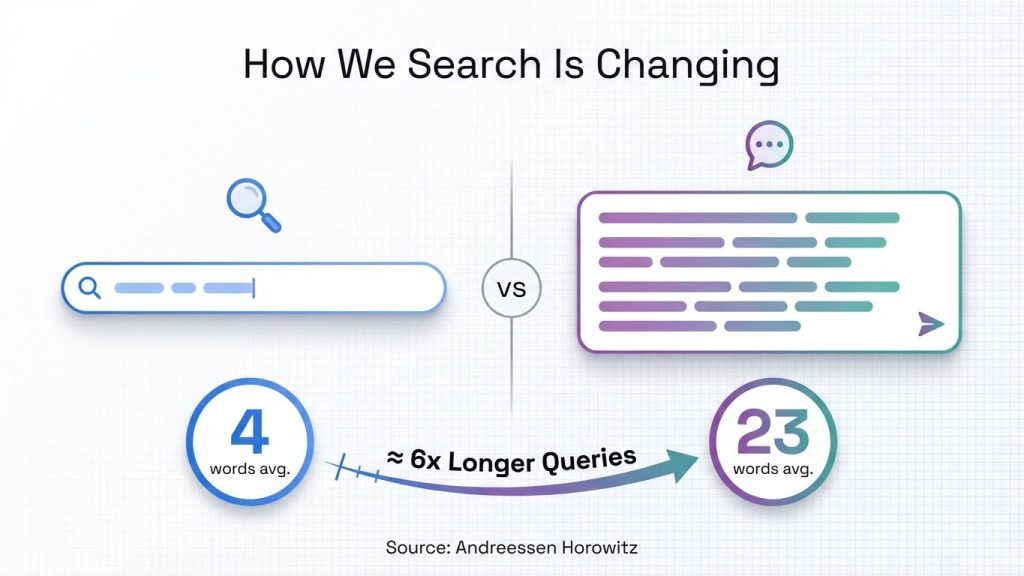
AI search queries average 23 words, compared to just 4 words for traditional Google searches. [Source: Andreessen Horowitz]
Search sessions on AI platforms average 6 minutes, indicating deeper engagement and more conversational interactions.
79.7% of consumers who use AI for shopping rely on it for at least half of their purchase decisions, fundamentally changing the buyer’s journey. [Source: Profound]
Traffic Predictions Are Sobering
Industry forecasts paint a stark picture:
Gartner predicts traditional search engine volume will drop 25% by 2026, with AI chatbots and virtual agents capturing that share. [Source: Gartner]
Organic search traffic is predicted to decrease by 50% or more as consumers embrace generative AI-powered search, according to Gartner’s extended forecast. [Source: Gartner]
58.5% of Google searches in the US already end without a click, rising to 75% on mobile. When AI Overviews are present, organic CTR drops by 61%. [Source: Seer Interactive]
The Business Impact Is Real
This isn’t theoretical—businesses are already feeling the effects:
Early GEO adopters report that 32% of their sales-qualified leads now come from generative AI search, compared to virtually none just months ago.
Traffic from AI platforms converts at significantly higher rates than traditional search, with some studies showing 5x higher conversion rates.
Reddit and YouTube are among the most-cited sources in AI Overviews and ChatGPT responses, demonstrating that AI engines favor user-generated, discussion-rich content.
GEO vs SEO vs AEO: Understanding the Differences
Understanding the distinctions between these optimization approaches is critical for developing an effective strategy. We’ve published a dedicated deep-dive on this topic — see AEO vs GEO vs SEO: What’s the Difference? for a full comparison with a decision framework on which to prioritize.
Factor
Traditional SEO
Answer Engine Optimization (AEO)
Generative Engine Optimization (GEO)
Primary Goal
Rank in SERPs
Featured snippets, voice results
AI citations, brand mentions
Target Platforms
Google, Bing
Google Assistant, Alexa, Siri
ChatGPT, Perplexity, Claude, AI Overviews
Success Metrics
Position, CTR, traffic
Answer box presence, voice share
Citation rate, brand mentions, share of voice
Query Type
Short keywords (4 words avg.)
Question phrases
Conversational (23+ words avg.)
Content Format
Keyword-optimized pages
Q&A structured content
Comprehensive, authoritative resources
Link Building
Backlinks critical
Less emphasis
Authority signals across web
User Behavior
Click through to website
Receive voice answer
Get synthesized response, may not click
Measurement
Google Search Console, rank trackers
Featured snippet tracking
AI visibility platforms (Profound, Otterly)
How Traditional SEO Works
Traditional SEO optimizes content to rank highly in search engine results pages. Success is measured by position, click-through rate, and organic traffic. The strategy revolves around keyword research, on-page optimization, technical SEO, and building backlinks to signal authority.
The fundamental unit of success is the click: users see your listing, click through to your website, and potentially convert. Your website is the destination.
How Answer Engine Optimization (AEO) Works
AEO emerged as voice assistants like Alexa, Google Assistant, and Siri gained adoption. The goal shifted from driving clicks to becoming the single answer to a user’s question—appearing in featured snippets, answer boxes, and voice search results.
AEO emphasizes question-and-answer formatting, structured data, and concise responses that voice assistants can read aloud. While still focused on Google’s ecosystem, AEO recognized that zero-click results were becoming more common.
How Generative Engine Optimization Works
GEO represents a more fundamental shift. Generative engines don’t return links—they synthesize information from multiple sources into cohesive, conversational responses. Your content must be:
Discoverable by AI crawlers and retrieval systems
Comprehensible to large language models parsing your content
Authoritative enough to be selected over competing sources
Extractable—structured so AI can pull relevant passages
Citable—providing clear facts, statistics, and claims AI can reference
The metric that matters isn’t ranking—it’s reference rate: how often your brand or content is cited when AI systems generate responses in your domain.
How Generative AI Engines Process and Cite Content
Understanding how AI engines work under the hood helps explain why certain optimization strategies succeed.
The RAG Architecture
Most generative search engines use Retrieval-Augmented Generation (RAG), a two-stage process:
Retrieval: The system searches an index (often web content, sometimes proprietary databases) to find relevant documents matching the user’s query.
Generation: A large language model synthesizes the retrieved information into a coherent response, selecting which sources to cite.
This differs fundamentally from traditional search. Google’s algorithm ranks pages; generative engines read pages, extract information, and reformulate it. Your content doesn’t just need to rank—it needs to provide information the AI can understand, trust, and articulate. For a deeper look at how this works specifically for ChatGPT — including its three retrieval layers and what actually gets cited — see our guide on how to rank on ChatGPT.
What Makes AI Engines Cite Your Content
Research and industry experience suggest several factors influence whether AI systems cite specific sources:
Comprehensiveness: AI models favor content that thoroughly addresses topics. Single-keyword pages optimized for traditional SEO often lack the depth AI systems prefer.
Structural Clarity: Clear headings, logical organization, and explicit relationships between concepts help AI parse and extract information. Think of your content architecture as a knowledge graph.
Factual Specificity: Content with specific data points, statistics, quotes, and verifiable claims receives preferential citation. The Princeton GEO study found that adding statistics improved visibility by up to 40%. [Source: Aggarwal et al., 2023]
Source Attribution: Paradoxically, citing other credible sources within your content increases your likelihood of being cited by AI. It signals thoroughness and trustworthiness.
Entity Clarity: Clearly identifying who you are, what you do, and what topics you cover helps AI systems categorize and retrieve your content appropriately.
Cross-Platform Presence: AI engines assess authority holistically. Consistent information across Wikipedia, reviews, social media, industry publications, and your own site strengthens citation likelihood.
Core GEO Strategies: How to Optimize for AI Search
Moving from theory to practice, here are the essential strategies for improving your AI visibility.
1. Create Comprehensive, Authoritative Content
The Princeton research demonstrated that content depth matters more than keyword optimization for GEO success. AI systems are trained to recognize substantive, well-researched content.
Actionable tactics:
Create definitive resources that answer not just the primary question, but anticipate follow-ups. If you’re writing about project management software, don’t just compare features—explain implementation, address common challenges, and provide selection frameworks.
Include original data, research, and insights. First-hand experience signals authority that AI systems increasingly recognize. Share proprietary statistics, case study results, and expert perspectives unique to your organization.
Address topics from multiple angles. Content that explores a subject comprehensively—pros/cons, use cases, alternatives, implementation—provides more extractable value than narrow treatments.
Update content regularly. AI systems that access real-time information favor fresh, maintained resources over outdated pages.
For a complete step-by-step framework on structuring content for AI citation across all platforms, see our AI search optimization guide.
2. Structure Content for AI Parsing
AI models excel at understanding relationships between concepts. Your content structure directly impacts retrievability.
Actionable tactics:
Use descriptive headings that clearly indicate what follows. Instead of “Our Approach,” use “How We Reduce Implementation Time by 40%.”
Implement FAQ sections that directly answer common queries. These provide AI with ready-made question-answer pairs to cite.
Create modular content blocks that work standalone. AI often extracts single passages—ensure each section provides complete, useful information independently.
Use summary paragraphs at section openings that encapsulate key points. These serve as extraction targets for AI systems.
Include glossaries and definitions for industry terms. When users ask “What is X?”, you want to be the cited definition.
Apply schema markup extensively: FAQ schema, HowTo schema, Article schema, Organization schema, and Product schema all help AI understand your content’s structure and purpose.
3. Build Entity Authority and Brand Signals
AI engines assess credibility across your entire digital presence, not just your website.
Actionable tactics:
Ensure your Wikipedia presence (if notable) or Wikipedia mentions are accurate. Wikipedia is among the most-cited sources in AI responses.
Claim and optimize Google Business Profile and knowledge panel information.
Maintain consistent NAP (Name, Address, Phone) across all platforms.
Build presence in authoritative industry publications. Guest posts, expert commentary, and research contributions in respected venues increase your entity’s authority.
Participate meaningfully in Reddit, Quora, and industry forums. These platforms are heavily cited by AI systems — OtterlyAI’s analysis of 1 million AI citations found that community-driven platforms captured 52.5% of citations across ChatGPT, Perplexity, and Google AI Overviews combined. Genuine expertise shared in community discussions often surfaces in AI responses.
Earn mentions and backlinks from high-authority domains—government sites (.gov), educational institutions (.edu), major publications, and industry leaders.
4. Implement Technical GEO Best Practices
Technical factors remain important for AI discoverability.
Actionable tactics:
Ensure content is crawlable and indexable. AI systems often use web crawling to build retrieval indices. Blocked pages won’t be cited.
Implement structured data (JSON-LD schema) to provide explicit context. This helps AI understand content type, author credentials, publication dates, and relationships.
Maintain fast page load speeds. When AI does drive referral traffic, user experience matters for brand perception.
Use clean, semantic HTML. Proper heading hierarchy, semantic tags, and accessible markup help AI parsers understand content structure.
Monitor your AI crawler logs. Tools like Profound track when AI bots visit your site, helping you understand which content AI systems are indexing.
Consider AI-specific meta descriptions that summarize your page’s key claims in extractable format.
5. Leverage Citations and External Validation
The Princeton research found that Cite Sources was among the top-performing GEO strategies. External validation strengthens your content’s citation worthiness.
Actionable tactics:
Cite credible sources within your content. Academic research, government data, and authoritative industry reports signal thoroughness.
Include expert quotes from recognized voices in your field. AI systems often extract quotations as evidence.
Reference specific studies, statistics, and data points with clear attribution. Vague claims get overlooked; specific, cited claims get cited themselves.
Build case studies with quantified results. “Increased revenue by 47% over 6 months” is more extractable than “significantly improved performance.”
Earn reviews and testimonials on third-party platforms. Aggregate sentiment across review sites influences how AI characterizes your brand.
6. Optimize for Conversational Queries
Remember: AI queries average 23 words compared to 4 for traditional search. Your content must match how people actually ask AI for help.
Actionable tactics:
Research question-based keywords using tools that reveal conversational queries. What are users asking AI about your industry?
Create content that answers compound questions: “What’s the best CRM for small businesses that integrates with Gmail and has good mobile support?”
Use natural language throughout. Write as if explaining to a colleague, not stuffing keywords.
Address intent comprehensively. AI queries often combine informational and commercial intent—users want to understand and decide simultaneously.
Include comparison content that helps AI answer “vs.” questions: “Slack vs. Teams for remote teams” type queries.
GEO Case Studies: Real Results from Real Brands
Case Study 1: How Zapier Increased AI Visibility Through Content Structure
Zapier, the automation platform, noticed declining organic traffic coinciding with AI Overview expansion. Their response exemplifies effective GEO strategy.
The approach: Zapier restructured existing content to feature clear, extractable summaries at the beginning of each integration guide. They added specific statistics about time saved and added FAQ sections addressing common follow-up questions.
The results: Within three months, Zapier’s content began appearing in AI-generated responses for automation-related queries. Their brand mentions in ChatGPT responses for “workflow automation” queries increased substantially, driving qualified traffic despite fewer traditional SERP clicks.
Key insight: They didn’t create new content—they restructured existing authority for AI comprehension.
Case Study 2: E-commerce Brand Visibility Transformation
A mid-sized e-commerce retailer in the outdoor equipment space found themselves invisible in AI shopping queries, despite strong traditional SEO rankings.
The challenge: When users asked ChatGPT for “best backpacking tents under $400,” competitors were consistently cited while they weren’t mentioned.
The approach: The team implemented comprehensive comparison content with specific product statistics, published video reviews to YouTube with detailed descriptions, engaged authentically in Reddit’s r/CampingGear community, and ensured product information was consistent across their site, Amazon listings, and review platforms.
The results: After six months, their brand began appearing in ChatGPT Shopping results. More importantly, the traffic arriving from AI-referred visitors showed significantly higher conversion rates than traditional organic traffic—these users arrived pre-informed and ready to purchase.
Key insight: AI visibility required presence across multiple platforms, not just on-site optimization.
Common GEO Mistakes to Avoid
As organizations rush to implement generative engine optimization, several pitfalls have emerged:
1. Over-Optimizing for Specific AI Models
Each AI model has nuances, but gaming one platform risks missing broader opportunities. Perplexity’s citation patterns differ from ChatGPT’s, which differ from Google’s AI Overviews. Focus on universal principles—comprehensive, authoritative content structured for AI comprehension—rather than exploiting temporary patterns in any single system.
2. Neglecting Traditional SEO
GEO supplements rather than replaces traditional SEO. Many AI systems still rely on web crawling, indexing, and traditional authority signals. Pages that rank poorly in Google often struggle in AI citations too. Maintain SEO fundamentals while layering GEO strategies on top.
3. Sacrificing User Experience for AI Optimization
Content overly structured for AI extraction—endless bullet points, robotic phrasing, repetitive formatting—frustrates human readers who find it through any channel. Balance AI comprehension with human readability. The best GEO content works for both audiences.
4. Ignoring E-E-A-T Principles
Google’s Experience, Expertise, Authoritativeness, and Trustworthiness principles matter even more in GEO. AI models are increasingly sophisticated at identifying authoritative sources and filtering low-quality content. Building genuine expertise—demonstrated through original research, expert credentials, and consistent thought leadership—remains essential.
5. Expecting Overnight Results
Unlike traditional SEO where ranking changes can occur within weeks, AI visibility builds over time as models are updated and retrained. GEO is a long-term investment. Organizations that maintain consistent efforts over 6-12 months see compounding returns as their content becomes established in AI knowledge bases.
6. Measuring with Wrong Metrics
Traditional SEO metrics—rankings, organic traffic, keyword positions—only partially capture GEO success. A page might generate significant brand influence through AI citations without driving direct traffic. Implement GEO-specific measurement including citation frequency, brand mention tracking, and sentiment analysis in AI responses.
7. Treating GEO as One-Time Optimization
AI platforms continuously update their models, retrieval systems, and citation patterns. What works today may be less effective tomorrow. Build systems for ongoing monitoring and optimization rather than treating GEO as a one-time project.
Best GEO Tools for 2026
The GEO tools market has matured rapidly. Here’s what’s available:
Free GEO Tools
Geoptie GEO Audit: Analyze your website’s AI readiness with comprehensive scoring across content structure, citation worthiness, and technical factors. Also available: dedicated ChatGPT Rank Tracker and Perplexity Rank Tracker for platform-specific monitoring.
HubSpot AI Search Grader: Free assessment of your brand’s AI visibility across ChatGPT, Perplexity, and Gemini. Provides competitive benchmarking and actionable recommendations. Best for initial baseline measurement. [Source: HubSpot]
Manual Testing: Query ChatGPT, Perplexity, Claude, and Google’s AI Mode with searches relevant to your business. Document how your brand appears (or doesn’t) and track changes monthly.
Paid GEO Platforms
Geoptie Pro: Complete GEO platform including rank tracking across AI engines, content optimization recommendations, and competitor monitoring. Integrates with existing SEO workflows for unified reporting.
Profound: Enterprise-grade platform tracking brand citations across 9+ AI engines. Connects to Google Analytics for revenue attribution, showing how AI citations translate to business outcomes. Starts at $499/month. [Source: Profound]
Semrush AI Visibility Toolkit: Part of Semrush’s broader SEO suite, offering AI search market analysis, brand sentiment tracking, and competitive share-of-voice reporting. Priced at $99/month per domain. Strong for teams already using Semrush. [Source: Semrush]
Otterly.AI: Focused on prompt-level tracking and link citation detection. Monitor specific queries to see when your brand appears in AI responses. Plans start at $29/month. Best for teams focused on specific query visibility. [Source: Otterly.AI]
AthenaHQ: Combines prompt tracking, brand monitoring, competitive benchmarks, and an action center for fixing visibility gaps. Good for mid-market teams wanting guided optimization.
Geoptie Keyword Finder: Discover which queries your audience asks AI platforms, identifying content gaps and optimization opportunities.
How to Measure GEO Success
Traditional SEO metrics don’t fully capture GEO performance. Here’s what to track:
Key GEO Metrics
Citation Frequency: How often AI systems cite your content in relevant queries. This requires systematic testing or dedicated tools.
Brand Mention Rate: Percentage of AI responses in your category that mention your brand, regardless of citation links.
Share of Voice: Your brand’s mention frequency compared to competitors in AI responses for target queries.
Sentiment Analysis: How positively or negatively AI platforms characterize your brand when mentioning it.
Citation Position: Where in AI responses your content appears—early mentions carry more weight than afterthoughts.
Response Inclusion Rate: Percentage of relevant queries where your content influences the AI’s response.
Indirect Indicators
Branded Search Volume: Increases in users searching your brand name directly, suggesting discovery through AI responses.
Direct Traffic Growth: Users who heard about you through AI may type your URL directly rather than clicking a citation.
Referral Traffic from AI Platforms: Monitor Google Analytics for traffic from chat.openai.com, perplexity.ai, and similar sources.
Conversion Rate Changes: AI-referred traffic often converts at higher rates—users arrive pre-informed. Track whether conversion rates shift as AI visibility improves.
GEO Measurement Tools
Geoptie GEO Rank Tracker: Automated monitoring of your brand’s position across major AI platforms. Track changes over time and set alerts for significant movements.
Manual Query Testing: Test your top 30-50 queries monthly across ChatGPT, Perplexity, Google AI Overviews, and Claude. Document citations and brand mentions.
GA4 Integration: Configure Google Analytics to segment AI-referral traffic. Analyze behavior, conversion, and value metrics for this audience specifically.
The Future of Generative Engine Optimization
Emerging Trends
Multimodal Optimization: Future AI engines will seamlessly blend text, images, video, and audio. GEO strategy will need to encompass optimization across all content formats—ensuring your YouTube videos, podcast episodes, and infographics are discoverable and citable alongside text content.
AI Shopping Integration: ChatGPT’s Shopping feature and similar integrations are transforming product discovery. E-commerce brands must optimize product data, imagery, and descriptions for AI shopping interfaces specifically.
Agentic AI: The rise of autonomous AI agents that take actions (booking, purchasing, researching) on users’ behalf creates new optimization challenges. Your content may need to serve AI agents working on behalf of users, not just users directly.
Personalization: Advanced AI models will provide increasingly personalized responses based on user history, preferences, and context. GEO strategies may need to account for how content performs across different user segments.
Predictions for 2026-2027
AI search parity: Based on current growth trends, AI-driven search could deliver equal or greater economic value than traditional search by late 2027, even with lower raw volume, due to higher conversion rates. [Source: Multiple industry analysts]
Platform diversification: Apple’s integration of AI-native search engines like Perplexity into Safari signals the end of Google’s distribution monopoly. Brands will need visibility across an increasingly fragmented AI search landscape.
Measurement standardization: As the GEO market matures, standardized metrics and benchmarks will emerge, making it easier to measure and compare performance.
Traditional SEO integration: The distinction between SEO and GEO will blur as Google’s AI Overviews become the dominant SERP feature. Optimization strategies will need to address both paradigms simultaneously.
Regulatory attention: As AI search influences consumer decisions, expect increased scrutiny of how AI systems select and cite sources, potentially creating new requirements for transparency.
Getting Started with GEO: Your Action Plan
Ready to implement generative engine optimization? Here’s your step-by-step checklist:
Week 1: Baseline Assessment
[ ] Test your brand visibility manually across ChatGPT, Perplexity, Claude, and Google AI Overviews for your top 20 queries
[ ] Iterate based on what content gets cited and why
Frequently Asked Questions About GEO
What is generative engine optimization?
Generative engine optimization (GEO) is the practice of optimizing digital content to appear in AI-generated search responses from platforms like ChatGPT, Perplexity, Claude, and Google’s AI Overviews. Unlike traditional SEO which focuses on ranking in search results, GEO ensures your brand is cited when AI systems synthesize information to answer user queries.
What is the difference between GEO and SEO?
SEO optimizes content to rank highly in traditional search engine results pages (SERPs), driving clicks to your website. GEO optimizes content to be cited in AI-generated responses. SEO success is measured by rankings and traffic; GEO success is measured by citation frequency and brand mentions in AI answers. Both remain important—GEO supplements rather than replaces traditional SEO.
How do I optimize my content for ChatGPT?
To optimize for ChatGPT and similar AI engines: create comprehensive, authoritative content that thoroughly addresses topics; use clear structure with descriptive headings; include specific statistics, data, and citations; implement FAQ sections; ensure consistency across your web presence; and build authority through mentions on Wikipedia, Reddit, and authoritative publications.
Does GEO replace traditional SEO?
No. GEO and SEO work together. Many AI systems still rely on traditional search indices and authority signals. Content that ranks well in Google often performs better in AI citations. Maintain SEO fundamentals while adding GEO-specific optimizations for comprehensive visibility.
How long does it take to see GEO results?
GEO typically takes longer than traditional SEO to show results. AI models are updated periodically rather than continuously crawling, so visibility improvements may take 3-6 months to materialize. However, once established, AI visibility tends to be more stable than search rankings.
What are the best GEO tools?
For free assessment, try Geoptie’s GEO Audit or HubSpot’s AI Search Grader. For ongoing tracking, Geoptie Pro, Profound, Semrush AI Toolkit, and Otterly.AI offer comprehensive monitoring. For enterprise needs with revenue attribution, Profound leads the market. See our full best GEO tools comparison for detailed reviews.
How do I measure GEO success?
Track citation frequency across AI platforms, brand mention rate, share of voice versus competitors, and sentiment in AI responses. Also monitor indirect indicators: branded search volume, direct traffic, AI referral traffic in Google Analytics, and conversion rate changes.
Is GEO worth the investment?
Yes. With ChatGPT serving 800+ million weekly users and AI Overviews appearing in 15-60% of Google searches, AI-driven discovery is already mainstream. Early GEO adopters report 32% of qualified leads coming from AI search. As traditional organic traffic continues declining, GEO investment becomes increasingly critical for visibility.
What content formats work best for GEO?
Comprehensive guides, FAQ pages, glossaries, comparison articles, and content with specific statistics perform well. User-generated content platforms like Reddit and YouTube are heavily cited by AI. Original research and case studies with quantified results also earn strong citations.
How do AI engines decide what to cite?
AI engines using RAG (Retrieval-Augmented Generation) first retrieve relevant documents, then generate responses citing selected sources. Factors influencing citation include content comprehensiveness, structural clarity, factual specificity with verifiable data, source credibility, and consistency across platforms.
Conclusion
Generative Engine Optimization represents the most significant shift in digital marketing since Google’s inception. As AI-powered search tools become the primary way people discover information, businesses that master GEO will have a substantial competitive advantage.
The data is clear: ChatGPT’s 800+ million weekly users, Perplexity’s 780 million monthly queries, and Google AI Overviews appearing in up to 60% of searches signal that the transition is already happening. Traditional search traffic is projected to drop 25% by 2026, with AI capturing that share.
But this shift also presents opportunity. Early movers in GEO are already seeing results—higher-converting traffic, stronger brand perception, and visibility where their competitors are invisible. The brands that establish authority in AI responses today will own the conversations in their industries tomorrow.
The fundamentals of GEO—comprehensive content, clear structure, factual specificity, and cross-platform authority—align with creating genuinely valuable resources for your audience. It’s not about gaming algorithms; it’s about becoming the definitive source that AI systems should cite.
The revolution is here. Start optimizing for generative engines today.
Ready to transform your content strategy for the AI era?Try Geoptie today and discover how generative engine optimization can amplify your digital presence. Our platform provides the insights and tools you need to track your AI visibility, audit your content’s readiness, and ensure your brand gets discovered and cited by AI-powered search engines.


![AI Search Optimization: How to Get Cited by ChatGPT, Perplexity & Google AI [2026]](https://cms.geoptie.com/wp-content/uploads/2026/04/Webpage_document_connecting_AI_i…_202604291551.jpeg)

![Generative Engine Optimization (GEO): The Definitive Guide [2026]](https://cms.geoptie.com/wp-content/uploads/2026/01/Concept_a_modern_2k_202601161507-scaled.jpeg)