Author: Omer Faruk Celik

  • 7 Best Promptwatch Alternatives for 2026

    7 Best Promptwatch Alternatives for 2026

    Promptwatch is a genuinely capable platform: daily refresh on every paid tier, MCP and API access from the $95 Essential plan, an expanding agentic content layer, and the kind of adoption that signals a mature tool. Teams still shop around it for two reasons. The Brands ladder climbs steeply, from $95 to $245 to $579, and every tier on that ladder tracks four models at a time out of a catalogue that now runs to eleven. Tracking everything means moving to the Agencies flow, which starts at $199.

    Most tools in this category cap engines somewhere, so the useful question is not which one has no cap. It is what the entry price buys: how many prompts, which engines are reachable without a sales call, and whether Claude is included, gated, or billed as an extra. The seven alternatives below are compared on exactly that. To see where a brand stands before working through them, the free AI rank tracker checks ChatGPT, Claude, Perplexity, and Gemini together with no signup.

    TL;DR — best Promptwatch alternatives by use case

    • Geoptie — the lowest flat entry price here at $49/mo, with Claude selectable on that entry plan rather than gated upward.
    • Profound — for enterprise teams that need the deepest engine breadth plus crawler analytics and real AI search-volume data.
    • AthenaHQ — eleven models including Claude on one paid tier, with a free five-engine plan underneath it to test first.

    These three cover most upgrade paths off Promptwatch. The full comparison and per-tool tradeoffs follow.

    Quick comparison table

    ToolBest forAI engines coveredPricing modelStarting price
    GeoptieTeams that want Claude on the cheapest flat entry planChatGPT, Claude, Perplexity, Gemini, AI Overviews, AI Mode, Copilot (any 4 tracked per brand)Flat per-plan$49/mo
    ProfoundEnterprise brands needing the deepest engine breadth with crawler analytics and prompt-volume dataChatGPT (Starter); ChatGPT, Perplexity, AI Overviews (Growth); up to nine including Claude (Enterprise)Flat per-plan (enterprise custom)$99/mo Starter
    AthenaHQAnalytics-led teams that want every model including Claude on one paid tier, with a free tier to test onChatGPT, Perplexity, AI Overviews, Gemini, Copilot (free Essential); plus Claude, AI Mode, Grok, DeepSeek, Meta AI, Mistral (Starter)Credit-basedFree, then $295/mo
    Peec AIEuropean teams that want multilingual brand-mention tracking with granular sentimentChatGPT, AI Mode, AI Overviews, Copilot, Perplexity, Gemini, Grok (choose 3 per tier); Claude on Enterprise via APIFlat per-plan (3-of-7 cap, per-engine add-ons)$95/mo (€89)
    ScrunchTechnical SEO teams that need named AI-crawler analytics alongside citation trackingChatGPT, Perplexity, AI Overviews, Copilot (Core); Claude, Gemini, Meta AI, AI Mode, Grok (Enterprise)Flat per-plan$250/mo Core
    Otterly AISolo SEOs and small teams wanting the cheapest paid entryChatGPT, AI Overviews, Perplexity, Copilot (base); Gemini, AI Mode, Claude as paid add-onsFlat per-plan + per-engine add-ons$29/mo Lite
    Ahrefs Brand RadarEstablished SEO teams that want a real-search-backed prompt database, not just custom promptsAI Overviews, AI Mode, ChatGPT, Perplexity, Copilot, Gemini, plus Claude on Custom PromptsFlat per-plan (Ahrefs add-on)$199/mo Index

    All pricing is the monthly-billed rate. Annual discounts apply on most plans. Engine coverage varies by tier on most of these tools, so the engine a team cares about may not be reachable at the entry price. Claude is the clearest example: included on Geoptie and AthenaHQ Starter, Enterprise-only on Profound, Peec and Scrunch, a paid add-on on Otterly, and metered at eight checks per update on Brand Radar.

    How we evaluated

    Seven tools were shortlisted and re-verified against first-party pricing pages in September 2026, judged on entry price and what it includes, how many engines each tracks at once and which ones are reachable without a sales call, where Claude sits in the plan ladder, prompt allowance and the cost of scaling it, self-serve versus sales-gated checkout, free trial or free tier, and refresh cadence.

    1. Geoptie (best for teams that want Claude on the cheapest flat entry plan)
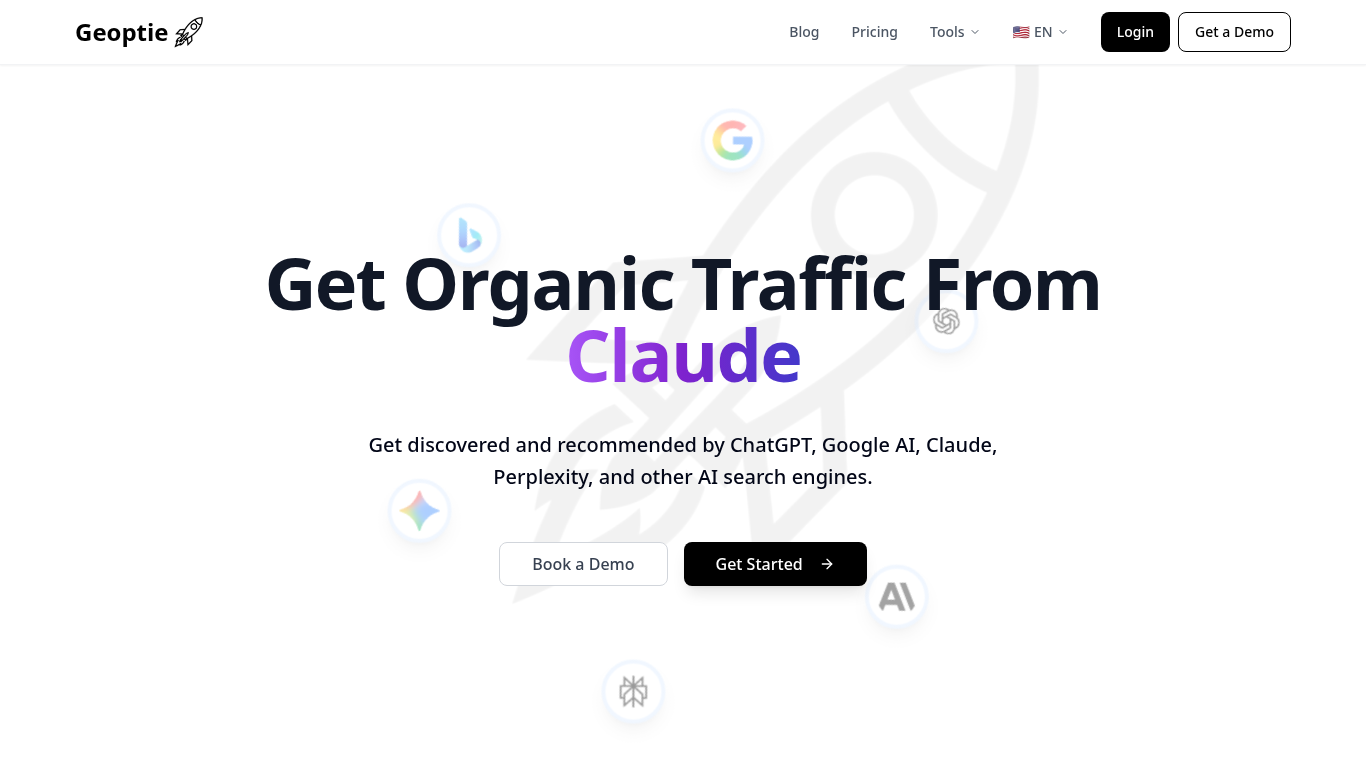
    Geoptie landing page — multi-engine AI visibility tracking on a flat-priced plan

    Flat-priced AI visibility tracking with all four leading answer engines on every paid tier.

    Geoptie tracks brand visibility across seven engines, ChatGPT, Claude, Perplexity, Gemini, Google AI Overviews, Google AI Mode, and Microsoft Copilot, with any four selectable per brand on every paid tier, starting at $49 a month. Daily refreshes, citation tracking, brand-mention tracking, sentiment scoring, and competitor share-of-voice sit in one dashboard.

    Geoptie caps engines per brand much as Promptwatch does, so the cap is not the difference. The difference is what the entry price reaches. Promptwatch Essential is $95 and tracks four of its eleven models; Geoptie Starter is $49 and tracks four of seven, with Claude among the four a team can pick. Engine selection is per brand rather than per account, so two brands on the same subscription can watch different mixes. There is no per-engine surcharge at any tier and no engine reserved for a higher plan.

    Key features

    • Daily tracking across ChatGPT, Claude, Perplexity, and Gemini on every paid tier, all bundled
    • Citation tracking (URL surfaced in an AI answer) and brand-mention tracking (brand named in the answer text) in one view
    • Competitor share-of-voice on the same prompt set
    • Multi-brand workspaces, 10 brands on Professional and unlimited on Enterprise
    • Free AI rank tracker, ChatGPT rank tracker, Claude rank tracker, and Perplexity rank tracker

    The dashboard is built for fast setup rather than configuration depth, so a brand and its competitors can be tracked within minutes of signup. Users value that there is no engine-selection decision to make and no separate add-on bill to forecast. Engine catalog is the tradeoff: Geoptie tracks four engines, so teams that need AI Overviews, AI Mode, Copilot, Grok, DeepSeek, or Meta AI will find Promptwatch’s nine-model catalog and Reddit and social citation tracking broader, and Profound and AthenaHQ both cover more engines on a single tier.

    Pricing

    • Free — geoptie.com/geo-rank-tracker. No credit card, no time limit.
    • Starter — $49/mo ($41/mo annually). 15 prompts, 2 brands.
    • Professional — $99/mo ($83/mo annually). 100 prompts, 10 brands, white-label reporting.
    • Enterprise — $399/mo ($333/mo annually). 400 prompts, unlimited brands.

    Unlimited seats come on every plan, and annual billing is two months free. Where Geoptie is weaker: it caps a brand at four engines from its seven, so a team that wants every surface in one view will hit that ceiling; it does not track Grok, DeepSeek, Meta AI or Mistral at all, which Promptwatch and Rankscale do; and there is no free plan or free trial, so the cheapest way in is the $49 Starter. The free standalone tools run without a subscription or a card, but they are not a plan tier.

    See how the flat-priced plans compare against Promptwatch’s $95 Brands entry.

    2. Profound (best for enterprise brands needing the deepest engine breadth with crawler analytics and prompt-volume data)
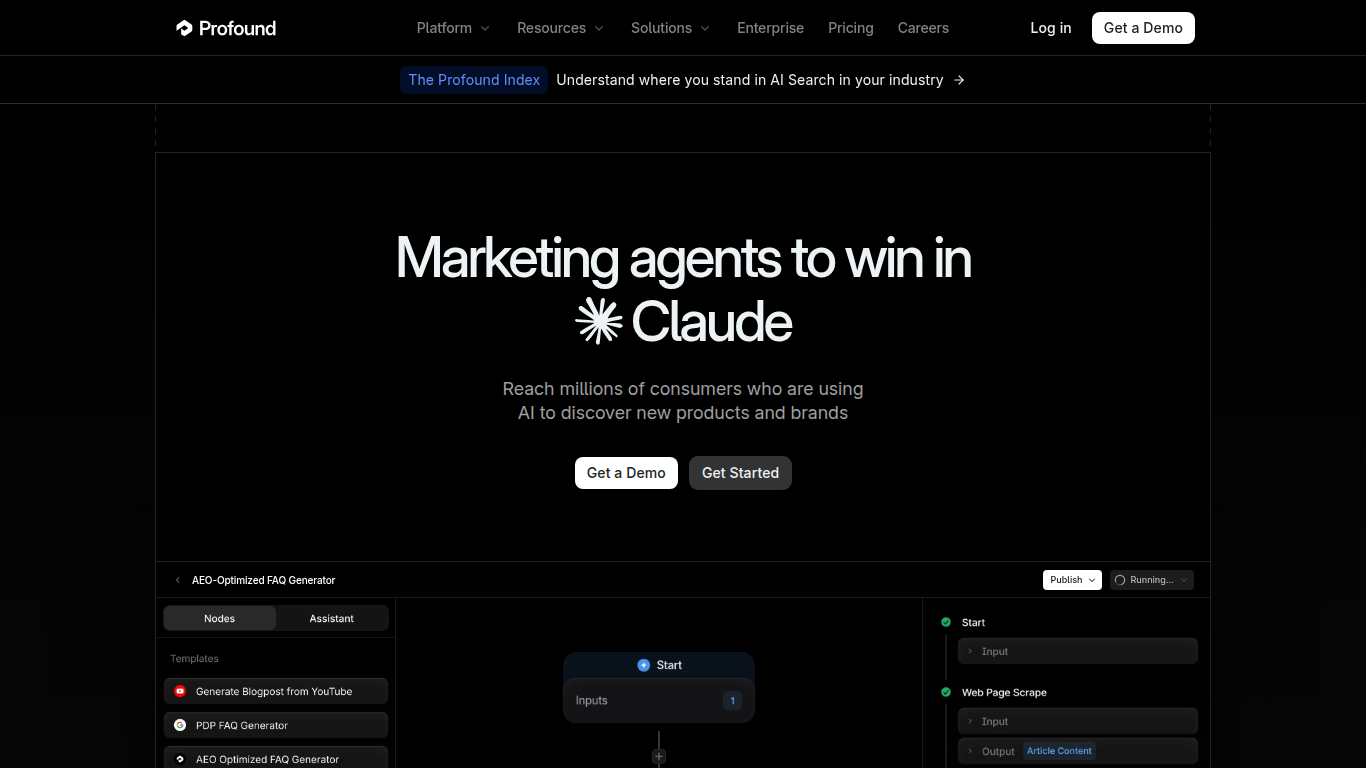
    Profound landing page — enterprise AI visibility platform with 10-engine breadth

    The enterprise step-up when engine breadth and AI search-demand data matter more than entry price.

    Profound is the move for a Promptwatch team that has outgrown the Business tier or wants research-grade demand data attached to its tracking. Starter at $99/mo tracks ChatGPT only with 50 prompts, narrower on engines than Promptwatch Essential but close on price. Growth at $399/mo opens three engines (ChatGPT, Perplexity, AI Overviews) plus a credit-metered content-generation layer. Enterprise (custom) covers up to nine answer engines including Claude, with SSO/SAML and SOC2 on the table.

    Key features

    • Up to 10 engines on Enterprise
    • Conversation Explorer with prompt-volume data showing real AI search demand
    • Agent Analytics, named AI-crawler visibility (Anthropic, OpenAI, Perplexity bots) with Cloudflare integration
    • Credit-based content and optimization engine (400 credits/mo on Growth)
    • SSO/SAML and SOC2 on Enterprise

    The platform leans data-heavy, and that is its appeal for larger teams and its drawback for smaller ones. Reviewers on G2 cite the depth of the Conversation Explorer and prompt-volume data as standout features, while also flagging occasional dashboard slowdowns and a steep learning curve when the data volume is more than a small team needs. Multi-engine coverage starting only at Growth ($399) means the broad view costs more than Promptwatch’s Agencies flow entry, and Claude requires an Enterprise contract on Profound where Promptwatch offers it from $95.

    Pricing

    • Starter — $99/mo. ChatGPT only, 50 prompts. Self-serve.
    • Growth — $399/mo. Three engines, 100 prompts, credit-based content layer. Self-serve “Try for free.”
    • Enterprise — custom. Up to 10 engines, SSO/SAML, SOC2, API access.

    3. AthenaHQ (best for analytics-led teams that want every model including Claude on one paid tier, with a free tier to test on)
    AthenaHQ landing page — credit-based AI visibility platform tracking up to 8 major LLMs

    The premium option that ships eleven models, Claude included, with no selection step, and a free five-engine tier underneath.

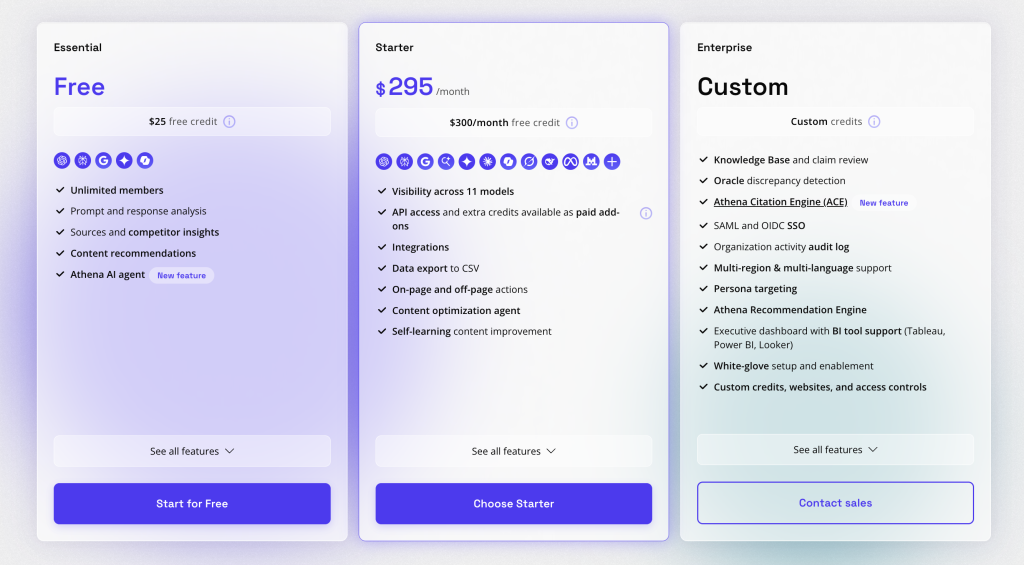
    AthenaHQ is the closest answer to Promptwatch’s model cap: its paid Starter plan tracks eleven models at once, including Claude, with no selection step. Where Promptwatch’s Brands flow makes a team pick four models to watch and reserves the full set for the Agencies flow, AthenaHQ exposes ChatGPT, Claude, Perplexity, Gemini, AI Overviews, AI Mode, Copilot, Grok, DeepSeek, Meta AI and Mistral on one tier. The model is credit-based: $295/mo buys 3,600 analyzed AI responses, with a $300/mo free credit allowance on top, and different models consume credits at different rates, so the practical cost depends on tracking volume.

    Underneath that sits a free Essential plan with 300 credits a month, unlimited members and five engines (ChatGPT, Perplexity, AI Overviews, Gemini and Copilot). It is the only genuinely free tier in this comparison, and it makes AthenaHQ testable at no cost, though Claude is not one of the five.

    Key features

    • Eleven models including Claude on Starter, no per-engine cap; free Essential tier covers five, without Claude
    • Credit-based tracking, 3,600 credits/mo plus a $300/mo free credit allowance on Starter
    • Action Center that turns monitoring data into prioritized recommendations
    • Prompt Volume estimation for how often real users ask specific questions
    • Unlimited seats with role-based access control

    The interface earns consistent praise for being intuitive and for surfacing concrete next steps rather than raw dashboards. The two recurring complaints on G2 are the premium price (the $295 Starter floor is the highest published paid entry in the category) and the credit math, since forecasting a monthly bill means estimating how many responses each model will consume. Starter is single-region, and API access and top-up credits are paid add-ons rather than included.

    Pricing

    • Essential — free. 300 credits, 5 engines, unlimited members, no Claude.
    • Starter — $295/mo (17% off annual). 3,600 credits plus $300/mo free credit, 11 models, single region.
    • Enterprise — custom. Multi-region, BI integrations, dedicated GEO specialist, API access.

    4. Peec AI (best for European teams that want multilingual brand-mention tracking with granular sentiment)
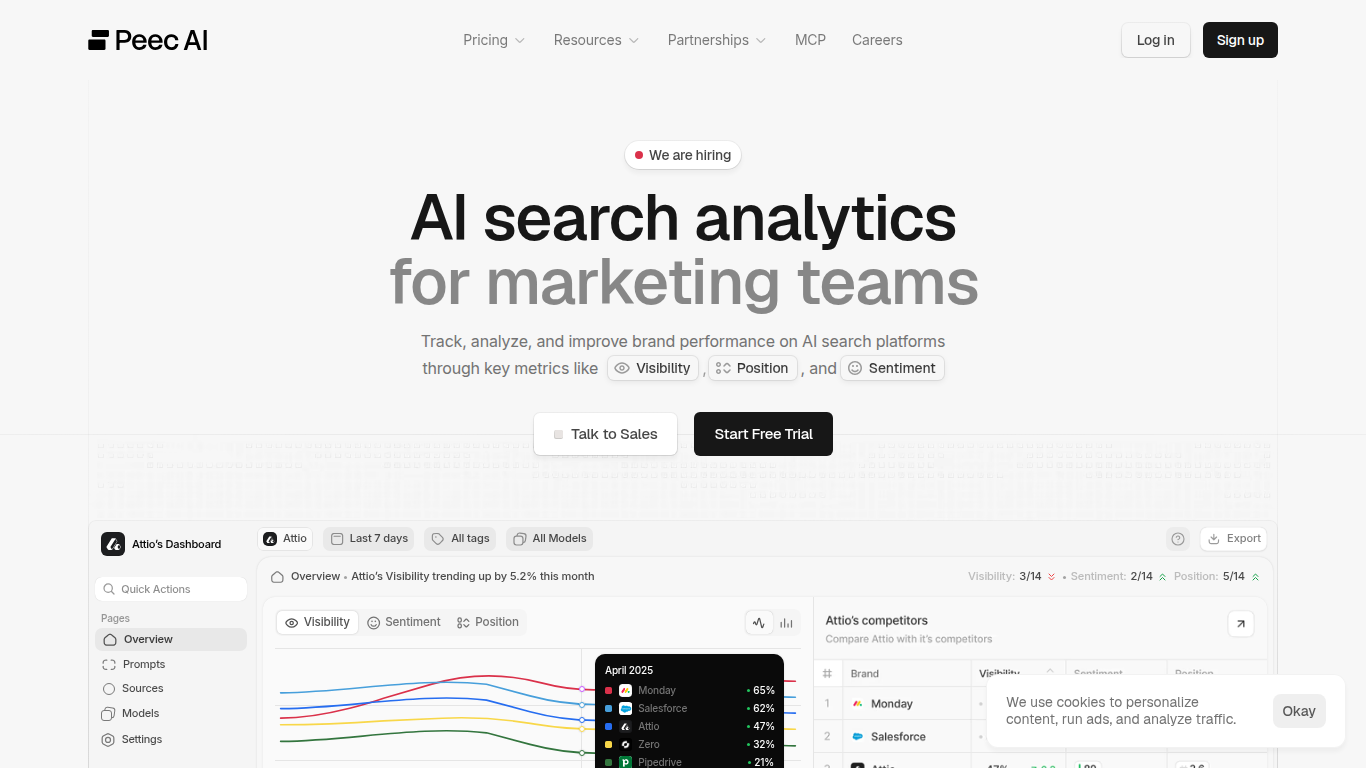
    Peec AI landing page — multilingual AI brand-mention tracking with sentiment scoring

    The European mid-market pick with the deepest sentiment scoring, though it carries its own engine cap.

    Peec is the European option closest to Promptwatch Essential on price, $95/mo (€89) against $95. The structural similarity runs deeper than price: like Promptwatch’s Brands flow, Peec caps engine tracking, here at three of seven available platforms on every self-serve tier (Starter, Pro at $245, and Advanced at $495), with each additional engine costing $35 to $165/mo depending on plan. Claude Sonnet 4 stays Enterprise-only via API. What Peec adds is depth, with brand-mention analytics across 14-plus languages and sentiment scoring that G2 reviewers commonly call the most granular in the category.

    Key features

    • Multilingual brand-mention analytics across 14+ languages
    • Country-level citation share breakdown
    • Granular sentiment scoring on brand mentions, widely cited as best in class
    • Unlimited user seats on every paid plan
    • Looker Studio connector and API on higher tiers

    Reviewers find the dashboard cleaner and less cluttered than heavier enterprise tools, which suits teams that want depth on a focused engine set rather than maximum breadth. The recurring limitation is a tighter version of Promptwatch’s: the three-of-seven cap holds even on the $495 Advanced tier, so a fourth engine is always a paid add-on, and Claude requires an Enterprise sales conversation. EUR-denominated billing also adds friction for USD budgets.

    Pricing

    • Starter — $95/mo (€89). 50 prompts, 3 of 7 engines, 1 project. 7-day free trial.
    • Pro — $245/mo (€205). 150 prompts, 3 of 7 engines, 2 projects. Extra engines $85/mo each.
    • Advanced — $495/mo (€425). 350 prompts, 3 of 7 engines, 5 projects. Extra engines $165/mo each.
    • Enterprise — custom. Adds Claude Sonnet 4 and GPT-5 Search via API.

    5. Scrunch (best for technical SEO teams that need named AI-crawler analytics alongside citation tracking)
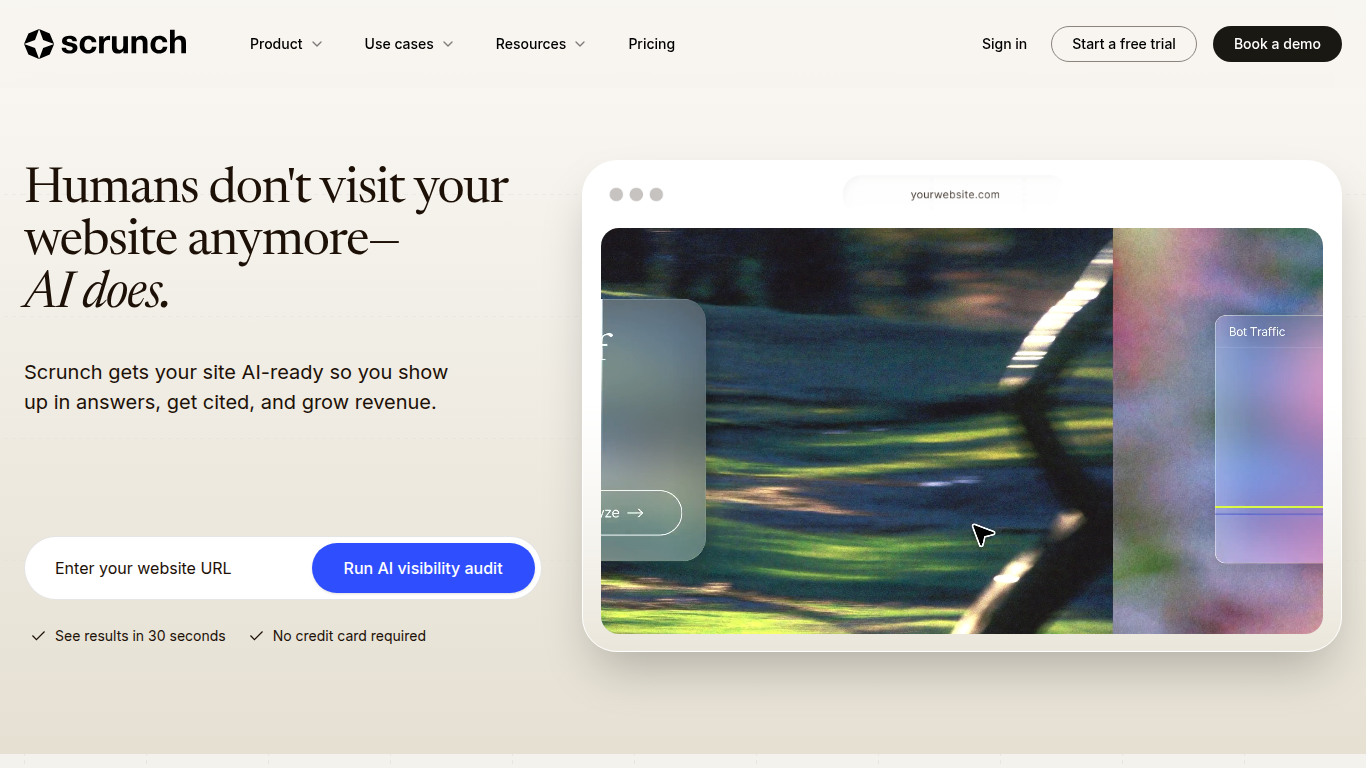
    Scrunch landing page — AI citation tracking and named-crawler analytics

    The technical-SEO step-up built around named AI-crawler analytics rather than monitoring alone.

    Scrunch is a different category of tool than Promptwatch, aimed at technical teams who care as much about how AI crawlers read their site as about where their brand surfaces. Core at $250/mo covers four engines (ChatGPT, Perplexity, AI Overviews, Copilot) with 125 unique prompts, 5 seats, and a 7-day free trial. The Enterprise tier adds Claude, Gemini, Meta AI, AI Mode, and Grok along with the Agent Experience Platform, named crawler analytics for ClaudeBot, GPTBot, and PerplexityBot at the page level, which Promptwatch does not expose in the same form.

    Key features

    • 4 engines on Core, 9 on Enterprise
    • Agent Experience Platform, named AI-crawler analytics (Enterprise-only)
    • 125 unique prompts on Core
    • Citation, mention, and sentiment tracking
    • Page-level audits and persona-based prompt sets

    The product suits SEO teams comfortable with technical diagnostics; teams that just want brand monitoring will find it heavier than they need. The clearest limitation against Promptwatch is the entry price, $250/mo Core is well above the $95 Brands entry, and the engines that close the gap with Promptwatch’s catalog, plus the crawler-analytics layer itself, are Enterprise-only. On engines tracked at once, Core matches Geoptie at four, though Geoptie lets a brand choose those four from seven and includes Claude among them, while Scrunch fixes its four and gates Claude to Enterprise. The real difference is the crawler diagnostics, not the monitoring breadth.

    Pricing

    • Core — $250/mo. 125 prompts, 4 engines, 5 seats, 1 brand workspace. 7-day free trial.
    • Agency Core — $500/mo. 250 prompts, 4 engines, unlimited seats, 3 brand workspaces.
    • Enterprise — custom. 9 engines, Agent Experience Platform, API, SSO.

    6. Otterly AI (best for solo SEOs and small teams wanting the cheapest paid entry)
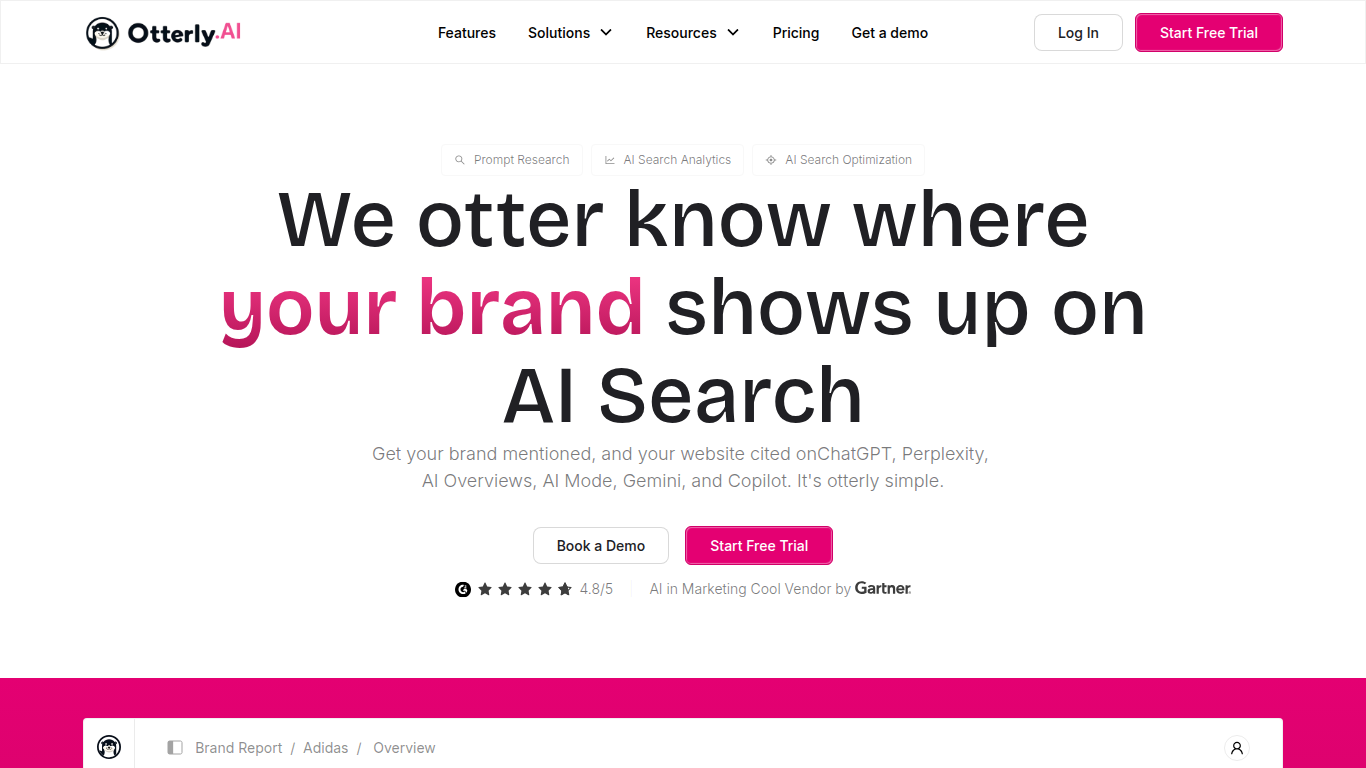
    Otterly AI landing page — affordable self-serve AI visibility tracking

    The cheapest paid entry in the category, with engine breadth handled through add-ons.

    Otterly is the budget end of the comparison, with a $29/mo Lite plan that undercuts Promptwatch Essential by $66. It is a Gartner Cool Vendor 2025 with unlimited seats on every tier and 50-plus country coverage. The engine model is its own version of metering: four base engines (ChatGPT, AI Overviews, Perplexity, Copilot) are included on every tier, while Gemini, AI Mode, and Claude are paid add-ons layered on top, so the cost of full coverage climbs above the headline plan price.

    Key features

    • Four base engines on every tier (ChatGPT, AI Overviews, Perplexity, Copilot)
    • Gemini, AI Mode, and Claude as priced add-ons
    • Unlimited team members on every paid tier
    • GEO crawlability audits and a keyword-to-prompt converter
    • 40+ country coverage with daily tracking

    The tool is easy to set up and reviewers on G2 praise the Looker Studio connector and the low entry price; the common complaint is dashboard clutter at higher prompt volumes, where the data spreads across many disconnected table charts. The same add-on math that affects Promptwatch buyers applies here: the $29 headline only holds for the four base engines, and Gemini, AI Mode, or Claude each add cost, with Claude running $29 to $439/mo depending on tier. The jump from Lite’s 15 prompts to Standard’s 100 is also steep at $189/mo.

    Pricing

    • Lite — $29/mo ($25/mo annually). 15 prompts, 4 base engines. 14-day free trial.
    • Standard — $189/mo ($160/mo annually). 100 prompts.
    • Premium — $489/mo ($422/mo annually). 400 prompts.

    7. Ahrefs Brand Radar (best for established SEO teams that want a real-search-backed prompt database, not just custom prompts)
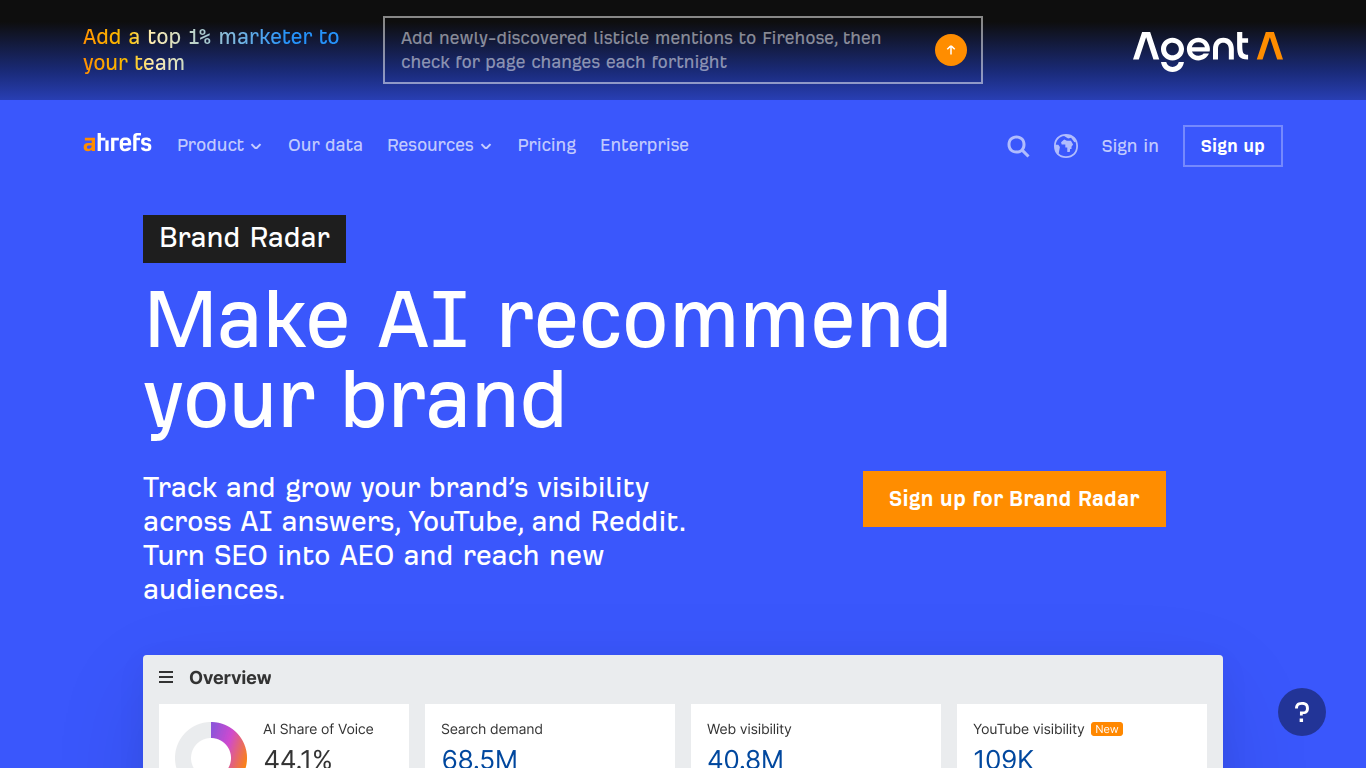
    Ahrefs Brand Radar landing page — AI visibility tracking on the 395M+ prompt dataset

    A fundamentally different shape, built on the largest real-search-derived prompt dataset in the category.

    Brand Radar approaches AI visibility from the opposite direction to Promptwatch. Instead of tracking a brand’s custom prompt set, where Promptwatch’s prompt allowance is the gating resource, Brand Radar indexes more than 455 million monthly prompts derived from real search behavior across six AI platforms, so any brand, topic, or vertical can be queried with no prompt-allowance ceiling.

    It is now sold as two products rather than a tier ladder. The AI Visibility Index is $199/mo and covers all platforms with Claude available, at 83 prompts a day plus 2,500 checks a month and $0.020 per check beyond that. Custom Prompts, which tracks questions you define, starts at $50/mo standalone and comes bundled free into every paid Ahrefs plan, from 5 prompts and 150 checks a month on Lite up to 20 prompts and 600 checks on Advanced. Both sit on top of an Ahrefs subscription.

    Key features

    • 395M+ monthly real-search-derived prompts, the largest dataset in the category
    • Up to seven AI platforms (Grok unlocks on All platforms)
    • Integration with the broader Ahrefs SEO suite
    • 90-day historical reporting
    • Beta YouTube, TikTok, and Reddit visibility on All platforms

    The fit is teams already living in Ahrefs who want AI visibility tied to their existing backlink and keyword data; for them the dataset is the draw. The limitations against Promptwatch are price and metering: the $199 Index is well above the $95 Brands entry once the underlying Ahrefs subscription is counted, and Claude, while now supported on Custom Prompts, consumes eight checks per update against one for other platforms, so it burns an allowance fast. Grok is no longer listed on the platform breakdown. As a pure AEO tool it is also less specialized than Profound or Scrunch.

    Pricing

    • AI Visibility Index — $199/mo. All platforms including Claude, 83 prompts/day, 2,500 checks/mo, $0.020/check overage.
    • Custom Prompts — from $50/mo standalone, and bundled free into every paid Ahrefs plan (Lite 5 prompts, Standard 10, Advanced 20). Claude costs 8 checks per update.

    How to choose the right Promptwatch alternative

    • Claude tracking at the lowest flat entry price: Geoptie — $49/mo, with Claude among the four engines a brand can select from seven.
    • Enterprise breadth with crawler analytics and prompt-volume data: Profound (Claude needs an Enterprise contract).
    • The widest model list on one paid tier, with a free tier to test on first: AthenaHQ (mind the credit math).
    • Multilingual brand-mention tracking with the deepest sentiment scoring: Peec AI (mind the 3-of-7 cap).
    • Named AI-crawler analytics for technical SEO teams: Scrunch.
    • Cheapest paid entry for a solo SEO or small team: Otterly AI (watch the engine add-ons).
    • A real-search-backed prompt database with no prompt ceiling: Ahrefs Brand Radar.
    • A free check before paying anyone: geoptie.com/geo-rank-tracker, no card and no account.

    FAQ

    What are the best Promptwatch alternatives in 2026?

    Geoptie, Profound, AthenaHQ, Peec AI, Scrunch, Otterly AI, and Ahrefs Brand Radar. Geoptie is the best value for flat-priced multi-engine coverage with Claude on the entry plan; Profound is the enterprise pick for engine breadth with crawler analytics and prompt-volume data; AthenaHQ ships the most models on a single paid tier and is the only one here with a free plan.

    How much does Promptwatch cost?

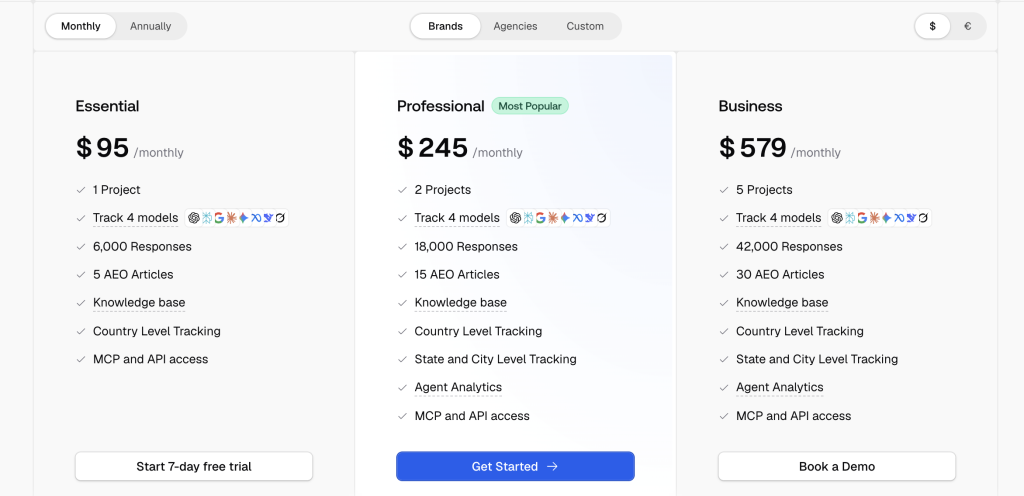
    The Brands flow runs Essential $95/mo, Professional $245/mo, and Business $579/mo, each tracking four models at a time. The Agencies flow runs Kick-off $199/mo, Growth $399/mo, and Scale $799/mo, each tracking all models with unlimited projects, pitch projects and prompts. A 7-day free trial is available on Essential, Professional, Kick-off and Growth, while Business and Scale are demo-led. Daily refresh, MCP, and API access come on every paid tier.

    Does Promptwatch track all the major AI engines at once?

    Not on the Brands flow. Promptwatch’s catalogue now runs to eleven surfaces (ChatGPT, Perplexity, Google AI Overviews, Google AI Mode, Claude, Gemini, Meta Llama, DeepSeek, Grok, plus OpenCode and Claude Code), but the Brands tiers let a team track only four at a time. Tracking everything at once requires the Agencies flow, which starts at $199/mo. Claude is selectable as one of the four on Essential and above, so the constraint is the four-at-once cap, not a Claude lock.

    Is there a cheaper Promptwatch alternative?

    Yes. Otterly Lite at $29/mo and Geoptie Starter at $49/mo both sit below Promptwatch’s $95 Essential entry, and AthenaHQ’s Essential tier is free. The difference is what the price includes: Geoptie charges one flat rate for whichever four engines a brand selects, Claude included, while Otterly’s $29 covers four base engines and treats Gemini, AI Mode, and Claude as paid add-ons that can reach $439/mo. AthenaHQ’s free tier covers five engines but not Claude.

    What does Promptwatch’s four-model cap actually mean in practice?

    On the Brands flow, a team chooses four models from the catalogue and tracks those four across its prompt set. Adding a fifth means either swapping one out or moving up to the Agencies flow at $199/mo, which tracks everything. For a brand that only cares about, say, ChatGPT, Claude, Perplexity, and Gemini, four is enough and the cap never bites; for a brand that also wants AI Overviews, Copilot, or Grok in the same view, the cap is the trigger to upgrade or switch. Most alternatives cap somewhere too: Peec at three of seven, Scrunch at four, Geoptie at four of seven per brand. AthenaHQ Starter is the exception, with no selection step.

    Does Promptwatch offer a free trial?

    Yes, a 7-day free trial on the Essential and Professional (Brands) and Kick-off and Growth (Agencies) tiers. Several alternatives offer trials too (Otterly 14 days, Scrunch 7 days, Peec 7 days, Rankscale 7 days), and AthenaHQ has a free Essential plan rather than a trial. Geoptie has neither a free plan nor a trial; its free standalone tools, including the AI rank tracker, run without a subscription or a card but do not open the dashboard.

    What’s the difference between Promptwatch and Geoptie?

    Both are daily-refresh AI visibility platforms with citation and mention tracking, and both cap engines per project. Promptwatch’s catalogue runs to eleven surfaces but the Brands flow tracks four at a time, with a ladder of $95 to $579, an agentic content layer, and standout MCP, API, and social tracking. Geoptie offers seven engines with any four tracked per brand from $49/mo. Promptwatch wins on catalogue size, crawler-era extras and content generation; Geoptie wins on entry price and on putting Claude in reach at $49 rather than $95.

    What to do next

    Promptwatch’s plan price is only half the picture. The other half is which four models the team picks, and what it costs to reach the ones outside that four. Almost every tool here caps engines somewhere, so the decision is rarely about finding one without a cap. It is about which cap sits closest to the engines you actually need, and what the entry plan charges to reach them. If ChatGPT, Claude, Perplexity and Gemini are the four that matter, several plans below $95 cover them. If the list runs wider, the Agencies flow or a credit-priced platform is the honest comparison. The free AI rank tracker covers those four at no cost, which is a quick way to see what your current coverage looks like before committing to anything. For broader context, see the best LLM tracking tools listicle and the best AEO tools roundup, or weigh the options on Geoptie.
  • Rankscale AI Review 2026: The Engine-Count Catch

    Rankscale AI Review 2026: The Engine-Count Catch

    A credit-pool plan only looks cheap until you work out what a single tracked prompt actually costs you each month. Rankscale is an AI visibility tracker built around that model, and it leads the category on one count in particular: the broadest advertised engine list, 17 and counting, with unused credits rolling over instead of expiring. The question a buyer needs answered is not whether Rankscale can watch the engine they care about, because it almost certainly can. It is what that engine costs to run, because the per-engine rates are not equal, and the gap between them decides the bill. That is the catch buried in the engine count.

    This review covers what Rankscale does, what each plan costs, how the credit system behaves once real engines are switched on, and who it suits.

    Rankscale at a glance

    • Engine breadth: the widest in the category. ChatGPT, Gemini, Perplexity, Google AI Mode and AI Overviews, Claude, DeepSeek, Mistral, Grok, and Copilot, with GUI and API variants of several.
    • Cost model: pay-per-run credits from a monthly pool, billed per prompt, per engine, per run, with rollover.
    • Cost predictability: the weak spot, and the reason the engine count misleads. Per-engine rates run from 0.25 credits to several, so the same prompt set can cost wildly different amounts depending on which engines are enabled.
    • Control and flexibility: strong. Each prompt can run against its own engine mix on its own schedule, which is genuinely rare at this price.
    • Polish and reporting: functional rather than refined. The data is deep and granular, the dashboards are plain, and there is no native report builder.

    What is Rankscale?

    Rankscale landing page — credit-based AI visibility tracking across 17+ engines

    Rankscale is a monitoring-first AI visibility platform, built by the German firm Rankscale GmbH, that tracks how a brand shows up inside AI-generated answers. It recreates the prompts real users would type, captures the full response from each engine, and records where the brand was mentioned, which sources were cited, and how that compares with competitors over time. Rather than selling a fixed number of tracked prompts, it meters usage through credits, so a team pays in proportion to how many prompts, engines, and refresh cycles it runs.

    That billing choice is the platform’s defining trait. It rewards teams that want granular control and a low floor to start from, which is why Rankscale tends to attract solo marketers, DIY-minded SEO leads, and agencies juggling many client brands rather than enterprises that prefer a flat, predictable line item.

    Rankscale pricing and plans

    Rankscale promotes three standard plans plus a sales-led custom tier. The entry point is Pro at $99 a month, and every plan carries the same engine list. What separates them is the size of the credit pool.

    PlanMonthly priceCredits/moBrand dashboardsPage audits/moEnginesFree entry
    Pro$99/mo1,200105017+7-day free trial
    Growth$385/mo5,5005020017+—
    Enterprise$780/mo12,00010020017+—
    CustomSales-ledTailoredCustomCustom17+—
    Rankscale pricing plans showing Pro at $99 for 1,200 credits, Growth at $385 for 5,500 credits, and Enterprise at $780 for 12,000 credits per month

    Annual billing takes 15% off any plan. Credits left unused roll into the next cycle, up to twice the monthly allocation on Pro and three times on Growth and Enterprise, and top-ups can be bought at any time. Every tier includes unlimited team seats with no per-seat charge, which is unusual and a real point in Rankscale’s favor for agencies. Pro can be tried free for seven days with no charge until day seven. The Growth plan, marked as the agency choice, adds white-label dashboards and REST API access along with an agency program of affiliate commissions, client discounts, a partner-directory listing and ten free prompt-research queries a month. The only genuinely custom tier is the sales-led one, reserved for buyers who need SSO, an SLA, or a dedicated success manager.

    What each credit buys matters more than the plan price, because that is where a $99 plan quietly becomes something else. Before committing to any of these tiers, it helps to know where a brand actually stands across the major engines right now. A free AI visibility audit returns that snapshot for one brand in about a minute, which gives any credit estimate a baseline to sit against.

    How Rankscale credits actually work

    This is the section that decides whether Rankscale is cheap or expensive for a given team, and it is where the “17+ engines on every plan” promise needs unpacking. The engines are all available on every paid tier. They simply do not cost the same to run.

    Each time Rankscale queries an engine for one prompt, it spends credits at a per-engine rate:

    • 0.25 credits per run: ChatGPT, Gemini, Perplexity, and Google AI Mode.
    • 1 credit per run: DeepSeek, Google AI Overviews, and several API model variants.
    • 2 credits per run: Claude, along with Perplexity’s Pro models and Mistral Large.
    • 4 credits per run: the heaviest API models, such as Gemini 3 Pro.

    The practical effect is that Claude costs eight times what ChatGPT costs to track. Take Pro’s 1,200 monthly credits and a realistic setup of 50 prompts checked weekly across the four base engines, which run at 0.25 each. That comes to roughly 217 credits a month, comfortably inside the pool. Add Claude to those same 50 prompts at the same weekly cadence and the bill climbs by about 433 credits, pushing the total to around 650, more than half the entire Pro allocation consumed by a single engine. Switch on DeepSeek or one of the Pro API models as well and the pool empties before the month does, at which point the choice is a top-up or the $385 Growth plan.

    None of this is hidden, and the rollover softens it. But it does mean the engine list is the first thing to price out, not the last. A team that came to Rankscale specifically to watch Claude should treat Claude as the line item that sets its real monthly cost. Watching the Claude slice on its own first, through a free Claude rank tracker, is a low-stakes way to gauge how much of that engine you actually need before paying eight times the base rate for it inside a credit pool.

    Rankscale’s key features

    Rankscale is organized around four jobs: see where a brand lands in AI answers, trace which sources fed those answers, benchmark the result against rivals, and audit individual pages for AI readiness.

    Prompt-level visibility tracking

    The core of the tool. Enter a prompt like “best AI rank trackers,” choose the engines and a cadence, and Rankscale runs it on schedule, storing the full answer each time. The result view shows the brand’s visibility score, its average position, how many times it was mentioned versus cited, and a detection rate, with a complete execution history so a team can open any single run and read the exact answer the engine returned. Because each prompt carries its own engine selection and frequency, a high-priority term can be tracked daily across several engines while a long tail of prompts runs weekly on ChatGPT alone.

    Citation and source analysis

    Visibility on its own does not explain why a brand wins or loses an answer, so Rankscale records the sources behind each response. The citations view ranks the domains AI engines lean on most for a tracked topic, and the sources view surfaces which URLs on a brand’s own site are being pulled into answers. For a prompt where a competitor keeps appearing, this turns a vague “they rank and we don’t” into a concrete list of the publications and pages feeding that result, which is the input a content or digital-PR plan actually needs.

    Competitor benchmarking

    Every tracked prompt runs under identical conditions for a brand and its named competitors, so the share-of-voice comparison is like-for-like. The benchmarking view aggregates mention frequency, citation share, and position into one standing per competitor, then splits it by engine, which regularly exposes asymmetries: a rival might dominate Google AI Overviews yet barely register on ChatGPT, telling a team where to defend and where to push. Trend graphs over weeks separate a genuine shift from the normal week-to-week noise of model outputs.

    Page audits

    Alongside prompt tracking, each plan includes a monthly allowance of page audits, 50 on Pro and 200 on Growth and Enterprise, that grade any URL for AI search readiness across content quality, authority signals, technical structure, and engagement, with specific suggestions for each. The recommendations are prescriptive and useful for quick fixes. The headline AI readiness score is best treated as a rough guide rather than a metric to report, since running the same page twice can return different numbers, a quirk Rankscale shares with most AI-generated scoring.

    Taken together, these features cover the monitoring and diagnosis side thoroughly. What Rankscale deliberately does not do is act on the findings: there is no built-in content generation or automated remediation, so turning insight into published change stays a manual job for the team.

    Interface and experience

    Rankscale is built for control rather than first impressions. Signing up takes only an email, no name required, though a card is needed once a plan is chosen, and setting up a brand and the first prompts is quick. From there the platform rewards a hands-on user: filters by engine, topic, and date range, per-prompt cadence settings, and a credit estimate shown before each prompt is saved. The trade-off is polish. The dashboards are dense and plain rather than presentation-ready, and there is no native report generator, so sharing with a client or manager means a dashboard link, a screenshot, or a PDF, with Looker Studio export available on Pro and above. Practitioners who want the data and the control tend to love it; those who want a tool that looks impressive in a stakeholder meeting often find it spartan.

    What users say about Rankscale

    Sentiment is positive but drawn from a small base, as expected for a young tool. Across review aggregators Rankscale sits around 4.7 out of 5, and the platform reports more than a thousand active users alongside an enterprise and agency customer list that includes Bosch, Iberdrola, UBS, Cartier, and agencies such as Dentsu, Publicis Sapient, and WPP Media.

    The praise is consistent across hands-on reviews and practitioner threads: the price-to-capability ratio is hard to beat, the engine breadth is unusually wide, and the per-prompt control gives more granularity than tools costing several times as much. The criticism is just as consistent. The dashboards are not polished, the absence of a report builder is a recurring annoyance, the page-audit scores are too inconsistent to trust as metrics, and credit consumption can be hard to predict once tracking expands across engines, regions, and clients. The common thread is that Rankscale is a strong instrument that still leaves interpretation and action entirely to the user.

    Rankscale pros and cons

    Strengths

    • The broadest advertised engine list, covering 17+ engines including Claude, DeepSeek, Mistral, and Grok on every paid tier, with no engine locked to a higher plan.
    • Per-prompt control over engine mix and cadence, which is rare at any price.
    • A credit calculator on the pricing page that prices a prompt set before you commit, which is more transparency than most metered tools offer.
    • Unusually current feature set, including query fanout analysis, sponsored-ad tracking inside ChatGPT and AI Mode, shopping-card analysis, and MCP access for querying your own data from an AI assistant.
    • Credits roll over and top-ups are available, so spend tracks usage rather than a fixed cap.
    • Unlimited team seats on every plan, plus white-label and API access from the $385 Growth tier, which suits agencies.

    Limitations

    • Uneven per-engine rates make the monthly bill hard to forecast: Claude costs 2 credits per run, eight times the 0.25 of the base engines.
    • The entry price is $99, well above the cheapest paid plans in the category, so the low-cost reputation does not survive contact with the current pricing page.
    • Heavy or multi-engine tracking burns through Pro’s 1,200 credits quickly, pushing real costs toward Growth or frequent top-ups.
    • No native report builder; sharing relies on dashboard links, exports, or screenshots.
    • Page-audit readiness scores are inconsistent and not reliable as reported metrics.
    • Monitoring only; no content generation or remediation layer.

    How Rankscale compares to Geoptie

    Rankscale and Geoptie answer the same question, how a brand shows up in AI answers, with opposite billing philosophies. Rankscale meters every prompt, engine, and run through a credit pool, which gives an agency fine control but a bill that moves with usage. Geoptie charges a flat monthly price, with Claude costing the same as every other engine on every paid tier, so the line item does not change when Claude is switched on.

    Rankscale genuinely beats Geoptie on breadth: 17 or more engines against Geoptie’s seven, including DeepSeek, Mistral and Grok, which Geoptie does not track at all. It also offers per-prompt cadence control and page audits that Geoptie does not match. The trade is that Geoptie caps a single brand workspace at four engines from its seven, while Rankscale lets a prompt run against everything it supports, for a price.

    RankscaleGeoptie
    Starting price$99/mo (1,200 credits)$49/mo
    Engines on entry tier17+ advertised, billed per engine per run7 available, any 4 tracked per brand
    Claude trackingIncluded, but at 2 credits/run (8x base)Included on every paid tier at one flat rate
    Pricing modelCredit pool, pay-per-run, rolls overFlat per-plan
    Free option7-day free trial on Pro; no free tierNo free plan or trial; free standalone tools need no card
    Best atWidest engine list, granular agency controlPredictable cost with Claude included

    Put simply, Rankscale leads on breadth and granular control, while Geoptie leads on entry price and a bill that stays still. A team that wants the longest possible engine list, fine per-prompt tuning, and the flexibility to scale spend up and down will get a lot from Rankscale, especially an agency. A team that mainly needs the major assistants, with Claude costing the same as ChatGPT and no credit math to manage, and can work within four engines per brand, is the one Geoptie fits. For the wider field, see the best Rankscale AI alternatives.

    Verdict

    Rankscale earns its reputation as the most flexible AI visibility tracker for hands-on users, and the broad engine list is genuine rather than marketing. The catch is in the credit rates, not the coverage. Every engine is available on every plan, but they are not priced alike, so the engine count tells you what Rankscale can watch, not what it will cost you to watch it.

    Good fit if: you are a DIY-minded SEO lead or an agency that wants the widest engine list, granular per-prompt control, and unlimited seats, and you are comfortable managing credit consumption to keep costs in check.

    Look elsewhere if: you want a flat, predictable monthly bill, you specifically need steady Claude tracking without it consuming most of your credit pool, you are shopping below $99 a month, or you want polished, presentation-ready reporting and a content layer that acts on what the tool finds.

    FAQ

    How much does Rankscale cost?

    Three standard plans: Pro at $99/mo (1,200 credits), Growth at $385/mo (5,500 credits), and Enterprise at $780/mo (12,000 credits), plus a sales-led custom tier. Annual billing takes 15% off, and credits roll over to the next cycle, up to twice the monthly allocation on Pro and three times on Growth and Enterprise.

    How do Rankscale credits work?

    Every tracked prompt spends credits each time it runs, charged per engine and per refresh. Base engines like ChatGPT cost 0.25 credits per run, while heavier engines cost more, so the same prompt set can cost very different amounts depending on which engines and how often it runs.

    Does Rankscale track Claude, and what does it cost?

    Yes, Claude is available on every paid tier, but it bills at 2 credits per run, eight times the 0.25 rate of the base engines. Tracking Claude across a meaningful prompt set can consume more than half of Pro’s 1,200 monthly credits on its own.

    How many engines does Rankscale support?

    Rankscale advertises 17 and more, including ChatGPT, Gemini, Perplexity, Google AI Mode and AI Overviews, Claude, DeepSeek, Mistral, Grok, and Copilot, with GUI and API variants of several. All are available on every paid plan; the difference between plans is the size of the credit pool, not the engine list.

    Does Rankscale have a free trial?

    Yes. Pro can be tried free for seven days, with no charge until day seven and cancellation at any time. There is no permanently free tier, and a card is required to activate a plan.

    Who is Rankscale best for?

    DIY SEO leads and agencies that value engine breadth, per-prompt control, and unlimited seats, and that can manage credit usage. Teams wanting a flat, predictable bill, a sub-$99 entry price, or polished reporting tend to find better value elsewhere.

    What are the best Rankscale alternatives?

    The closest flat-priced option with Claude included on its entry plan is Geoptie, at $49 a month with seven engines available and any four tracked per brand. The wider set of trackers and platforms is covered in the best Rankscale AI alternatives roundup and the broader best LLM tracking tools breakdown.

    What to do next

    Whether Rankscale’s credit model works in your favor comes down to one number: what your engine list costs per month once the engines you care about are switched on. Map that out before you commit, with Claude and any heavier engines priced at their real per-run rates rather than the headline. It also helps to see where your brand stands today, so the spend has a target. Geoptie’s free AI visibility audit gives that baseline at no cost, and the free AI rank tracker covers ChatGPT, Claude, Perplexity, and Gemini with no credit card and no subscription.

  • AthenaHQ Review 2026: Is $295/mo Worth It?

    AthenaHQ Review 2026: Is $295/mo Worth It?

    In the GEO category, a published price is usually a fixed monthly number, but a credit-based plan turns that number into a floor rather than the whole bill. AthenaHQ is one of the most polished platforms in the space, and it does something most of its rivals do not: it puts eleven AI models, Claude among them, on a single paid plan, and reviewers consistently call its dashboard one of the easiest to navigate in the category. There is now a free tier underneath that plan, which changes the question a buyer has to settle. It is no longer whether to risk money on an unknown platform, because the free tier answers that. It is whether the jump from free to $295 a month buys enough, and whether paying by credit instead of a flat fee leaves the monthly cost predictable enough to plan around.

    This review covers what AthenaHQ does, what it really costs once credits enter the picture, where it genuinely leads, and where the price and the billing model give buyers pause.

    AthenaHQ at a glance

    • Engine coverage: the strength. Eleven models on one paid plan, with Claude included rather than reserved for a sales-led tier, which is unusual in this category.
    • Pricing model: the part to understand. Billing is credit-based, not flat. The $295/mo Starter plan includes a pool of credits, and how fast that pool drains depends on how much tracking is switched on.
    • Free tier: a recent and significant addition. A permanently free Essential plan covers five engines on 300 credits a month, which makes AthenaHQ testable at no cost. Claude is not one of the five.
    • Pricing accessibility: still the weak spot above the free line. At $295, Starter is the most expensive published paid entry in the category, and the gap between free and Starter is steep.
    • Interface and ease of use: a genuine plus. The dashboard is widely described as intuitive, and unlimited seats come on both the free and paid plans.
    • Revenue attribution: distinctive. Shopify, Webflow, Google Analytics and Search Console integrations connect AI visibility to actual sales, which is rare and valuable for e-commerce teams.

    What is AthenaHQ?

    AthenaHQ landing page — credit-based AI visibility platform tracking up to 11 AI models

    AthenaHQ is an answer-engine and generative-engine-optimization platform. It tracks how a brand appears across AI assistants, measures citations, mentions, sentiment, and share of voice against competitors, and adds a layer of action on top: recommendations, AI-drafted content, and a way to tie AI visibility back to traffic and revenue. It is aimed at agencies running AI search for multiple clients, e-commerce and DTC brands that need to prove the channel pays, and mid-market marketing teams that treat AI search as a real growth lever rather than an experiment.

    What separates AthenaHQ from a plain rank tracker is its emphasis on outcomes: it ties AI visibility to traffic and sales rather than stopping at a score. The flip side of that ambition is a platform with a lot of moving parts and a price to match.

    AthenaHQ pricing and plans

    AthenaHQ publishes three plans: a free tier, a paid plan with a public price, and a custom Enterprise tier. The headline figure is $295 a month for Starter, and unlike most tools in this category, that single plan carries the full model list.

    PlanMonthly priceCreditsModelsSeats
    EssentialFree300/mo, plus $25 free credit5 (no Claude)Unlimited
    Starter$295/mo3,600/mo, plus $300 free credit11 (incl. Claude)Unlimited, with RBAC
    EnterpriseCustomCustom11, plus more on requestUnlimited, with RBAC
    AthenaHQ plans page showing the free Essential plan, the Starter plan at $295 a month with 3,600 credits, and a custom Enterprise plan

    Two things soften the Starter price: a $300 per month free credit allowance that offsets a slice of usage, and 17% off on annual billing. The bigger softener is the free Essential tier, which carries 300 credits a month, a $25 free credit, unlimited members, and the core monitoring feature set across five engines. It is a genuine no-cost way to see the platform work before committing, and it replaces the free trial AthenaHQ has never offered.

    What the free tier does not include is Claude, AI Mode, Grok, DeepSeek, Meta AI or Mistral. Essential covers ChatGPT, Perplexity, Google AI Overviews, Gemini and Copilot. That makes the free-to-Starter gap a coverage decision rather than a trial expiring: a team that only needs those five may sit on Essential indefinitely, while a team that needs Claude pays $295 to get it.

    The line between Starter and Enterprise is less about models than about depth. Starter already covers all eleven models, unlimited topics, unlimited competitor tracking, sentiment, citation intelligence, and the Shopify, Webflow, Google Analytics and Search Console integrations. Enterprise is where the heavier machinery lives: the Athena Citation Engine, the advanced content agent with deep research, persona targeting, multi-region tracking, BI-tool dashboards, SAML SSO, audit logs, and a dedicated specialist. One detail worth pricing in before signing: on Starter, API access and top-up credits are both paid add-ons billed on top of the subscription rather than included in it.

    Before committing at this price, it helps to know what an equivalent flat plan would cost for the engines that matter most. Geoptie’s pricing covers seven engines, any four per brand, on a fixed monthly fee with no credit metering, which gives a clean reference point for judging whether AthenaHQ’s premium and credit model are worth it for a given team’s usage.

    How AthenaHQ’s credit-based pricing works

    The credit model is the single most important thing to understand before buying, because it is what makes $295 a starting figure rather than the final one.

    AthenaHQ bills by credit, where one credit equals one analyzed AI response, and the Starter plan comes with 3,600 a month. Every tracked prompt spends credits each time it runs, on each model it runs against, so the pool drains in proportion to three choices: how many prompts are tracked, how many of the eleven models each is checked on, and how often the checks repeat. A modest prompt set on two or three models weekly leaves plenty of headroom; every prompt across all eleven models on daily refreshes can move a heavy account from comfortable to constrained, at which point add-on credits are available as a paid extra.

    The effect is that AthenaHQ rewards deliberate tracking and frustrates a team that turns everything on by default. The trade cuts both ways: a small, focused program pays only for what it analyzes, while a broad one gets a bill that moves month to month. That unpredictability, a usage-based cost rather than a number locked in at signup, is the most common reservation in independent reviews.

    Engine coverage

    Engine coverage is where AthenaHQ is genuinely strong, and it is worth stating plainly because it runs against the pattern in the rest of the category.

    The Starter plan tracks eleven models: ChatGPT, Perplexity, Google AI Overviews, Google AI Mode, Gemini, Claude, Microsoft Copilot, Grok, DeepSeek, Meta AI, and Mistral, with additional models available on request. That list grew from eight over the course of 2026, and the additions are the long-tail models most competitors skip entirely.

    The notable part is still Claude. Across most of the category, Claude tracking is reserved for a top, sales-led tier, with several capable trackers putting Claude behind a custom Enterprise contract. AthenaHQ includes it on its one published paid plan, which means a team that came specifically to track Claude can do so without a sales call. It is also the cleanest line between the free and paid tiers: the free Essential plan stops at ChatGPT, Perplexity, AI Overviews, Gemini and Copilot, so Claude is precisely what the $295 buys.

    The qualifier ties back to credits: because each model a prompt runs against spends credits, breadth has a running cost, so the model list is an advantage on access and a factor to budget for on usage. A team that wants Claude and a wide spread can have both on Starter, as long as the prompt set and cadence stay inside the credit pool. For a no-cost way to watch a core set while weighing that trade, the free AI rank tracker covers ChatGPT, Claude, Perplexity, and Gemini with no metering and no account.

    AthenaHQ’s key features

    AthenaHQ is built around three jobs: monitoring where a brand stands in AI answers, acting on the gaps, and tying both back to revenue.

    Monitoring and competitor intelligence

    This is the core, and it works the way buyers expect. A team tracks prompts grouped into topics, and AthenaHQ records the mention and citation rate for each, on every engine in the plan, plus the competitors named in the same answers and the gap to a brand’s rivals. Track a prompt like “best AI visibility platform” and it shows where the brand surfaced on ChatGPT versus Perplexity versus Claude, which competitors appeared instead, and which sources the engines cited. Real-time sentiment sits alongside the counts, so a team sees not just whether it was named but how it was framed, and impersonation detection flags answers where a rival is passed off in a brand’s place.

    Action Center

    The Action Center turns monitoring into a task list. It surfaces on-page recommendations, usually topics where a brand’s mention rate trails the competition, and off-page ones, such as third-party pages and subreddits where a mention would help. The on-page suggestions are the stronger half, pointing at a specific gap with the performance data behind it; the off-page side is thinner, often a list of placements without a clear path to securing them, and testers find the outreach generator too generic to land. It identifies opportunities well and leaves much of the execution to the team.

    Content optimization agent

    The Starter plan includes a base content agent that drafts briefs and full articles for topics where a brand is under-cited. The briefs are reasonable starting points; the drafts need calibrating, since without brand guidelines configured the output tends toward generic AI prose and still needs fact-checking and an editing pass before publishing. It is a useful accelerator for a team that treats it as a first draft. The advanced deep-research agent and the Athena Citation Engine, which reverse-engineers why a source gets cited, are Enterprise-only.

    Revenue attribution and e-commerce

    This is the feature that most distinguishes AthenaHQ from a pure tracker. Through native Shopify, Webflow, Google Analytics and Search Console integrations, it connects AI citations to traffic and sales, so a Shopify brand can see whether a rise in citations for a product topic lined up with a rise in orders, and publish GEO content straight to the store. AI-search attribution is hard, so the numbers read as directional rather than exact, but for a DTC team that has to justify the spend, a credible link to revenue is more than most competitors attempt.

    AI crawler tracking and blindspot detection

    Rounding out the platform is a set of technical features: AI crawler tracking through the analytics integration, blindspot detection that flags where a brand is invisible to the engines, and management of robots.txt and llms.txt to control crawler access. Together they address not just where a brand ranks but whether the engines can read its content at all, with the base versions on Starter and the deepest analytics on Enterprise.

    Interface and experience

    AthenaHQ’s interface is one of its strongest selling points. Reviewers describe the dashboard as clean and intuitive, with the key metrics, visibility, citations, sentiment, and competitor standing, surfaced without a steep ramp, and unlimited seats let a whole team in without per-user math on both the free and paid plans. The friction sits elsewhere. Configuring the content agents to produce on-brand output takes real setup work, and the credit model adds account management most flat tools avoid: deciding which prompts and engines to run and how often, then watching the burn, which several users find harder than it should be because the platform is not always transparent about how credits and prompt volumes are calculated.

    What users say about AthenaHQ

    AthenaHQ is a newer entrant, and its public review base reflects that: strong ratings on a thin foundation. It holds a High Performer badge in G2’s Answer Engine Optimization category with high star ratings, but only a dozen-plus reviews at the time competitors last counted, so the sentiment is positive without being deep. The praise is consistent on two points: the platform is easy to use, and the recommendations are genuinely actionable, with the support team singled out by several users.

    The criticisms are just as consistent. The credit-based pricing draws the most comment, with users wanting clearer visibility into how credits and prompt volumes are calculated so the bill is easier to forecast. The content drafts need editing before they are publishable, and as with any fast-moving startup, testers report occasional bugs and a rapid pace of feature change. The fair summary is that AthenaHQ is well-liked by the teams using it, with price and credit accounting the recurring reservations.

    AthenaHQ pros and cons

    Strengths

    • Eleven models on a single paid plan, with Claude included rather than gated to a sales-led Enterprise tier.
    • A genuinely free tier with unlimited members, five engines and the core monitoring feature set, which most rivals do not offer at all.
    • Intuitive, widely praised dashboard with unlimited seats and role-based access control.
    • Shopify, Webflow, Google Analytics and Search Console revenue attribution, a genuine differentiator for e-commerce and DTC teams.
    • Unlimited topics and unlimited competitor tracking on the base paid plan, with sentiment and impersonation detection included.

    Limitations

    • At $295/mo, Starter is the highest published paid entry price in the category, and the step up from the free tier is steep.
    • Claude, AI Mode, Grok, DeepSeek, Meta AI and Mistral are all absent from the free tier, so the five free engines are the common ones rather than the differentiated ones.
    • Credit-based billing makes the real monthly cost a function of usage, so heavy tracking can push it well above the headline price.
    • API access and top-up credits are paid add-ons on Starter rather than included.
    • Content drafts need a human editing and fact-checking pass before publishing.
    • The most advanced features, the Athena Citation Engine, persona targeting, multi-region tracking, and the deep-research agent, are Enterprise-only.
    • Users report the credit and prompt-volume accounting is not always transparent, which complicates budgeting.

    How AthenaHQ compares to Geoptie

    AthenaHQ and Geoptie take opposite approaches to the same job. AthenaHQ is a premium, credit-priced platform with broad model coverage and a revenue-attribution layer, built for teams that want depth and can manage a usage-based bill. Geoptie is a flat-priced platform built for teams that want multi-engine visibility, Claude included, on a predictable monthly fee with no credit metering.

    AthenaHQ’s strengths are real, and two of them are things Geoptie does not match. Its eleven-model list is wider than Geoptie’s seven, and it covers Grok, DeepSeek, Meta AI and Mistral, which Geoptie does not track at all. Its Shopify and Webflow attribution is something Geoptie does not attempt. Its interface is genuinely easier to use than most. And it has a free tier, where Geoptie has none.

    Where Geoptie differs is on cost and predictability. It covers seven engines, any four selectable per brand, on every paid tier starting at $49 a month, and the bill is the same whether a team runs ten prompts or its full allowance. Both tools put Claude on their entry paid plan, so the comparison comes down to price and billing shape rather than Claude access.

    AthenaHQGeoptie
    Free tierEssential: 5 engines, 300 credits, no ClaudeNone. Paid plans only, from $49/mo
    Entry paid price$295/mo (Starter)$49/mo (Starter)
    Models on entry paid tier11, including Claude7 available, any 4 tracked per brand
    Claude trackingIncluded on StarterIncluded on every paid tier
    Pricing modelCredit-based (3,600 credits/mo)Flat per-plan, no metering
    SeatsUnlimited, with RBACUnlimited on every plan
    Best atModel breadth, intuitive UI, revenue attributionPredictable flat pricing at a low entry point

    The straight read is that AthenaHQ wins on model breadth, ease of use, e-commerce attribution, and having a free tier at all, while Geoptie wins on paid entry cost and a bill that does not move. A team that wants the widest model spread, a polished platform, and a way to tie AI visibility to Shopify sales, and can plan its credit usage, will get a lot from AthenaHQ. A team that mainly needs the major engines including Claude on a flat, low monthly fee, and can work within four engines per brand, is the one Geoptie fits. For the wider field, see the best AthenaHQ alternatives.

    Verdict

    AthenaHQ is a strong, well-designed GEO platform that earns its reputation on broad model coverage and ease of use, and the free tier now makes it easy to judge for yourself.

    Good fit if: you are an agency, e-commerce brand, or mid-market marketing team that wants broad model coverage with Claude included, values an intuitive platform and Shopify revenue attribution, and can plan your tracking to fit a credit budget that starts at $295 a month.

    Look elsewhere if: you want a predictable flat bill rather than usage-based credits, the five engines on the free tier are not the ones you need and $295 is hard to justify before proving the channel, or you mainly need the major engines on a low paid entry price without managing credit burn.

    Start free if: the engines you care about are ChatGPT, Perplexity, AI Overviews, Gemini and Copilot. The Essential tier covers those at no cost, and there is no deadline forcing an upgrade.

    FAQ

    How much does AthenaHQ cost?

    There is a free Essential tier with 300 credits a month and five engines. The paid Starter plan is $295 a month and includes 3,600 credits plus a $300 per month free credit allowance. Annual billing takes 17% off the ongoing rate. Enterprise is custom-priced through sales. API access and extra credits are paid add-ons on Starter.

    How do AthenaHQ credits work?

    AthenaHQ bills by credit, where one credit equals one analyzed AI response. The Starter plan includes 3,600 credits a month and the free Essential plan includes 300, and every prompt consumes credits each time it runs against each model, so tracking more prompts, more models, or more frequently drains the pool faster. Add-on credits can be purchased when the base allowance runs out.

    Does AthenaHQ track Claude?

    Yes, on the paid Starter plan. Claude is one of the eleven models included at $295 a month, which is unusual in this category, where many competitors reserve Claude tracking for a custom-priced Enterprise tier. Claude is not available on the free Essential tier.

    What AI engines does AthenaHQ cover?

    Eleven on Starter: ChatGPT, Perplexity, Google AI Overviews, Google AI Mode, Gemini, Claude, Microsoft Copilot, Grok, DeepSeek, Meta AI, and Mistral, with additional models available on request. The free Essential tier covers five of those: ChatGPT, Perplexity, Google AI Overviews, Gemini and Copilot. Enterprise covers the full set plus more on request.

    Does AthenaHQ have a free plan?

    Yes. The Essential plan is free, with 300 credits a month, a $25 free credit, unlimited members, and tracking across five engines. There is no time-limited free trial on the paid plans, but the free tier has no deadline, and Starter carries a $300 per month free credit allowance on top of its 3,600 credits.

    Is AthenaHQ worth $295 a month?

    For an agency, e-commerce brand, or marketing team that uses the full breadth of models, the revenue attribution, and the recommendations, and can manage credit usage, the price is defensible. For smaller teams or those early in an AI search program, the honest first step is the free Essential tier, and the question becomes whether Claude and the six other paid-only models are worth the jump. If they are not, a flat-priced tool often lands cheaper than Starter.

    What are the best AthenaHQ alternatives?

    The closest flat-priced option that includes Claude on its entry plan is Geoptie, at $49 a month with seven engines available and any four tracked per brand. The wider set of trackers and platforms is covered in the best AthenaHQ alternatives roundup and the broader best AEO tools breakdown.

    What to do next

    Deciding on AthenaHQ comes down to two questions: whether the five free engines cover what you need, and if not, whether Claude and the wider model list are worth $295 a month against a flat-priced alternative. Start on the free tier, then put the cost side by side before upgrading. The free AI rank tracker shows your position across ChatGPT, Claude, Perplexity, and Gemini with no credit card, which is a quick way to see what Claude coverage actually surfaces before paying for it, and Geoptie’s flat-priced plans give a fixed-cost reference to weigh against AthenaHQ’s credit model.

  • Promptwatch Review 2026: Is the $95 Plan Enough?

    Promptwatch Review 2026: Is the $95 Plan Enough?

    Most AI visibility platforms make the price the last thing you find out, after a demo call and a sales email. Promptwatch goes the other way: it publishes a $95 entry plan that, unusually, ships with daily refresh, MCP and API access, AEO content generation, and AI-crawler logs all included rather than parcelled out across higher tiers. The question worth answering is not whether Promptwatch is capable, because it clearly is, but whether the $95 Essential plan covers what a brand actually needs once the engine list comes into focus.

    This review walks through what Promptwatch does, what each plan costs, where it genuinely leads, and the one constraint that decides whether Essential is enough or a brand ends up on a much larger plan.

    Promptwatch at a glance

    • Entry price: strong. Essential is $95/mo and arrives with the full feature set rather than a stripped-down starter.
    • Engine coverage: nine engines are supported, but the Brands flow tracks only four of them at once on every tier.
    • Refresh cadence: daily on every paid plan, including Essential, which is rare at this price.
    • Attribution: multi-modal. A JS snippet, Google Search Console, and server-log analysis all feed AI-traffic data.
    • Polish: capable but still maturing. Reviewers praise the depth and flag interface bugs on a fast-moving product.

    What is Promptwatch?

    Promptwatch landing page — daily-refresh AI visibility tracking with MCP access

    Promptwatch is an AI search visibility and generative engine optimization platform. It tracks a set of prompts across AI assistants on a daily schedule, records whether a brand is mentioned and where it ranks in each answer, and maps which sources the engines cite when they respond. Around that monitoring it adds an AEO content generator, AI-crawler log analysis, and multi-modal traffic attribution, so a team can connect what AI engines read on a site to what they end up saying about the brand.

    It is built for brands, in-house SEO teams, and agencies that want prompt-level tracking without a procurement cycle. The Amsterdam-based product leans into being self-serve and transparent: public pricing, a 7-day trial on the entry tier of each flow, and a feature set deep enough that experienced practitioners get raw data rather than simplified dashboards. Configurable and fast is what most of its users cite first.

    Promptwatch pricing and plans

    Promptwatch sells through two routes that differ in one decisive way. The Brands plans are the self-serve ladder most readers will land on; the Agencies plans cost more but lift the engine ceiling.

    Brands planMonthly pricePromptsModels trackedRefresh
    Explore$0 (forever)10ChatGPT only—
    Essential$95/mo504 of 9Daily
    Professional$245/mo1504 of 9Daily
    Business$579/mo3504 of 9Daily
    Agencies planMonthly priceProjectsModels tracked
    Kick-off$199/mo5All 9
    Growth$399/mo15All 9
    Scale$799/mo30All 9
    Promptwatch pricing page showing Essential at $95 a month, Professional at $245, and Business at $579, each tracking four of nine AI engines

    Annual billing takes roughly 17% off, which works out to about two free months at each tier. What stands out on the Brands flow is how little is held back at the bottom: Essential at $95 includes daily refresh, MCP and API access, the AEO content generator, crawler logs, country-level tracking, and a 7-day free trial. Many competitors meter API access, content generation, or refresh frequency by tier, so getting all of them at the entry price is a real point in Promptwatch’s favour. The climb from there buys volume and depth rather than unlocking core features: Professional at $245 adds state and city tracking, agent analytics, and higher prompt and crawler ceilings, and Business at $579 raises projects and prompts again for larger brands.

    The decision that matters more than the price ladder is how many engines a brand needs to watch at once, because that is where the Brands and Agencies flows split. A baseline read across the assistants makes that easier to judge, and Geoptie’s flat-priced plans track four engines on every tier with nothing held back for higher plans, which is a useful reference point when sizing a Promptwatch tier.

    Engine coverage

    Engine coverage is the part of Promptwatch most third-party write-ups get wrong, and it is the single most important thing to understand before paying.

    Promptwatch supports nine engines in total: ChatGPT, Perplexity, Google AI Overviews, Google AI Mode, Claude, Gemini, Meta’s Llama, DeepSeek, and Grok. It also tracks the OpenCode and Claude Code developer tools as a separate category. That is a wider list than almost anything else in the category.

    The catch is that the Brands flow tracks only four of those nine at a time, and that cap holds on every Brands tier, including the $579 Business plan. A brand picks its four engines and monitors those; watching a fifth means swapping one out or moving to the Agencies flow, where Kick-off at $199 and every plan above it tracks all nine at once. So the headline “nine engines” is accurate at the platform level but not at the brand-tier level, and several pricing posts that claim all nine come included on every plan are simply describing the agency product.

    Claude is worth singling out, because it is one of the four assistants most audiences use and because earlier write-ups misreported it. Claude is selectable on Essential and up as one of the four chosen models, not gated to a higher tier. The constraint is not which engines are available but how many run at once: a brand that wants ChatGPT, Claude, Gemini, and Perplexity together is fine on Essential, but adding AI Overviews or Grok to that set means rotating the selection or upgrading. For teams whose audience spans more than four surfaces, the four-engine cap is the line that pushes them onto an agency plan. A free AI rank tracker is a no-cost way to watch ChatGPT, Claude, Perplexity, and Gemini together while deciding whether four engines is enough or the agency tier is the real requirement.

    Promptwatch’s key features

    Promptwatch organizes its work around three jobs: tracking where a brand appears in AI answers, showing which sources earn those answers, and turning the gaps into action.

    Monitors

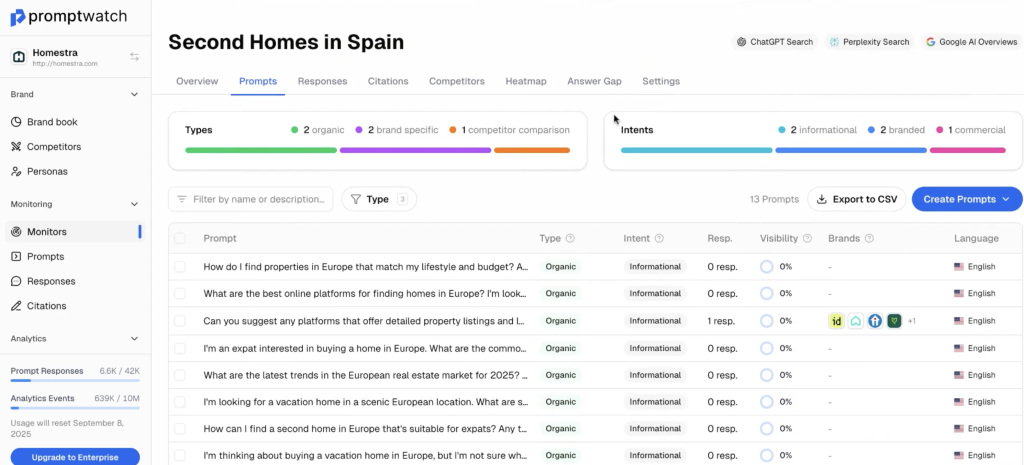
    Monitors are how Promptwatch structures tracking. A team groups prompts into separate containers by geography, funnel stage, product line, or campaign, and each Monitor reports brand visibility and citations on its own. A B2B brand might run one Monitor for top-of-funnel category prompts like “best project management software for agencies” and another for branded comparison prompts, then read each independently and cap spend per Monitor. It is the feature reviewers most often call the most configurable way to measure visibility across prompt sets and markets.

    Promptwatch Monitors dashboard showing prompts grouped into campaigns with brand visibility scores and competitor mentions across AI engines

    Answer Gap analysis

    Answer Gap is the feature experienced users rate highest. It surfaces prompts where competitors appear in AI answers and the brand does not, then points at the content or citation gap behind the miss. When a prompt keeps skipping the brand, the report separates a coverage problem from a credibility one and reads as a concrete brief for what to publish or pitch next. The flip side, noted by reviewers, is that it assumes SEO fluency: the output is concise rather than hand-holding, so a non-specialist may find it cryptic without context.

    Sources and citation tracking

    For every captured answer, Promptwatch parses which domains, pages, Reddit threads, and YouTube videos the engine cited, and ranks them by how often they show up in a category. This turns opaque AI responses into a map of which sources the models trust, and it routinely surfaces that a third-party listicle or a Reddit thread outranks the brand’s own pages in citations, which is a direct pointer for where digital-PR effort should go next.

    Multi-modal traffic attribution

    Promptwatch is one of the few trackers that tries to connect visibility to real visits. It offers three attribution methods at once: a JS snippet for tracking AI-referral sessions, a Google Search Console integration for AI Overviews and AI Mode traffic, and server-log analysis to spot AI-crawler activity. A team can run all three together, which is closer to a full picture of AI-driven traffic than the visibility-only view most tools stop at. The crawler-log angle, paired with the included crawler logs on every tier, is a remnant of where the product started and remains one of its more distinctive pieces.

    AEO content generation

    Each tier includes a monthly allowance of AEO articles, from 5 on Essential to 30 on Business, built to match what engines tend to cite. It is a genuine time saver for closing a content gap quickly, though it is the weakest part of the suite: reviewers find the output needs heavy editing for tone and originality and lags dedicated writing tools. It reads as a useful add-on rather than a reason to choose the platform.

    Interface and experience

    Promptwatch is built for people who already think in AI-visibility terms. Setup is straightforward, with prompt suggestions generated from a website or keywords, and the daily refresh means real movement shows up within days of a content or PR push rather than at the end of a monthly cycle. The trade-off is polish. Hands-on reviewers describe an interface that is less flashy than some rivals and, more pointedly, one carrying interface bugs and reporting glitches that are hard to flag or escalate, on a product that ships new features fast enough to be hard to keep up with. It rewards an SEO-fluent user who wants data over guidance, and it asks more of a newcomer than the quick setup suggests.

    What users say about Promptwatch

    Promptwatch carries a 4.7 on G2 and steady praise from hands-on reviewers, who single out the same strengths: the configurability of Monitors, the daily refresh, the Answer Gap report, and the breadth of attribution. The customer base backs up the credibility, with the platform citing 1,480-plus brands and agencies and a logo set that includes Duolingo, Typeform, Shutterstock, Yelp, Fireflies, and several European banks, a strong roster for a product founded in 2025. Reviewers who use it daily describe it as their most-used AI SEO tool while still recommending it with caution.

    The criticisms are consistent. The interface bugs noted above are the most common complaint, and reviewers want a clearer way to report them. The built-in content generation lags specialist tools and needs editing before use. The learning curve is real for anyone new to AI search, since the most powerful reports assume the reader can interpret them. And the four-engine cap on the Brands flow is the limit teams run into once they want to watch more than four surfaces at once.

    Promptwatch pros and cons

    Strengths

    • A genuinely full-featured $95 entry: daily refresh, MCP and API access, AEO content, and crawler logs are all on Essential, not reserved for higher tiers.
    • Daily refresh on every paid plan, which surfaces the impact of content and PR within days.
    • The widest engine list in the category, nine in total, with Claude selectable from Essential up.
    • Multi-modal traffic attribution (snippet, Search Console, and server logs) that few competitors match.
    • Highly configurable Monitors and a strong Answer Gap report that experienced SEOs rate above peers.

    Limitations

    • The Brands flow tracks only 4 of the 9 engines at once on every tier, including the $579 Business plan; all-9 coverage requires the Agencies flow at $199 and up.
    • Reviewers report interface bugs and reporting glitches on a fast-changing product.
    • Built-in content generation is underdeveloped and needs heavy editing.
    • The most useful reports assume SEO fluency, so there is a learning curve for newcomers.
    • The step from Essential’s 50 prompts to Professional’s 150 is a sizeable jump to $245.

    How Promptwatch compares to Geoptie

    Promptwatch and Geoptie solve a similar problem from different ends. Promptwatch competes on depth and breadth: nine supported engines, daily refresh, multi-modal attribution, and a content and crawler-log suite, with the trade that the Brands flow watches four engines at a time. Geoptie competes on giving a team all of its four engines, including Claude and Gemini, on a flat plan with no per-engine cap and a lower entry price.

    PromptwatchGeoptie
    Entry price$95/mo (Essential)$49/mo (Starter)
    Engines tracked at once4 of 9 (Brands flow, every tier)All 4 on every paid tier
    Claude trackingSelectable on Essential and upIncluded on every paid tier
    All-engine coverageAgencies flow only ($199+), all 9All 4 engines, no choose-N cap
    Pricing modelPer-plan, split Brands and Agencies flowsFlat per-plan
    Free option7-day trial (Essential and Kick-off)Free tracker, no card, no time limit
    Best atDaily refresh, attribution, and breadthFour engines including Claude, flat, no cap

    The fair read is that Promptwatch wins on breadth and on a couple of features, the attribution stack and the daily refresh at $95, that are genuinely strong. A brand or agency that wants to watch a wide range of engines, values crawler-log and traffic attribution, and has the SEO fluency to use the data will find a lot to like. The picture narrows for a team that mainly needs the four assistants most audiences use, because Geoptie tracks all four with no choose-N cap, starts at $49.

    Verdict

    Promptwatch is one of the more capable trackers at its price, and for a team that fits its shape the $95 plan delivers a lot.

    Good fit if: you want daily refresh, MCP and API access, and content generation without paying a premium for them, you value multi-modal traffic attribution and crawler-log analysis, and the four engines you care about most fit inside the Brands flow’s cap, or you are an agency that needs all nine on the Agencies plans.

    Look elsewhere if: you need to watch more than four engines at once without stepping up to an agency tier, you want a polished, low-learning-curve interface over raw data depth, or you want all of your engines included on a flat plan at a lower entry price.

    FAQ

    How much does Promptwatch cost?

    The Brands flow has three paid plans: Essential at $95/mo (50 prompts), Professional at $245/mo (150 prompts), and Business at $579/mo (350 prompts), plus a free Explore tier that tracks ChatGPT only. The Agencies flow runs $199, $399, and $799 a month. Annual billing saves roughly 17%, about two months at each tier.

    Is the $95 Essential plan enough?

    For a brand tracking up to four engines and around 50 prompts, yes: Essential is a full-featured plan with daily refresh, MCP and API access, content generation, and crawler logs, not a stripped-down starter. It falls short if you need to watch more than four engines at once or need more than 50 prompts, at which point Professional or the Agencies flow becomes the answer.

    How many AI engines does Promptwatch track?

    Promptwatch supports nine: ChatGPT, Perplexity, Google AI Overviews, Google AI Mode, Claude, Gemini, Meta’s Llama, DeepSeek, and Grok. The Brands plans track four of those nine at a time on every tier; the Agencies plans track all nine at once.

    Does Promptwatch track Claude?

    Yes. Claude is selectable on the Essential plan and above as one of the four engines a Brands account tracks, and it is part of the all-nine coverage on the Agencies plans. It is not reserved for a higher tier.

    Does Promptwatch offer a free trial?

    Yes, a 7-day free trial on the Essential and Kick-off plans, plus a permanently free Explore tier that tracks ChatGPT only. The higher Brands tiers do not include the trial.

    Who is Promptwatch best for?

    Brands, SEO teams, and agencies that want deep, daily prompt-level tracking with strong attribution and the SEO fluency to act on it. Agencies in particular benefit from the all-nine Agencies plans. Teams wanting a simple, low-learning-curve tracker or all engines on a single flat plan tend to look elsewhere.

    What are the best Promptwatch alternatives?

    The closest flat-priced option that includes all four of its engines on every tier, with no choose-N cap, is Geoptie. The wider field is covered in the best LLM tracking tools breakdown.
    What to do next

    Settling the Promptwatch question comes down to one count: how many engines the brand needs to watch at once. List them first, because four or fewer keeps Essential in play while five or more points at the Agencies flow and a very different bill. A baseline helps too. Geoptie’s free AI rank tracker shows where a brand stands across ChatGPT, Claude, Perplexity, and Gemini with no credit card and no time limit, and the platform keeps all four engines on a flat plan with no per-engine cap if the four-of-nine math on the Brands tiers starts to pinch.

  • Otterly AI Review 2026: Is the $29 Plan Enough?

    Otterly AI Review 2026: Is the $29 Plan Enough?

    In a category where most tools hide their price behind a sales call, a published $29 plan stands out before anything else does. Otterly AI is the cheapest real paid entry in AI visibility tracking, a self-serve tool that won a Gartner Cool Vendor nod in 2025 and lets unlimited teammates into every plan, including the cheapest one. The decision a buyer actually has to make is narrower than “is Otterly any good.” It’s whether the $29 Lite plan does enough on its own, when the jump to the $189 Standard or $489 Premium plan is worth it, and which of the engines you came to track are bundled in versus billed as paid extras.

    This review walks through what Otterly does, what each tier costs, where it genuinely leads, and where the headline price stops telling the whole story.

    Otterly AI at a glance

    • Entry price: the lowest real paid entry in the category. Lite is $29/mo with a public sign-up, not a sales call.
    • Engine coverage: four base engines on every tier. Gemini, Google AI Mode, and Claude are paid add-ons billed on top.
    • GEO audit: a genuine strength. The crawlability and AI-readiness audit is among the most detailed at this price.
    • Team access: unlimited seats on every plan, Lite included, which is rare in a category that usually meters users.
    • Dashboard depth: capable but busy. Setup is fast, while the reports get dense once prompt volumes climb.

    What is Otterly AI?

    Otterly AI landing page — affordable self-serve AI visibility tracking

    Otterly AI is a self-serve AI search visibility platform. It runs a set of prompts across AI assistants on a daily schedule, captures the full answer each one returns, records whether a brand was mentioned and where it ranked, and tracks which domains the engines cited. On top of the monitoring it adds a generative engine optimization audit that scores a site for AI-readiness, plus reporting and exports for sharing the numbers with a team or a client.

    It is built for lean marketing teams, in-house SEOs, and agencies that want to start tracking AI search without a procurement process or a per-seat tax. The Austria-based product leans into accessibility: quick AI-assisted onboarding, public pricing, a free trial, and unlimited team members on every plan. Affordable and easy to start is what most of its customers cite first.

    Otterly AI pricing and plans

    Otterly publishes three self-serve plans plus a custom Enterprise tier. The $29 headline is real, and it buys a working plan rather than a teaser.

    PlanMonthly pricePromptsBase enginesWorkspacesFree trial
    Lite$29/mo154 (ChatGPT, AI Overviews, Perplexity, Copilot)114 days
    Standard$189/mo1004Unlimited14 days
    Premium$489/mo4004Unlimited14 days
    EnterpriseCustomCustom4UnlimitedDemo
    Otterly AI pricing page showing Lite at $29 a month, Standard at $189, and Premium at $489, each tracking four base AI search engines

    Annual billing knocks roughly 15% off, bringing the effective rates to $25, $160, and $422 a month. Every tier includes the same feature set, unlimited team members, daily tracking, and the GEO audit. The only things that scale with price are prompt volume, the number of workspaces, the audit allowance, and API access, which arrives on Standard.

    The gap between Lite and Standard is the first thing to weigh. At $29, Lite tracks 15 prompts in a single workspace, enough for a solo marketer or a small brand validating whether AI search demand is real for them, but not enough to cover a full product line, several markets, or a competitor set, and unused prompts do not roll over. Standard at $189 is the first plan that feels practical for a working brand: 100 prompts, unlimited workspaces, API and Looker Studio access. Premium at $489 raises the ceiling to 400 prompts for agencies and larger prompt sets, with an Agency Partner program that lifts those allowances further. Extra prompts add to Standard and Premium in packs of 100 at $99/mo.

    Before committing to any tier, it helps to see where a brand actually stands across the major assistants today. A free AI rank tracker returns that picture across ChatGPT, Claude, Perplexity, and Gemini with no credit card, which makes a paid plan easier to size.

    Which engines Otterly tracks

    Engine coverage is where the $29 framing needs the most care, because the base price covers four engines and the rest are billed on top.

    • All tiers (4 base engines): ChatGPT, Google AI Overviews, Perplexity, and Microsoft Copilot.
    • Paid add-ons: Google AI Mode and Gemini at $9 (Lite), $59 (Standard), or $149 (Premium) per month each; Claude at $29 (Lite), $109 (Standard), or $439 (Premium) per month.

    The practical consequence is that engine breadth is the real variable in the bill. The four base engines cover a lot of ground, but a team that wants Gemini, Google AI Mode, or Claude pays extra for each, and the add-on prices climb steeply with the tier. Claude is the one worth flagging, because it is one of the four assistants most people use day to day, and Otterly is often reported as simply “supporting Claude.” The accurate position is that Claude is a paid add-on, not part of any base plan, so tracking it means stacking $29 to $439 a month on top of the plan price depending on tier. DeepSeek, Grok, and Meta AI are not offered at all. For a brand whose audience lives mostly in ChatGPT and Google’s surfaces, the base four are a reasonable spread. For anyone who needs Claude or Gemini, the engine add-ons are the first line to price out, because they can quietly move the real cost well above the headline. A free Claude rank tracker is a no-cost way to watch the Claude slice while deciding whether Otterly’s add-on is worth it.

    Otterly AI’s key features

    Otterly is organized around three jobs: tracking where a brand shows up in AI answers, showing which sources the engines trust, and auditing a site so it can earn more of those citations.

    Search prompt monitoring

    This is the core. A team defines the prompts that matter, and Otterly runs them daily across the four base engines, storing the full answer text rather than a snippet. Track a prompt like “best project management software for agencies” and the record shows whether the brand was named, where it landed in the answer, and which competitors appeared alongside it, with the history building day over day so a content push can be checked against actual movement. The AI-assisted setup suggests prompts, niches, and competitors during onboarding, so the first dataset arrives in minutes rather than after a manual prompt-building session.

    Otterly AI prompt monitoring dashboard listing tracked prompts with brand mention status and position across ChatGPT, Perplexity, AI Overviews, and Copilot

    For every captured answer, Otterly parses which URLs the engine cited and ranks domains by how often they appear in a category. This turns opaque AI responses into a competitive map: a team can see which sources ChatGPT and Perplexity lean on when answering questions in their space, which competitors keep earning citations, and which of their own pages get referenced. It often surfaces the uncomfortable fact that a third-party listicle outranks the brand’s own site in AI citations, which is a useful pointer for where to invest in coverage next.

    Otterly AI link citations and domain ranking view showing the most-cited domains and URLs across AI engines for a category

    Brand Visibility Index

    The Brand Visibility Index rolls mention frequency and average position into a single score per brand, so a team can track its standing over time and against named competitors without reading a dozen separate charts. It is a feature reviewers single out as genuinely distinct; the equivalent metric is not packaged this cleanly in most competing trackers. For a marketing lead who needs one number to put in a monthly report, it is the headline the dashboard is built around.

    GEO audit

    This is the feature that earns Otterly its strongest praise. The generative engine optimization audit evaluates a site against a long list of factors tied to AI citation, including content depth, structure, freshness, structured data, and crawlability, then flags what is holding pages back. When a prompt keeps skipping the brand, the audit helps separate a topical-coverage gap from a technical one, and the output is concrete enough to hand to a content team as a brief. The audit allowance scales by tier, from 1,000 URL audits a month on Lite up to 10,000 on Premium.

    Prompt research and reporting

    Otterly’s AI Prompt Research tool turns a keyword, brand, or URL into the conversational prompts an audience would actually type into an assistant, which takes some guesswork out of building a prompt set. Around the monitoring sit the reporting pieces: multi-country support across 50+ markets, CSV exports, and a Google Looker Studio connector on Standard and up that lets agencies fold AI visibility into the client dashboards they already send. None of this is unique alone, but together it closes the loop from tracking to a shareable report.

    Interface and experience

    Otterly is genuinely easy to start. The four-step, AI-assisted setup picks niches, prompts, and competitors for a new account, and most users see real data within about 15 minutes, which is reflected in the near-perfect ease-of-use scores it carries on review sites. The trade-off shows up later: as prompt volume grows, the dashboard fills with separate table-style reports, and related information ends up split across brand reports, citation reports, and domain rankings without a strong narrative tying them together. Heavy users describe the interface as clean to look at but busy to navigate, with a learning curve steeper than the quick setup suggests. It rewards someone comfortable reading tables more than someone looking for a single guided “here’s what to do next” view.

    What users say about Otterly

    Otterly carries strong marks where it is reviewed: a 5.0 on Product Hunt, near-perfect ease-of-use scores on OMR Reviews, and steady G2 praise for how quickly teams reach useful data. Hands-on reviewers consistently name two things as better than the field at the price: the GEO audit and the Brand Visibility Index. The credibility markers back that up, including the Gartner Cool Vendor 2025 recognition, a 10,000-plus user milestone, and a customer list spanning Opera, Avis Budget Group, Sportradar, and A1 Telekom. One frequently cited result is Bacula Enterprise reaching the top spot in ChatGPT’s answer for “best HPC backup software” after using Otterly to tune its prompt coverage.

    The criticisms are just as consistent. The dashboard clutter noted above is the most common usability complaint. Sentiment tracking is described in Otterly’s own materials but reviewers report struggling to find it usefully surfaced in the dashboard, so it is safer to treat it as immature than as a headline feature. And like nearly every tool in this category, Otterly tells a brand it appeared in an answer but not whether anyone clicked through, so it is a visibility tracker rather than a traffic or revenue attribution platform. Pairing it with analytics is still on the buyer.

    Otterly AI pros and cons

    Strengths

    • The lowest real paid entry in the category at $29/mo, with a public sign-up rather than a demo gate.
    • Unlimited team members on every plan, Lite included, which most competitors meter or reserve for higher tiers.
    • A best-in-class GEO audit and a distinctive Brand Visibility Index that reviewers rate above peers at the price.
    • Fast, AI-assisted onboarding that gets a team to real data in minutes.
    • Transparent, flat feature set: every tier gets the same tools, with only prompt volume and workspaces scaling.

    Limitations

    • Only four engines are included; Gemini, Google AI Mode, and Claude are paid add-ons that can push the bill well above the plan price.
    • Claude in particular costs $29 to $439/mo on top depending on tier, so it is never bundled.
    • Lite’s 15 prompts are quickly outgrown, and the next step up is a sizeable jump to $189.
    • The dashboard gets cluttered at higher prompt volumes, and sentiment tracking is underdeveloped.
    • No AI-referral traffic or revenue attribution; it tracks visibility, not outcomes.

    How Otterly AI compares to Geoptie

    Otterly and Geoptie are aimed at a similar buyer from different angles. Otterly competes on the lowest possible entry price and a strong audit, with engine breadth sold separately on top. Geoptie competes on giving a team all four major engines, including Claude and Gemini, on a flat plan with nothing gated behind add-ons.

    Otterly AIGeoptie
    Entry price$29/mo (Lite, 15 prompts)Free tier, then $49/mo (Starter, 15 prompts)
    Base engines on entry4 (ChatGPT, AI Overviews, Perplexity, Copilot)4 (ChatGPT, Claude, Perplexity, Gemini)
    Claude trackingPaid add-on ($29 to $439/mo by tier)Included on every paid tier
    Gemini trackingPaid add-on ($9 to $149/mo by tier)Included on every paid tier
    Pricing modelPer-plan, plus engine and prompt add-onsFlat per-plan
    Free option14-day trialFree tracker, no card, no time limit
    Best atLowest paid entry, GEO audit, unlimited seatsFour engines including Claude, flat on every tier

    The fair read is that Otterly wins on headline entry price and on a couple of features, the GEO audit and the unlimited seats, that are genuinely strong. A solo marketer or small brand that mainly tracks ChatGPT and Google’s surfaces, values a detailed site audit, and wants to add seats freely will find Otterly hard to beat at $29. The picture changes the moment Claude or Gemini matters, because those are extras at Otterly and included at Geoptie, so a team needing the full four engines often ends up paying more at Otterly than the headline implies. Geoptie also keeps a permanently free tier rather than a 14-day trial. For the wider field, see the best Otterly AI alternatives.

    Verdict

    Otterly is the most accessible on-ramp into AI search tracking, and for the right team that is exactly enough.

    Good fit if: you’re a solo marketer, small brand, or agency that wants a low, predictable entry price, you value a detailed GEO audit and unlimited team seats, and your tracking centers on ChatGPT, Perplexity, AI Overviews, and Copilot rather than Claude or Gemini.

    Look elsewhere if: you need Claude or Gemini tracking without paying a per-engine premium, you expect to outgrow 15 prompts quickly and want the next tier to stay affordable, or you want AI visibility and traffic attribution in one place rather than a visibility tracker alone.

    FAQ

    How much does Otterly AI cost?

    Three self-serve plans: Lite at $29/mo (15 prompts), Standard at $189/mo (100 prompts), and Premium at $489/mo (400 prompts), plus a custom Enterprise tier. Annual billing brings those to about $25, $160, and $422 a month. Every tier covers the same four base engines and the same feature set.

    Is the $29 Lite plan enough?

    For a solo marketer or a small brand validating AI search, yes: it is a real working plan with daily tracking, the GEO audit, and unlimited seats. It is not enough to monitor a full product line, several markets, or a large competitor set, since 15 prompts go quickly and do not roll over. Most growing teams move to Standard for the 100-prompt allowance.

    Does Otterly AI track Claude?

    Only as a paid add-on. Claude is not included on any base plan; adding it costs $29 (Lite), $109 (Standard), or $439 (Premium) per month on top of the plan price. So Otterly can track Claude, but never as part of the headline price.

    What AI engines does Otterly AI cover?

    Four engines are included on every tier: ChatGPT, Google AI Overviews, Perplexity, and Microsoft Copilot. Google AI Mode, Gemini, and Claude are available as paid add-ons. DeepSeek, Grok, and Meta AI are not offered.

    Does Otterly AI have a free trial?

    Yes, a 14-day free trial is available on the self-serve plans, with no long-term commitment. There is no permanently free tier.

    Who is Otterly AI best for?

    Lean marketing teams, in-house SEOs, and agencies that want an affordable, self-serve tracker with a strong site audit and room to add teammates at no extra cost. Teams that need Claude or Gemini in the base price, or that want traffic attribution alongside visibility, tend to find better fits elsewhere.

    What are the best Otterly AI alternatives?

    The closest flat-priced option that includes Claude and Gemini on every tier is Geoptie. The broader field is covered in the best Otterly AI alternatives roundup and the wider best AEO tools breakdown.
    What to do next

    If Otterly is on the shortlist, the cost question is easier to settle once the engine list is clear, so start by writing down which assistants actually matter for the brand and pricing the add-ons against them. It also helps to have a baseline to compare any tool against. Geoptie’s free AI rank tracker shows where a brand stands across ChatGPT, Claude, Perplexity, and Gemini with no credit card and no time limit, and the platform keeps all four engines on a flat plan if the add-on math on a four-engine tracker starts to add up.

  • Scrunch AI Review 2026: Pricing & Crawler Analytics

    Scrunch AI Review 2026: Pricing & Crawler Analytics

    Most AI visibility tools tell a brand where it ranks in AI answers; far fewer tell a technical team how the AI crawlers actually treat the site behind those answers. Scrunch AI leans into that second job, and it is where the platform is genuinely strong: its named crawler and agent-traffic analytics, paired with a GA4 view of AI referral traffic, are some of the best in the category for teams that think in logs and crawl budgets. What a buyer has to weigh is narrower: whether the $250 Core plan earns its price when its four tracked engines match much cheaper tools, and whether the parts Scrunch is increasingly known for, including Claude coverage and the Agent Experience Platform, justify moving to a custom Enterprise contract.

    This review covers what Scrunch does across its plans, what it costs, where it leads, and where the tier gates change the math.

    Scrunch AI at a glance

    • Crawler and traffic analytics: the standout. Named tracking of ClaudeBot, GPTBot, and PerplexityBot, plus a GA4-connected view of AI referral traffic, is consistently the most-praised part of the platform.
    • Engine coverage: four on the entry tier (ChatGPT, Perplexity, Google AI Overviews, Copilot), nine on Enterprise. Claude is gated to the top tier.
    • Action and optimization layer: monitoring comes first. The recommendation and site-audit features work, but reviewers note they reward a team with in-house technical expertise to act on them.
    • Setup and onboarding: hands-on, with a real curation cost. Auto-generated prompts skew toward branded queries, so accurate tracking needs manual prompt work up front.
    • Pricing accessibility: the weak spot. Core starts at $250/mo for the same four engines that flat-priced trackers cover for far less.

    What is Scrunch AI?

    Scrunch landing page — AI citation tracking and named-crawler analytics

    Scrunch AI is a technical-SEO-focused AI visibility platform. It tracks how a brand shows up across AI assistants, measures citations, mentions, sentiment, and share of voice against competitors, and adds a layer most trackers skip: detailed analytics on how AI crawlers and agents access a site. It is built for technical SEO leads, agencies reporting to multiple clients, and enterprise growth teams that treat AI search as a channel worth instrumenting properly.

    What sets Scrunch apart from a pure answer-tracker is that it looks at both sides of the citation. It records where a brand appears in AI responses, and it records which bots visited the site, which pages they read, and how often, then connects that crawl activity to the referral traffic AI sources actually send. For a team trying to work out why a page is or is not being cited, that combination is more diagnostic than a visibility score on its own.

    Scrunch AI pricing and plans

    Scrunch splits its self-serve pricing into two flows, one for brands and one for agencies, with a shared custom Enterprise tier above both. The headline figure is $250 a month, and it describes the entry brand plan.

    PlanMonthly pricePrompts trackedEnginesSeats and workspacesFree entry
    Core$250/mo125 unique4 (ChatGPT, Perplexity, Google AI Overviews, Copilot)5 seats, 1 brand workspace7-day free trial
    Agency Core$500/mo250 unique4 (same four)Unlimited seats, 3 brand + 3 pitch workspaces7-day free trial
    EnterpriseCustomCustom9 (adds Claude, Gemini, Meta AI, Google AI Mode, Grok)CustomDemo
    Scrunch AI pricing page showing Core at $250 per month for four engines and a custom Enterprise plan with nine engines

    Scrunch does not publish an annual-billing discount, so the monthly figures above are the rates to plan around. Both Core and Agency Core include a 7-day free trial, which is worth using, because the most important thing to understand about Scrunch sits inside the tier structure rather than the price.

    Core and Agency Core differ mainly in scale, not capability. Core gives one brand workspace, five seats, and 125 prompts; Agency Core opens up unlimited seats, three brand workspaces, three pitch workspaces for prospecting, and 250 prompts, which is the shape an agency managing several clients needs. Neither changes the engine list. The capabilities Scrunch is most distinctive for, including Claude tracking, expanded engine coverage, and the AXP layer, are reserved for Enterprise. A team comparing Scrunch against other tools should be clear about which of those two products it is actually buying: the four-engine Core, or the nine-engine Enterprise platform that requires a sales conversation.

    Before committing at any tier, it helps to see where a brand stands across the major assistants today. Geoptie tracks ChatGPT, Claude, Perplexity, and Gemini on a flat plan, and its free AI rank tracker returns a first read with no credit card, which makes any paid tool easier to judge against a baseline.

    Which engines Scrunch AI covers

    Engine coverage is tiered, and for many buyers it is the deciding factor.

    • Core and Agency Core ($250 / $500): ChatGPT, Perplexity, Google AI Overviews, and Microsoft Copilot.
    • Enterprise (custom): all nine engines, adding Anthropic Claude, Google Gemini, Meta AI, Google AI Mode, and Grok.

    The practical consequence is that Claude sits behind the Enterprise tier. A team that came to Scrunch specifically to track Claude visibility, one of the four most-used assistants, cannot do it on either self-serve plan; it requires a custom contract. Gemini, Meta AI, AI Mode, and Grok are in the same position. For brands whose AI audience is concentrated in ChatGPT and Perplexity, the four Core engines are a reasonable spread. For anyone tracking a broader set, the engine list is the first thing to price out, because the answer usually moves the real cost to Enterprise. A free Claude rank tracker is a low-stakes way to watch the Claude slice on its own before deciding whether it is worth an Enterprise upgrade.

    Scrunch AI’s key features

    Scrunch is organized around three jobs: monitoring where a brand stands in AI answers, instrumenting how AI crawlers interact with the site, and acting on the gap between the two.

    AI crawler and bot-traffic analytics

    This is the differentiator and the reason technical teams shortlist Scrunch. Rather than treating AI search as a black box, it tracks named crawlers, so a team can see that ClaudeBot hit a pricing page eleven times last week, that GPTBot is indexing the blog but skipping the docs, or that PerplexityBot has never reached a key landing page at all. That crawl-level view turns a vague “we want to show up in AI” into specific, fixable observations about which content the engines can actually read.

    Scrunch AI agent traffic dashboard showing crawl activity from ClaudeBot, GPTBot, and PerplexityBot across a site over time

    GA4 AI-referral reporting

    Paired with the crawler view is a connection to Google Analytics 4 that surfaces the traffic AI sources actually send, formatted for reporting rather than left raw in a GA4 export. Independent reviewers single this out as the most useful part of the platform: an agency can connect a client’s GA4 property and produce a clean, presentation-ready picture of AI referral traffic over months without rebuilding the report by hand each time. It closes the loop between being cited and seeing visits arrive, which is the connection most AI trackers struggle to make.

    Prompt, citation, and competitor monitoring

    The monitoring core works the way buyers expect. A team adds prompts, organized into topics, and Scrunch runs them across the engines on the plan, recording where the brand was cited, where competitors were named instead, and the share of voice across a topic. Citations break down by source, so a team can see which third-party pages, including review sites like G2 and Capterra, the engines lean on. One caveat reviewers raise repeatedly: the auto-generated prompts tend to be branded (“best [category] like [your brand]”), which inflates visibility, so the genuinely useful, non-branded prompts have to be added and maintained by hand.

    Scrunch AI prompt monitoring dashboard showing brand citation share and competitor mentions across AI engines

    Site audits and page optimization

    Scrunch audits pages for AI-friendliness, flagging technical issues that can stop crawlers from reading content cleanly, such as a JavaScript-rendered page whose non-JavaScript version is missing the substance. Core includes five site audits a month and one page optimization, with sentiment analysis and recommendations alongside. The findings are accurate, but they tend to be developer-level fixes rather than content tweaks, so acting on them usually needs engineering time.

    AXP, the Agent Experience Platform

    AXP is Scrunch’s most forward-looking feature and its clearest Enterprise pitch. It generates an agent-facing version of a site, delivered to AI crawlers in a clean, structured format that strips away the code that confuses bots, so the version an engine reads is optimized for how it parses rather than how a browser renders. It is an Enterprise-only capability, not part of Core, and it is the layer that most distinguishes a full Scrunch contract from the entry plan.

    Together, the crawler analytics and AXP are what let Scrunch argue it is a technical AI-optimization platform rather than a dashboard. The pattern from the pricing section repeats: the most distinctive of those capabilities lives on Enterprise.

    Interface and experience

    Scrunch’s interface is clean and, by most accounts, pleasant to navigate once it is configured. The friction is in getting there. New accounts start with default prompts that skew branded and, for local or niche businesses, can produce misleading visibility numbers until they are replaced with the queries that actually matter. Reviewers describe an onboarding that benefits from the hands-on setup Scrunch provides but still asks the user to understand prompt curation, personas, and topics before the dashboards mean much. It rewards a technical owner who will tune it, more than a generalist who wants a number at a glance. Setup is quick; reaching trustworthy data takes a few sessions of curation.

    What users say about Scrunch AI

    Scrunch is a newer entrant than the most established names in the category, so its public review base is thinner, and sentiment leans on hands-on write-ups and practitioner threads as much as aggregate scores. The praise is consistent on one point: the crawler and GA4 AI-traffic layer is the feature people remember, described by independent reviewers as the standout and the part that genuinely saves reporting time. On G2 and in Reddit AEO discussions, Scrunch is also credited for clean dashboards and broad engine coverage at the top tier, and one Scrunch case study reports a large lift in brand presence for non-branded prompts after adoption.

    The recurring criticism is just as steady. Reviewers describe Scrunch as monitoring-first, with the actionable insights and site-audit recommendations feeling thinner than the tracking, so teams without in-house AEO expertise can struggle to turn the data into a plan. The manual prompt setup comes up often, as does the view that, for a single small brand tracking a handful of prompts, much of what Scrunch consolidates could be gathered by hand. The entry price draws comment too, since the four Core engines match tools that cost much less.

    Scrunch AI pros and cons

    Strengths

    • Named AI-crawler analytics (ClaudeBot, GPTBot, PerplexityBot) are a genuine differentiator, with crawl-level detail few competitors match.
    • The GA4 AI-referral reporting is the most-praised feature, and a real time-saver for agency and client reporting.
    • Nine-engine coverage on Enterprise, with enterprise security including SOC 2 and SAML SSO.
    • Granular segmentation by persona, topic, funnel stage, country, and competitor.
    • Agency Core adds unlimited seats and pitch workspaces, which fits a multi-client workflow.

    Limitations

    • Core’s four engines (ChatGPT, Perplexity, Google AI Overviews, Copilot) are the same four cheaper trackers cover, at a $250/mo entry price.
    • Claude, Gemini, Meta AI, AI Mode, and Grok are Enterprise-only, so broad engine coverage means a custom contract.
    • AXP, the most distinctive optimization layer, is Enterprise-only and not part of Core.
    • Monitoring leads; the recommendation and audit layers reward teams with technical and content resources to act on them.
    • Setup is manual: auto-generated prompts skew branded and need curation before the data is reliable.

    How Scrunch AI compares to Geoptie

    Scrunch AI and Geoptie aim at different buyers. Scrunch is built for technical and enterprise teams that want crawl-level instrumentation, the AXP layer, and nine-engine breadth, and can justify a $250-and-up commitment with Enterprise for the full product. Geoptie is built for teams that want multi-engine visibility, including the engines that get gated elsewhere, on a flat, low entry price.

    The engine math is worth stating precisely, because it is easy to get wrong. Scrunch Core and Geoptie both track four engines. The difference is the list. Scrunch Core covers ChatGPT, Perplexity, Google AI Overviews, and Copilot, and puts Claude on Enterprise. Geoptie covers ChatGPT, Claude, Perplexity, and Gemini on every paid tier, starting at $49/mo, so Claude is included rather than gated.

    Scrunch AIGeoptie
    Starting price$250/mo (Core)$49/mo
    Engines on entry tier4 (ChatGPT, Perplexity, Google AI Overviews, Copilot)4 (ChatGPT, Claude, Perplexity, Gemini)
    Claude trackingEnterprise-onlyIncluded on every paid tier
    Pricing modelTiered, Claude and AXP gated to EnterpriseFlat per-plan
    Free option7-day trial on CoreFree tracker, no card, no time limit
    Best atNamed crawler analytics, GA4 AI traffic, AXPMulti-engine coverage including Claude on a low flat price

    Scrunch wins on technical depth: if a team needs named crawler analytics, the AXP layer, and the full nine-engine spread, and has the budget for Enterprise, it is hard to match. Geoptie wins on entry cost and engine access: a team whose main need is seeing how it ranks across ChatGPT, Claude, Perplexity, and Gemini, without paying $250 for four engines that exclude Claude or moving to a custom contract to get it, is the one Geoptie fits. For the full field, see the best Scrunch AI alternatives.

    Verdict

    Scrunch AI is one of the strongest options in the category for technical AI-search work, and its named-crawler analytics are the reason.

    Good fit if: you are a technical SEO team, agency, or enterprise that wants crawl-level visibility into how AI bots read your site, you value the GA4 AI-referral reporting, and you either need only the four Core engines or have the budget for the Enterprise tier that adds Claude, the rest of the engine list, and AXP.

    Look elsewhere if: you want Claude tracking without a sales call, you need multi-engine coverage on a low flat price, or your four most important engines do not line up with Scrunch Core’s list and an Enterprise contract is hard to justify before you have proven the channel.

    FAQ

    How much does Scrunch AI cost?

    Core is $250/mo for brands and Agency Core is $500/mo for agencies, both covering four engines, with a 7-day free trial. Enterprise, which adds Claude and four more engines plus AXP, is custom-priced through sales. Scrunch does not publish an annual-billing discount.

    Does Scrunch AI track Claude?

    Only on Enterprise. Claude, along with Gemini, Meta AI, Google AI Mode, and Grok, sits on the custom-priced Enterprise tier, so tracking Claude requires a sales conversation. The Core and Agency Core plans do not include it.

    What AI engines does Scrunch AI cover?

    Up to nine across the tiers: ChatGPT, Perplexity, Google AI Overviews, Copilot, Claude, Gemini, Meta AI, Google AI Mode, and Grok. Core and Agency Core cover the first four; the full nine are Enterprise-only.

    What is AXP (the Agent Experience Platform)?

    AXP generates an agent-facing version of a site, served to AI crawlers in a clean, structured format that strips away code that confuses bots, so the engines read an optimized version of the content. It is an Enterprise-only feature, not part of Core.

    Does Scrunch AI have a free trial?

    Yes. Both Core and Agency Core include a 7-day free trial. The full nine-engine Enterprise product is sales-led through a demo rather than a self-serve trial.

    Who is Scrunch AI best for?

    Technical SEO teams, agencies, and enterprise growth teams that want crawl-level analytics and broad engine coverage, and have the resources to act on technical recommendations. Smaller teams that mainly need affordable multi-engine tracking tend to find better value elsewhere.

    What are the best Scrunch AI alternatives?

    The closest flat-priced, multi-engine option that includes Claude on entry is Geoptie; the wider field is covered in the best Scrunch AI alternatives roundup and the broader best AEO tools breakdown.

    What to do next

    The fastest way to know whether Scrunch is worth its tier is to see your own starting point: where you stand across the major engines, which competitors are winning the citations, and whether the engines you care about are the four Scrunch covers on Core or the ones it puts on Enterprise. Geoptie’s flat-priced plans track ChatGPT, Claude, Perplexity, and Gemini together, and the free AI rank tracker gives you that baseline with no credit card and no time limit, so the comparison starts from data rather than a demo.

  • Peec AI Review 2026: Pricing & Engine Limits

    Peec AI Review 2026: Pricing & Engine Limits

    AI visibility trackers like to compete on how many engines they cover, but the number on the homepage and the number a given plan actually monitors are rarely the same. Peec AI is one of the most polished trackers in the category, built in Berlin, and its brand-mention sentiment scoring is the capability competitors most often try to match. The decision a buyer faces with Peec is less about whether the product is good, because it is, and more about which three engines you are willing to give up, whether that cap loosens as you spend more, and what happens when the engine you came to track turns out to be Enterprise-only.

    This review walks through what Peec does, what each plan costs, where it genuinely leads, and where the engine math stops you short.

    Peec AI at a glance

    • Sentiment and mention analytics: the standout. Peec scores how a brand is talked about, not just whether it is named, and reviewers regularly single this out as the best in its class.
    • Multilingual and geographic reach: genuinely strong. Tracking spans 14+ languages with country-level breakdowns, and you can monitor any supported region or language at no extra prompt cost.
    • Engine coverage: the constraint. Every self-serve plan lets you pick three engines from a list of seven, and that limit holds from the $95 Starter all the way to the $495 Advanced.
    • Ease of use: low friction. Setup takes minutes, the dashboard is clean, and unlimited seats come on every paid plan.
    • Optimization depth: thin by design. Peec measures and benchmarks; it does not audit your site, hand you a fix list, or attribute AI mentions to traffic and leads.

    What is Peec AI?

    Peec AI landing page — multilingual AI brand-mention tracking with sentiment scoring

    Peec AI is an AI search analytics platform that tracks how a brand shows up when assistants like ChatGPT, Perplexity, and Google’s AI surfaces answer buyer questions. It measures visibility, average position, citation share, and sentiment across a set of prompts, then benchmarks all of it against named competitors. Rather than calling model APIs, Peec scrapes the assistants’ own web interfaces, so the responses it logs are close to what a real user would see. It is aimed at marketing teams and agencies that want clean, trustworthy monitoring across several engines and languages without a heavy learning curve.

    What sets it apart from a basic rank checker is the depth on the qualitative side: Peec does not just record that a brand was mentioned, it estimates the tone of that mention and traces the exact sources feeding the answer.

    Peec AI pricing and plans

    Peec publishes three self-serve plans and a custom Enterprise tier. Prices render in US dollars or euros depending on your region; the dollar figures below are the headline monthly rates, with the euro equivalent noted.

    PlanMonthly pricePromptsEngines includedProjectsNotable adds
    Starter$95/mo (€89)503 of 71Unlimited seats, daily tracking
    Pro$245/mo (€205)1503 of 72Everything in Starter, more competitors
    Advanced$495/mo (€425)3503 of 75Multi-country, Looker Studio connector
    EnterpriseCustomCustomAll 7 plus Claude and GPT-5 SearchUnlimitedAPI access, SSO, weekly or daily tracking
    Peec AI pricing page showing Starter at $95 a month, Pro at $245, and Advanced at $495, each capped at three of seven engines

    Annual billing takes 15% off any plan, and there is a 7-day free trial with no credit card required. Unlimited user seats apply to every paid tier, which is unusually generous and a real plus for agencies and larger teams.

    The thing to understand before buying is what climbing the ladder actually buys. Moving from Starter to Pro to Advanced raises the prompt allowance from 50 to 150 to 350 and the project count from one to five, plus the multi-country view and Looker connector at the top. What it does not raise is the number of engines you can monitor: that stays fixed at three on all three self-serve plans. Adding a fourth engine is a separate paid add-on, priced at $35 a month on Starter, $85 on Pro, and $165 on Advanced, per extra model. So a team that wants broad coverage should price out the add-ons alongside the base plan, because the headline figure assumes three engines, not the full set.

    Before signing up at any tier, it helps to know where a brand actually stands across the major engines right now. A free AI visibility check returns that picture for one brand in about a minute, which makes it far easier to judge how many engines you genuinely need to pay Peec to watch.

    Engine coverage

    Engine coverage is where most Peec evaluations live or die, so it is worth being precise about it.

    The self-serve plans share one pool of seven engines, and you choose three of them at onboarding: ChatGPT, Google AI Mode, Google AI Overviews, Microsoft Copilot, Perplexity, Gemini, and Grok. That choice is the same on every tier. A team on the $495 Advanced plan picks three engines from the same seven as a team on the $95 Starter; the extra money buys prompts, projects, and reporting reach, not a wider engine list. Tracking a fourth engine means paying the per-model add-on on top.

    Claude is the bigger catch. Claude Sonnet 4 is not in the seven-engine self-serve pool at all; along with GPT-5 Search, it sits on the Enterprise tier and runs through an API integration. A brand that came to Peec specifically to monitor Claude, one of the four assistants most people actually use, cannot do it on Starter, Pro, or Advanced, and cannot unlock it with an add-on either. It requires an Enterprise sales conversation and a custom contract. Peec is not unusual here: several capable trackers in the category reserve Claude for a top, sales-led tier as well. For teams whose audience clusters in ChatGPT, Perplexity, and Google’s surfaces, three engines is a workable spread. For anyone who needs Claude or wants to watch more than three engines at once, the engine list is the first number to price out, because it often quietly moves the real cost upward. A free Claude rank tracker is a no-cost way to keep an eye on the Claude slice while deciding whether Peec’s Enterprise tier is worth the call.

    Peec AI’s key features

    Peec is organized around measuring presence, reading the tone of that presence, and showing where it comes from.

    Brand-mention sentiment scoring

    This is the feature Peec is best known for. Beyond logging that a brand appeared in an answer, Peec scores how it was characterized and tracks that sentiment over time and against competitors. Ask a tool whether a brand shows up for “best project management software for agencies” and most will tell you yes or no; Peec also tells you whether the assistant framed it as the value pick, the enterprise option, or an also-ran, and whether that framing is trending warmer or cooler week to week. Reviewers who have tested several trackers consistently rate this as the most credible sentiment implementation in the category.

    Peec AI sentiment dashboard charting how positively a brand is described in AI answers over time against tracked competitors

    Sources and citation breakdown

    Peec’s Sources view shows the exact domains and individual URLs that AI answers cite when they discuss a topic, then categorizes each one as a competitor, an owned property, editorial, user-generated content like Reddit, or a reference site. The URL-level tab is the genuinely useful part: instead of learning that a competitor is cited “a lot,” a team sees the specific blog post or comparison page driving those citations, plus a gap view of sources that name rivals but not them. That turns into a concrete outreach and content list rather than a vague instruction to “improve coverage.”

    Peec AI Sources view showing cited URLs categorized by type with a gap column flagging sources that mention competitors but not the tracked brand

    Competitor share of voice

    Every prompt result rolls up into a share-of-voice standing against the competitors a team adds. The Industry Ranking view lists each tracked brand with its average position, sentiment, and the percentage of answers it appears in over a chosen window, so a team can see at a glance whether it is gaining or losing ground on a topic. Clicking a competitor surfaces the exact prompts and answers where that rival is winning citations, which is where benchmarking stops being a scoreboard and starts being a to-do list.

    Suggested prompts and onboarding

    Most trackers assume a team already knows which prompts to monitor. Peec analyzes a site and proposes a starter set of prompts based on its topics, which can be accepted or rejected in a click, so a brand with no prompt list can be tracking sensible queries within minutes. Onboarding includes a guided kickstart session, and the whole setup, adding a domain, competitors, and prompts, typically takes a few minutes rather than the multi-week ramp heavier platforms ask for.

    Peec AI suggested-prompts screen proposing trackable queries generated from a brand's website during onboarding

    Multilingual and country-level analytics

    Peec tracks across 14+ languages and breaks citation share down by country, with no surcharge for extra regions or languages, since pricing is tied to prompt volume rather than geography. For a brand selling into several European markets, that means seeing from one dashboard that it leads the German-language answers for a topic but trails in French, a level of localization most competitors either skip or gate behind a higher tier.

    Interface and experience

    Peec is one of the easier tools in this space to get comfortable with. The dashboard puts visibility, sentiment, sources, and competitor ranking on the landing screen, and reviewers routinely describe understanding the whole product within about half an hour. Setup is quick, and the unlimited-seat policy lets a team bring in everyone who needs the data without per-user math. One limit worth flagging: Peec only shows data from the day tracking begins, with no historical backfill, so a brand that signs up today has to let the dataset accumulate rather than looking back at last quarter.

    What users say about Peec AI

    Peec carries a small but positive review base on G2 and comes up regularly in practitioner discussions, including a widely read Reddit write-up from a team that ran it for three months. The praise is consistent: the interface is clean, the suggested-prompts feature saves real setup time, the source-level citation data is useful for outreach, and unlimited seats plus a no-card trial make it easy to get a team started. The sentiment tracking is the most-cited strength, and one detail backs up that it is more than marketing: it is bundled into the mid-tier plan, where several competing tools either charge a large premium for sentiment or do not offer it at all.

    The recurring criticism is just as steady, and it is not about accuracy. Reviewers describe Peec as a monitoring tool rather than an optimization one: it shows what is happening and where, but it does not run a site audit, hand back a prioritized fix list, or tell a team how to earn the citations it is missing. Several also note that it does not estimate AI-referred traffic or connect mentions to leads, even on paid plans, so attribution has to come from separate analytics. The no-backfill limit and the lack of an advertised SOC 2 certification come up for larger or regulated buyers. The fair summary across reviews is that Peec answers “where do we stand?” very well and leaves “what do we do about it?” to the team.

    Peec AI pros and cons

    Strengths

    • Best-in-class brand-mention sentiment scoring, bundled rather than sold as a premium add-on.
    • Strong multilingual and country-level analytics, with no surcharge for extra regions or languages.
    • URL-level source and gap analysis that translates directly into outreach targets.
    • Clean, fast-to-learn interface with unlimited seats on every paid plan.
    • A genuine 7-day free trial with no credit card, which is rarer in this category than it should be.

    Limitations

    • Every self-serve plan caps included engines at three of seven, and the cap does not lift on the $495 Advanced tier.
    • Claude and GPT-5 Search are Enterprise-only, so the two most-requested missing engines require a sales call.
    • Monitoring only: no site audit, no fix playbook, and no AI-traffic or lead attribution.
    • No historical backfill; data starts the day tracking begins.
    • Per-model add-ons mean broad engine coverage costs more than the headline price suggests.

    How Peec AI compares to Geoptie

    Peec and Geoptie overlap on the core job of tracking brand visibility across AI answers, but they make opposite choices on engines and price. Peec leads on the qualitative side, its sentiment depth and multilingual reach are real advantages, and gives you three engines on a plan that starts at $95. Geoptie takes a flatter approach: all four of its engines are included on every paid tier, starting at $49 a month, with Claude in the set from the entry plan rather than behind an Enterprise contract.

    Peec AIGeoptie
    Starting price$95/mo (€89)$49/mo
    Engines on entry tier3 of 7 (choose at onboarding)4 (ChatGPT, Claude, Perplexity, Gemini)
    Claude trackingEnterprise-only, via APIIncluded on every paid tier
    Pricing modelTiered; engine count capped at 3, extras as add-onsFlat per-plan, all engines included
    Free option7-day trial, no cardFree tracker, no card, no time limit
    Best atSentiment depth and multilingual analyticsAll-engine coverage on a low flat price

    The straight read is that Peec wins on sentiment nuance and language reach, while Geoptie wins on engine access and entry cost. A team whose priority is reading how its reputation is described across languages and markets, and that is happy choosing three engines, will get a lot from Peec. A team that wants to watch ChatGPT, Claude, Perplexity, and Gemini together without a per-engine surcharge or a sales call is the one Geoptie is built for. For the wider field, see best Peec AI alternatives.

    Verdict

    Peec is a genuinely well-made tracker that is strong where it counts: sentiment scoring, multilingual coverage, and a clean day-to-day workflow.

    Good fit if: you care most about how your brand is described rather than just whether it appears, you sell across multiple languages or countries, you want a clean tool a whole team can use without per-seat fees, and three engines (chosen from the seven on offer) cover the assistants your audience actually uses.

    Look elsewhere if: you need to track Claude without an Enterprise contract, you want more than three engines without stacking add-ons, you are looking for a tool that tells you how to improve rather than only how you are doing, or a $95-and-up monthly spend is hard to justify before you have proven AI search as a channel.

    Frequently Asked Questions

    How much does Peec AI cost?

    Peec has three self-serve plans: Starter at $95/mo (€89) for 50 prompts, Pro at $245/mo (€205) for 150 prompts, and Advanced at $495/mo (€425) for 350 prompts, plus a custom Enterprise tier. Annual billing takes 15% off, and every paid plan includes unlimited seats.

    How many AI engines does Peec AI track?

    Seven are available on the self-serve plans, but you choose only three of them: ChatGPT, Google AI Mode, Google AI Overviews, Microsoft Copilot, Perplexity, Gemini, and Grok. That three-engine cap is the same on Starter, Pro, and Advanced; a fourth engine is a paid add-on ($35 to $165 a month depending on plan).

    Does Peec AI track Claude?

    Only on Enterprise. Claude Sonnet 4, along with GPT-5 Search, is not in the seven-engine self-serve pool and runs through an API integration on the custom-priced Enterprise tier. No add-on unlocks it on Starter, Pro, or Advanced.

    Does Peec AI have a free trial?

    Yes. Peec offers a 7-day free trial with no credit card required, which is enough to set up prompts and see the visibility, sentiment, and source data before paying.

    Is Peec AI worth it?

    For teams that treat AI visibility as a real channel and have someone to act on the data, yes, especially if sentiment and multilingual coverage matter. It is a measurement tool, not an optimization one, so a brand expecting it to fix its citation gaps or prove traffic and leads will need other tools alongside it.

    Who is Peec AI best for?

    Marketing teams and agencies that want clean, multi-engine monitoring with strong sentiment and language coverage and are comfortable choosing three engines. It fits brands that already have some AI search presence to measure rather than brand-new sites with nothing yet to track.

    What are the best Peec AI alternatives?

    The closest flat-priced, all-engine option is Geoptie, which includes Claude on its entry plan. The broader set of trackers and monitors is covered in our best Peec AI alternatives roundup and the wider best LLM tracking tools breakdown.

    What to do next

    The engine cap is the part of a Peec decision worth resolving first, and the cleanest way to do that is to look at where your brand actually stands today. Run a free AI visibility check to see your position across the major engines, then compare that against Geoptie’s flat-priced plans, where ChatGPT, Claude, Perplexity, and Gemini are all included from $49 a month with no per-engine add-ons. With that baseline in hand, whether Peec’s three engines and sentiment depth are the right trade for your team becomes a much easier call.

  • Profound Review 2026: Pricing & Is It Worth It?

    Profound Review 2026: Pricing & Is It Worth It?

    Most AEO tools save their real surprise for the pricing page, where the plan that carries the product’s reputation turns out to sit two tiers above the one with the headline price. Profound is the most established name in the category, and for good reason: its Prompt Volumes data is genuinely unmatched, its enterprise customer base is real, and the depth of its top tier is hard to rival. The question a buyer actually faces is narrower than “is Profound any good.” It’s whether the $99 Starter plan is worth paying for at all, whether the jump to the $399 Growth plan is justified, and whether the engine you came to track is even available without a sales call.

    This review covers what Profound does across its three tiers, what it costs, where the platform genuinely leads, and where it stops.

    Profound at a glance

    • Engine coverage: deep at the top, gated below. Ten engines on Enterprise, but only ChatGPT on Starter and three on Growth.
    • Data depth: the strongest in the category. Prompt Volumes shows real AI search demand by topic, which no direct competitor matches.
    • Content layer: capable. The Agents feature turns citation data into briefs and drafts, on a credit model.
    • Onboarding and ease of use: moderate. Powerful, but it rewards a team with a dedicated AEO owner rather than a casual user.
    • Pricing accessibility: the weak spot. Meaningful functionality starts at $399/mo, and the engine many buyers want is Enterprise-only.

    What is Profound?

    Profound landing page — enterprise AI visibility platform with 10-engine breadth

    Profound is an enterprise AI visibility and answer-engine-optimization platform. It tracks how a brand appears across AI assistants, measures citations, sentiment, and share of voice against competitors, and layers on content tools that act on what it finds rather than just reporting it. It is built for marketing, growth, and PR teams that treat AI search as a real channel, and its customer list leans toward larger brands with the budget and headcount to run a program around it.

    The platform’s reputation rests on data most competitors can’t produce. Where a typical tracker tells a brand where it ranks for a set of prompts, Profound also estimates how often people are asking those questions in the first place, which turns AI visibility from a vanity score into a content-strategy input.

    Profound pricing and plans

    Profound publishes three plans. The headline number is $99 a month, but it describes the smallest of the three by a wide margin.

    PlanMonthly pricePrompts trackedEnginesSeatsFree entry
    Starter$99/mo50 (1,500 responses/mo)ChatGPT only1—
    Growth$399/mo100 (9,000 responses/mo)3 (ChatGPT, Perplexity, Google AI Overviews)3Self-serve “try for free”
    EnterpriseCustomCustomUp to 10 (adds Claude, Gemini, Copilot, Meta AI, Grok, DeepSeek, AI Mode)CustomDemo only
    Profound pricing page showing Starter at $99/mo for ChatGPT only, Growth at $399/mo for three engines, and a custom Enterprise plan

    Annual billing takes two months off both Starter and Growth, so the effective yearly rate is roughly 17% lower than the monthly figures above.

    The gap between Starter and Growth is the most important thing to understand before buying. At $99/mo, Starter tracks a single engine (ChatGPT), 50 prompts, and a small monthly response allowance, with no exports and no Opportunities. It’s enough to see what Profound looks like, not enough to run an AEO program. The capabilities Profound is known for, including multi-engine tracking, the Opportunities panel, the Agents content engine, and exports, begin at the $399 Growth plan. A team comparing Profound against other tools should treat $399 as the real entry price, not $99.

    Before committing to any plan at this price, it’s worth knowing where your brand actually stands across the major engines today. A free AI visibility audit returns that picture for one brand in about a minute, which makes any vendor’s demo easier to judge.

    Which engines Profound tracks

    Engine coverage is tiered, and it’s where most Profound evaluations turn.

    • Starter ($99): ChatGPT only.
    • Growth ($399): ChatGPT, Perplexity, and Google AI Overviews.
    • Enterprise (custom): up to ten engines, adding Google AI Mode, Gemini, Microsoft Copilot, Meta AI, Grok, DeepSeek, and Anthropic Claude.

    The practical consequence is that Claude sits behind the Enterprise tier. A team that came to Profound specifically to track Claude visibility, one of the four most-used assistants, can’t do it on any self-serve plan; it requires a sales conversation and a custom contract. The same is true of Gemini and Copilot. For brands whose AI audience is concentrated in ChatGPT, Growth’s three engines are a reasonable spread. For everyone tracking a broader set, the engine list is the first thing to price out, because the answer often pushes the real cost to Enterprise. A free ChatGPT rank tracker is a low-stakes way to see the ChatGPT slice on its own before deciding how much engine breadth you actually need to pay for.

    Profound’s key features

    Profound is organized around three jobs: measuring where a brand stands in AI answers, showing what people are actually asking, and acting on the gap.

    Answer Engine Insights

    This is the monitoring core. Track a prompt like “best AI rank trackers” and the execution log shows where the brand landed on each engine on the plan: cited third on ChatGPT, mentioned once on Perplexity, absent from Google AI Overviews, with the competing brands named in each answer listed alongside. Visibility score, average position, and citation share are tracked over time, so a team can tell whether a content push actually moved placement rather than guessing. The share-of-voice view rolls those individual prompts up into a single standing against named competitors across a topic.

    Profound Answer Engine Insights dashboard showing brand visibility score, average position, and share of voice against competitors across AI engines

    Prompt Volumes

    The standout, and the feature most often cited as genuinely unique. Where most trackers tell a brand where it ranks for a prompt, Prompt Volumes estimates how often people are asking that kind of question in the first place, clustered into topics and broken down by engine, region, and demographics. For a category like “content operations,” it surfaces the total monthly prompt demand and which platform carries most of it, which turns AI visibility from a vanity score into an input for what to write next. On Growth it covers relevant keywords; the full search dataset is Enterprise-only.

    Profound Prompt Volumes dashboard showing monthly AI search demand for a topic, broken down by engine and demographics

    Opportunities

    Available from Growth up, this is the layer that tells a team what to do rather than leaving them to read a chart. Instead of a generic “improve your coverage,” it surfaces specific, prioritized actions: a particular content gap to fill, a named publication and writer to pitch with the rationale attached, or a specific discussion thread to engage. Each item carries the current performance data behind it, so the list can be worked in impact order.

    Agents

    Profound’s content engine. Agents generate AEO-optimized briefs and full drafts built from what’s actually being cited in a brand’s category, so a brief arrives with the target topic, the prompts and platforms it should win, and the pages currently being cited to reference. It runs on a credit model rather than a flat article count: 100 credits a month on Starter, 400 on Growth, custom on Enterprise, with each run costing credits in proportion to its complexity.

    Profound Agents content brief showing target topic, target prompts, target platforms, and top-cited pages for an AI-optimized draft

    Agent Analytics

    The attribution layer. It connects to web analytics to show how AI crawlers like GPTBot, ClaudeBot, and PerplexityBot access a site, which pages they read, and how visitors arriving from AI search go on to behave, closing the loop between being cited and seeing traffic from it.

    Together, the demand data and the content engine are what let Profound argue it’s more than a dashboard. The catch repeats from the pricing section: almost all of this lives on Growth and above.

    Interface and learning curve

    Profound is powerful and, by most accounts, not the fastest tool to get comfortable with. The dashboards are dense, the data is deep, and teams report that the platform pays off once prompt sets are tuned and someone owns the workflow. Reviewers consistently note that it works best with a dedicated AEO or SEO lead driving it, rather than as a tool a marketing generalist checks occasionally. Setup itself is quick; reaching the point where the insights change what a team does takes longer, typically a few weeks of tuning.

    What users say about Profound

    Profound holds a leader position on G2 with the deepest review base in the AEO category, and it comes up frequently in practitioner discussions on Reddit, which is unusual for a B2B tool and suggests genuine adoption rather than marketing noise. The customer base backs that up: brands like MongoDB, Indeed, and US Bank are the kind that clear procurement and security review, and Ramp’s reported jump in AI visibility after adopting the platform is the most-cited result in the category.

    The praise centers on two things: the depth of the data and the specificity of the recommendations. Teams that have tried several AEO tools single out Prompt Volumes as a capability they couldn’t find elsewhere, and the Opportunities panel for telling them what to do rather than leaving them to interpret a chart. The recurring criticism is just as consistent. Pricing structure is the most common complaint, with the $99 Starter widely read as a funnel toward the $399 Growth plan. The second is the learning curve, and the related observation that smaller teams without a clear owner struggle to turn the volume of data into action.

    Profound pros and cons

    Strengths

    • Prompt Volumes is a genuine differentiator; no direct competitor shows AI search demand at the same depth.
    • The deepest engine coverage in the category at the top tier (ten engines), with enterprise-grade compliance and support.
    • The Opportunities panel produces specific, prioritized actions rather than raw metrics.
    • The Agents content layer turns citation data into production-ready drafts without a separate tool.
    • Credible enterprise customer base and the most-cited case studies in the category.

    Limitations

    • Real functionality starts at $399/mo; the $99 Starter is a single-engine orientation tier, not a working plan.
    • Claude, Gemini, and Copilot are Enterprise-only, so broad engine coverage means a custom contract.
    • Steeper learning curve than lighter trackers; it rewards a dedicated owner.
    • No flat self-serve path to multi-engine coverage below $399.

    How Profound compares to Geoptie

    Profound and Geoptie solve overlapping problems for different buyers. Profound is built for enterprise teams that want the deepest possible data and a content engine to match, and that can justify the $399-and-up commitment. Geoptie is built for teams that want multi-engine visibility on a flat, low entry price without gating the engines that matter behind an upgrade.

    ProfoundGeoptie
    Starting price$99/mo (ChatGPT only); $399/mo for multi-engine$49/mo
    Engines on entry tier1 (ChatGPT)4 (ChatGPT, Claude, Perplexity, Gemini)
    Claude trackingEnterprise-onlyIncluded on every paid tier
    Pricing modelTiered, multi-engine gated to Growth+Flat per-plan
    Free optionSelf-serve trial on GrowthFree tracker, no card, no time limit
    Best atEnterprise depth, Prompt Volumes, content AgentsMulti-engine coverage on a low flat price

    Profound wins on depth; Geoptie wins on entry cost and engine access. A team that needs Prompt Volumes, ten-engine coverage, and an in-platform content engine, and has the budget for Enterprise, will find Profound hard to beat. A team whose main need is seeing how it ranks across ChatGPT, Claude, Perplexity, and Gemini without paying $399 or talking to sales is the one Geoptie is built for. For the full set of options, see best Profound alternatives.

    Verdict

    Profound is the category’s most complete enterprise AEO platform, and it earns that standing on data depth and engine breadth few rivals can match.

    Good fit if: you’re an enterprise or growth-stage team treating AI search as a core channel, you have a dedicated owner to run it, you want Prompt Volumes and a content engine in one place, and your budget reaches the $399 Growth plan or an Enterprise contract.

    Look elsewhere if: you want multi-engine coverage on a low flat price, you specifically need Claude or Gemini tracking without a sales call, or you’re early enough in your AEO motion that $399/mo is hard to justify before you’ve proven the channel.

    FAQ

    How much does Profound cost?

    Three plans: Starter at $99/mo (ChatGPT only, 50 prompts), Growth at $399/mo (three engines, 100 prompts), and Enterprise at custom pricing (up to ten engines). Annual billing takes roughly two months off the Starter and Growth rates.

    Is the $99 Starter plan worth it?

    Only as an orientation. Starter tracks one engine with no exports and no Opportunities, which is enough to see how Profound works but not to run a real program. The features that justify the platform begin at the $399 Growth plan.

    Does Profound track Claude?

    Only on Enterprise. Claude, along with Gemini, Copilot, Meta AI, Grok, and DeepSeek, sits on the custom-priced Enterprise tier, so tracking Claude requires a sales conversation. The Starter and Growth plans don’t include it.

    What AI engines does Profound track?

    Up to ten across all tiers: ChatGPT, Perplexity, Google AI Overviews, Google AI Mode, Gemini, Microsoft Copilot, Meta AI, Grok, DeepSeek, and Claude. The split is one engine on Starter, three on Growth, and the full list on Enterprise.

    Does Profound have a free trial?

    The Growth plan offers a self-serve “try for free” entry, while Enterprise is sales-led through a demo. There’s no free trial of the full ten-engine product.

    Who is Profound best for?

    Enterprise and growth-stage teams with a dedicated AEO owner and the budget for the $399 Growth plan or an Enterprise contract. Smaller teams and those who mainly need affordable multi-engine tracking tend to find better value elsewhere.

    What are the best Profound alternatives?

    The closest flat-priced, multi-engine option is Geoptie; the broader field is covered in our best Profound alternatives roundup and the wider best AEO tools breakdown.

    What to do next

    Profound is a strong platform for a team that’s ready for it. The clearest way to know whether you are is to see your own AI visibility first: where you stand across the major engines, which competitors are winning citations, and whether you need ten-engine depth or just a clear view of the handful that matter. Geoptie’s free AI visibility audit gives you that baseline at no cost, and the free AI rank tracker covers ChatGPT, Claude, Perplexity, and Gemini with no credit card and no time limit.

  • 8 Best Perplexity Rank Tracker Tools for 2026

    8 Best Perplexity Rank Tracker Tools for 2026

    Perplexity handles around 780 million queries a month and has roughly 45 million monthly users (DemandSage and Business of Apps, 2026). When Perplexity cites a brand, the impact is unusually direct: Perplexity displays sources in a prominent panel next to its answers, and the brands sitting at the top of that panel convert visitors at rates well above traditional organic search, about 10.5% versus 2.8% per Microsoft Clarity data from 2026.

    That display format is what makes Perplexity tracking different from tracking ChatGPT or Claude. ChatGPT shows citations as inline footnotes that vary in prominence; Claude often does not link at all. Perplexity shows sources as a clearly visible, ordered list, which means source position becomes the highest-leverage metric in the category. Being cited at position 1 versus position 5 changes click-through dramatically, and the gap is wider than for any other answer engine. The eight tools below cover Perplexity tracking at different depths. The free Perplexity rank tracker covers citation and brand-mention tracking with no credit card and no time limit.

    TL;DR — best Perplexity rank trackers by use case

    • Geoptie — best for marketing teams that want Perplexity tracked alongside a choice of six other engines on a flat entry tier
    • Ahrefs Brand Radar — best data depth: the 451M+ real-search prompt database surfaces prompts no synthetic generator finds
    • Otterly AI — best cheap entry: Perplexity sits in the base engine set on a $29/mo flat plan

    Those three cover most buyers. The full comparison, the source-position framework, and the budget options are below.

    Quick comparison table

    ToolBest forAI engines coveredPricing modelStarting price
    GeoptieMarketing teams that want Perplexity plus a choice of six other engines on a flat entry tierPerplexity, ChatGPT, Claude, Gemini, AI Overviews, AI Mode, Copilot — any 4 per brandFlat per-plan$49/mo
    Ahrefs Brand RadarSEO teams that want to discover untapped prompts at scale from real search dataPerplexity, AI Overviews, AI Mode, ChatGPT, Copilot, Gemini, GrokFlat per-plan$398/mo
    ProfoundEnterprise teams running compliance-grade visibility programs across many enginesPerplexity unlocks on Growth ($399); up to nine engines on EnterpriseFlat per-plan; Enterprise custom$99/mo Starter (ChatGPT-only)
    Peec AIBrand teams focused on how Perplexity describes them, with sentiment scoringPerplexity, ChatGPT, AI Mode, AI Overviews, Copilot, Gemini, Grok — choose 3 of 7Flat per-plan + engine add-ons$95/mo Starter
    SE RankingIn-house marketers who want SEO and Perplexity tracking in one platformPerplexity, AI Overviews, AI Mode, ChatGPT, Gemini (AI Search add-on)Flat plan + add-on$218/mo combined
    NightwatchSEO teams adding Perplexity tracking without leaving their existing rank trackerPerplexity, ChatGPT, Claude, Gemini, AI Mode, AI Overview on every tierFlat per-plan€79/mo (~$85) Starter
    Advanced Web Ranking (AWR)Enterprise SEO teams folding Perplexity into the rank-tracking reports they already runPerplexity, ChatGPT, Claude, Gemini, AI Overviews, AI Mode, Bing AI Stories on every planFlat per-plan, shared keyword quota$139/mo Pro
    Otterly AISolo marketers and small teams testing the AI search channel on a tight budgetPerplexity, ChatGPT, AI Overviews, Copilot in base; Claude, Gemini, AI Mode as paid add-onsFlat per-plan + engine add-ons$29/mo Lite

    All pricing is monthly-billed. Perplexity is on the entry plan of every tool here with two exceptions: Profound gates it to the $399 Growth tier, and SE Ranking requires the AI Search add-on on top of its Core subscription.

    The source-position framework for Perplexity tracking

    The four metrics below describe what every paid tracker measures. Their relative importance is different for Perplexity than for ChatGPT or Claude, because the source panel is a visible, ordered list of citations rather than an inline footnote or a buried reference.

    MetricWhat it capturesWhy it matters more for Perplexity than for other engines
    Source positionWhere a URL sits in Perplexity’s source panel (1, 2, 3, …)Position 1 drives significantly more clicks than position 5 because the panel is visible by default. ChatGPT footnotes do not have this gradient as strongly; Claude rarely links at all.
    Citation frequencyHow often Perplexity cites a URL across a prompt setThe AI-era equivalent of an organic backlink, and the strongest leading indicator of source-panel position over time
    Brand-mention frequencyHow often Perplexity names a brand in the answer text, with or without a linkPerplexity often names a brand in prose without dropping a link; pure citation tools miss this dimension
    Citation source mixWhich surfaces Perplexity is pulling from for a given prompt (publisher sites, Reddit, YouTube, TikTok)Perplexity cites Reddit, YouTube, and TikTok aggressively, more than any other major engine. Brand visibility on those surfaces feeds Perplexity visibility in a way it does not for ChatGPT or Claude.

    Three implications follow from this:

    Source position is the highest-leverage metric. Most paid tools report a binary signal (“you appeared in 12 of 50 prompts”) which misses the difference between a position-1 citation and a position-5 citation. Tools that surface source position by prompt are meaningfully more useful for Perplexity than for any other engine.

    Reddit, YouTube, and TikTok visibility feeds Perplexity citations. This is structurally different from ChatGPT (Bing-backed) and Claude (Brave-backed). A brand that is being discussed in Reddit threads has a real Perplexity-visibility advantage that does not transfer to the other engines.

    Pro mode behaves differently from free mode. Perplexity Pro (paid tier) uses different and more complete source sets than free mode. Tools that only test free-mode Perplexity miss part of the picture for users likely to be on Pro.

    1. Geoptie

    Best for marketing teams that want Perplexity tracked alongside a choice of six other engines on a flat entry tier.

    Geoptie landing page — multi-engine AI visibility tracking on a flat-priced plan

    Tracking types: citation, source-position, brand mention, sentiment, prompt-level.

    Geoptie tracks seven engines, with any four selectable per brand on every paid tier starting at $49/mo: Perplexity, ChatGPT, Claude, Gemini, Google AI Overviews, Google AI Mode, and Microsoft Copilot. Perplexity sits on the entry plan with no per-engine surcharge, which matters given that most tools at this price point either price Perplexity above their starter or charge several hundred dollars a month for it. Because engine selection is per brand rather than per account, an agency can run Perplexity and both Google surfaces for one client and Perplexity plus Claude for another on the same subscription. The free Perplexity rank tracker covers citation, brand-mention, and prompt-level tracking with no credit card and no time limit.

    Key features

    • Seven engines with any four per brand on every paid tier, no per-engine add-on pricing
    • Cited sources reported in the order Perplexity returned them, so citation position is visible per prompt
    • Top cited pages and top cited domains across the tracked prompt set
    • Per-prompt citation and brand-mention tracking, scored as separate signals, with daily refresh
    • Sentiment scoring on every tracked answer
    • Competitor share-of-voice benchmarking across the same prompt set
    • Recommendations engine that turns tracked prompts into prioritized actions
    • Content generation: briefs and drafts produced against the gaps the tracker finds
    • Multi-brand workspaces (10 on Professional, unlimited on Enterprise), white-label reporting on Professional and above
    • Unlimited user seats on every plan, with CSV and PDF export

    Pricing

    • Starter — $49/mo ($41/mo billed annually). 15 prompts, 2 brands.
    • Professional — $99/mo ($83/mo annually). 100 prompts, 10 brands.
    • Enterprise — $399/mo ($333/mo annually). 400 prompts, unlimited brands.
    • Annual billing is two months free. Add-on prompt pack: +100 prompts at $99/mo.

    Pros

    • Lowest entry price of any flat-priced tracker that puts Perplexity, Claude and both Google surfaces in the same selectable set
    • Source position, top cited pages and top cited domains on the entry plan, where most tools at this price report only whether a brand appeared
    • Unlimited seats on every plan and 10 brand workspaces at $99/mo
    • Tracking runs through to recommendations and generated drafts in one workspace

    Cons

    • Four engines per brand at a time rather than all seven, and Grok, DeepSeek and Meta AI are not covered at all
    • No PerplexityBot crawler-log analysis, which Profound and Scrunch both offer
    • Smaller real-search prompt dataset than Ahrefs Brand Radar
    • No free trial on the platform itself, only the standalone free tools

    2. Ahrefs Brand Radar

    Best for SEO teams that want to discover untapped prompts at scale from real search data.

    Ahrefs Brand Radar landing page featuring AI visibility tracking on a 451M+ prompt dataset

    Tracking types: citation, brand mention, prompt-level.

    Brand Radar is an add-on to the Ahrefs platform with a structural differentiator no competitor matches: a prompt database of more than 451 million monthly organic prompts, drawn from real search behavior rather than synthetic prompt generation. For Perplexity specifically, this matters more than for any other engine, because Perplexity cites Reddit, YouTube, and TikTok aggressively and Brand Radar tracks brand visibility on those surfaces in beta alongside the AI answer engines. The trade-off is price: $398/mo for a single platform is the steepest entry tier on this list.

    Key features

    • 451M+ monthly organic prompts, the largest real-search dataset in this category
    • Perplexity tracked alongside AI Overviews, AI Mode, ChatGPT, Copilot, Gemini, and Grok
    • Beta tracking on Reddit, YouTube, and TikTok, the surfaces Perplexity cites heavily
    • Custom prompt tracking via add-on credits
    • Sits inside the Ahrefs backlink and keyword ecosystem
    • 90-day historical reporting and sentiment analysis across brand variations

    Pricing

    • Select platforms — $398/mo. Six engines.
    • All platforms — $699/mo. Adds Grok and 2,500/mo custom-prompt checks.

    Pros

    • Largest organic prompt database, best in class for prompt discovery on Perplexity
    • Reddit, YouTube, and TikTok coverage matches Perplexity’s citation patterns
    • Strong fit for teams already paying for Ahrefs

    Cons

    • $398 entry tier is the steepest in this list
    • Pricing stacks on top of an existing Ahrefs subscription
    • No Claude coverage on either tier
    • No free trial

    3. Profound

    Best for enterprise teams running compliance-grade visibility programs across many engines.

    Profound landing page — enterprise AI visibility platform with 10-engine breadth

    Tracking types: citation, brand mention, prompt-level, AI agent analytics.

    Profound covers up to nine engines on its top tier with the deepest citation analytics in this category. The structural quirk for a Perplexity-focused buyer: the $99 Starter is ChatGPT-only, so Perplexity does not appear at all on the entry plan. Perplexity unlocks at $399 Growth alongside ChatGPT and Google AI Overviews, and the full engine breadth lives on custom-priced Enterprise. See the Profound alternatives comparison.

    Key features

    • Deepest Perplexity citation-source analytics in this category
    • Up to nine answer engines on Enterprise, which is where Claude also lives
    • Agent Analytics — PerplexityBot crawler visibility with Cloudflare integration
    • SOC 2 compliance, SSO/SAML, dedicated Slack support on Enterprise
    • Profound Agents, a credit-metered content and optimization layer (400 credits/mo on Growth)
    • Conversation Explorer, built on a large real-prompt dataset

    Pricing

    • Starter — $99/mo. 50 prompts, ChatGPT only, no Perplexity.
    • Growth — $399/mo. 100 prompts across ChatGPT, Perplexity and AI Overviews. 400 Agent credits/mo.
    • Enterprise — custom. Up to nine engines, dedicated support, full compliance.
    • Annual billing is two months free on Starter and Growth.

    Pros

    • Deepest Perplexity citation breakdowns once Growth is reached
    • PerplexityBot crawler analytics is rare in the category
    • Strongest compliance posture for regulated industries

    Cons

    • Perplexity requires the Growth tier at $399, and is absent from the $99 Starter
    • Custom pricing on Enterprise with no public ceiling
    • Smallest prompt allowances on self-serve tiers among comparable platforms

    4. Peec AI

    Best for brand teams focused on how Perplexity describes them, with sentiment scoring.

    Peec AI landing page — multilingual AI brand-mention tracking with sentiment scoring

    Tracking types: brand mention (strongest in category), sentiment, prompt-level.

    Peec’s sentiment scoring is the strongest in this category. It tracks not just whether Perplexity names a brand but how the brand is framed, as industry leader, budget alternative or cheap knockoff, which can matter as much as the citation itself when Perplexity writes long, conversational answers. Self-serve tiers cap engine selection at 3 of 7, with Perplexity universally selectable, and Claude sits behind an Enterprise sales conversation. See the Peec AI alternatives breakdown.

    Key features

    • Best-in-class brand-mention sentiment scoring across Perplexity and six other engines
    • Choose 3 of 7 engines per project on self-serve, Perplexity included
    • Daily prompt updates and competitor benchmarking
    • Multi-language and country-level breakdown
    • Looker Studio integration and unlimited user seats
    • Separate agency pricing with pitch workspaces and white-label reporting

    Pricing

    • Starter — $95/mo (€89/mo). 50 prompts, choose 3 of 7 engines.
    • Pro — $245/mo. 150 prompts.
    • Advanced — $495/mo. 350 prompts.
    • Enterprise — custom. Adds Claude Sonnet 4 and GPT-5 Search via API.
    • 15% discount on annual billing. Extra engines cost $35 to $165/mo depending on tier.

    Pros

    • Best-in-class sentiment depth, answering how Perplexity frames a brand rather than just whether it appears
    • Unlimited seats on every paid plan
    • Strong multilingual and regional analytics, plus a dedicated agency plan

    Cons

    • Claude requires an Enterprise sales call, and the paid engine add-ons draw from the same self-serve pool, so they do not unlock it
    • The 3-of-7 engine cap does not widen as you scale, so a $495 Advanced plan tracks the same number of engines as a $95 Starter
    • Lighter on URL citation tracking than citation-first tools
    • 7-day free trial is shorter than the 14 days offered by SE Ranking, Nightwatch and Otterly

    5. SE Ranking

    Best for in-house marketers who want SEO and Perplexity tracking in one platform.

    SE Ranking landing page — SEO suite with AI Search add-on for AI visibility tracking

    Tracking types: citation, prompt-level, brand mention, sentiment.

    SE Ranking is a traditional SEO suite with an AI Search add-on. Perplexity sits inside the add-on alongside ChatGPT, Gemini, AI Overviews, and AI Mode, with the same dashboard handling Google rank tracking and keyword research. The combined entry is $218/mo (Core $129 plus AI Search $89), with a 14-day free trial on Core and no credit card.

    Key features

    • AI Search add-on covers Perplexity, AI Overviews, AI Mode, ChatGPT and Gemini
    • Unified dashboard with Google rank tracking, keyword research, AI visibility
    • SE Visible, a separate strategic dashboard for brand mentions, citations, sentiment trends
    • AI visibility and source data across seven markets, filterable across five languages
    • API access plus MCP, so the data can be queried live from an AI assistant
    • Free public AI visibility checker: own domain plus five competitors, five checks per day

    Pricing

    • Core (SEO) — $129/mo ($103.20/mo annually). Required base.
    • AI Search add-on — $89/mo ($71.20/mo annually). 200 prompts. Required for Perplexity.
    • Combined entry — $218/mo ($174.40/mo annually).
    • Growth (SEO) — $279/mo ($223.20/mo annually).

    Pros

    • Strongest integration of Perplexity visibility with traditional Google rank tracking
    • Unified billing for teams already using SE Ranking
    • 14-day free trial, more generous than most dedicated AEO tools

    Cons

    • True entry is $218/mo combined, since Core alone does not include AI Search
    • No Claude in the AI Search add-on engine list
    • Weak as a standalone AEO pick, since the value depends on wanting the SEO suite too

    6. Nightwatch

    Best for SEO teams adding Perplexity tracking without leaving their existing rank tracker.

    Nightwatch landing page — SEO rank tracker with AI Tracking across 4 LLMs and unlimited team seats

    Tracking types: citation, prompt-level, sentiment, plus classic Google rank tracking.

    Nightwatch pairs long-standing Google and SEO rank tracking with AI visibility, and Perplexity is on every tier including the €79/mo entry plan. For SEO teams that already think in terms of keyword rank tracking and want to add Perplexity without learning a new tool, it is the most natural fit on this list. The engine list is unusually complete for the price: Claude and both Google surfaces are included on the entry plan, which is rare below $100.

    Key features

    • Perplexity, ChatGPT, Claude, Gemini, AI Mode and AI Overview on all tiers
    • Citation analysis and sentiment analysis included with AI tracking
    • Classic rank tracking across Google, Bing, Yahoo, DuckDuckGo, YouTube and Maps
    • Unlimited brands and URLs tracked on every tier
    • Unlimited team seats with no per-user fees
    • Looker Studio integration and white-label reports on Professional and above
    • 3-year SERP history, SOC 2 compliant, 107,000+ locations across 190+ countries

    Pricing

    • Starter — €79/mo (~$85/mo). 500 keywords, 50 AI prompts, 5 websites.
    • Professional — €159/mo. 2,500 keywords, 150 AI prompts, 25 websites.
    • Agency — €399/mo. 7,500 keywords, 500 AI prompts, 100 websites.
    • 14-day free trial on every plan, no credit card. Annual billing saves 20%.

    Pros

    • Perplexity, Claude, both Google surfaces, citation analysis and sentiment all included on the entry tier
    • Unlimited seats and unlimited tracked brands, so agencies save real money against per-seat competitors
    • One tool for both classic rank tracking and AI visibility

    Cons

    • 50 AI prompts on Starter is modest once a prompt set has been built out fully
    • AI features are newer than those of Perplexity-first specialists
    • Pricing in euros, so USD buyers face FX noise

    7. Advanced Web Ranking (AWR)

    Best for enterprise SEO teams folding Perplexity into the rank-tracking reports they already run.

    Advanced Web Ranking landing page — enterprise SEO rank tracker with AI Visibility citation reporting

    Tracking types: citation, brand mention, prompt-level, sentiment, plus classic Google rank tracking.

    AWR has tracked search rankings for two decades and treats AI surfaces as further engines inside the same project rather than as a separate product. Perplexity sits on the $139 Pro plan alongside ChatGPT, Claude, Gemini, Google AI Overviews, Google AI Mode and Bing AI-generated Stories, with no AI add-on. Tracking an AI platform consumes keyword units exactly as adding another search engine or location would, so there is no prompt allowance to outgrow. For a team already reporting Google rankings to clients, Perplexity citations land in the report that goes out anyway.

    Key features

    • Seven AI surfaces on every paid plan: Perplexity, ChatGPT, Claude, Gemini, Google AI Overviews, Google AI Mode and Bing AI-generated Stories
    • AI tracking draws on the same keyword quota as Google rank tracking, with no AI credits to buy and no prompt cap
    • Citation, mention and sentiment tracking, with email and Slack alerts on shifts
    • Competitor benchmarking across up to 50 domains, with share-of-voice and traffic-potential metrics
    • Captures the HTML of AI answers, so a citation can be audited as the user saw it
    • White-label reports on Agency and above or on any annual plan, unlimited users and projects on every tier

    Pricing

    • Pro — $139/mo. 7,000 keyword units, AI Visibility tracking included.
    • Agency — $279/mo. 14,500 units, Looker Studio, Developer API.
    • Enterprise — $699/mo. 35,500 units, BigQuery connector, cross-project reporting.
    • Ent Plus 50k — $980/mo. 50,000 units, SSO, dedicated account manager.
    • Annual billing saves 10%. 7-day free trial with no credit card, and a 30-day money-back guarantee on every plan.

    Pros

    • Perplexity, Claude and both Google surfaces on the entry plan, with no AI add-on
    • AI visibility sits in the same client report as Google rankings, under your own branding
    • A 30-day money-back guarantee on every plan, on top of the free trial

    Cons

    • $139/mo is a high entry for a team that only wants Perplexity tracking
    • AI checks draw on the shared keyword quota, and daily updates cost seven times weekly ones
    • Above-the-fold citation quality is reported for Google AI Overviews, not for Perplexity’s source panel
    • No PerplexityBot crawler-log analysis, and the Developer API starts at Agency

    8. Otterly AI

    Best for solo marketers and small teams testing the AI search channel on a tight budget.

    Otterly AI landing page — affordable self-serve AI visibility tracking

    Tracking types: citation, brand mention, prompt-level, sentiment.

    Otterly is the cheapest way onto this list, and Perplexity is one of its four base engines rather than a paid extra, so the $29/mo Lite plan tracks Perplexity from day one. Link citation analysis, the brand visibility index and domain ranking are available on every tier, which makes the entry plan genuinely usable for citation work rather than a stripped demo. Engine breadth is where the money reappears: Claude, Gemini and Google AI Mode are each billed as add-ons on top of the base four.

    Key features

    • Perplexity, ChatGPT, Google AI Overviews and Microsoft Copilot as base engines on every tier
    • Link citations analysis, brand visibility index and domain ranking on every tier
    • Multi-country support across 50+ markets with daily tracking
    • Unlimited team members on every paid tier
    • API and MCP access on Standard and above, with Agent Analytics crawler events
    • Agency Partner program adding pitch workspaces, unlimited client workspaces and white-label Looker reports

    Pricing

    • Lite — $29/mo ($25/mo annually). 15 prompts, 1 workspace.
    • Standard — $189/mo ($160/mo annually). 100 prompts, unlimited workspaces, API and MCP.
    • Premium — $489/mo ($422/mo annually). 400 prompts.
    • Enterprise — from $1,000/mo. Adds SSO and a dedicated success manager.
    • Engine add-ons: AI Mode and Gemini $9 to $149/mo by tier; Claude $29 to $439/mo by tier. Annual billing is 15% off.

    Pros

    • Cheapest Perplexity tracking on this list, with citation analysis included rather than gated
    • Unlimited team members on every paid tier
    • 14-day free trial

    Cons

    • Claude, Gemini and AI Mode are all paid add-ons, so a full engine set costs well above the headline price
    • Lite has one workspace and no API, MCP, Looker connector or Agent Analytics
    • The step from $29 Lite to $189 Standard is steep for a team that simply outgrows 15 prompts

    How to choose the right Perplexity tracker

    • Broadest engine choice at the lowest flat-priced entry: Geoptie at $49/mo, with Perplexity plus any three of ChatGPT, Claude, Gemini, AI Overviews, AI Mode and Copilot.
    • Cheapest Perplexity tracking: Otterly AI Lite at $29/mo, with Perplexity in the base engine set.
    • Largest real-search prompt database for discovery: Ahrefs Brand Radar at $398/mo.
    • Enterprise Perplexity programs with compliance: Profound Growth, where Perplexity unlocks, or Enterprise.
    • How Perplexity describes a brand (sentiment): Peec AI Starter at $95/mo.
    • Acting on Perplexity citation gaps rather than just reporting them: Geoptie, where tracked prompts feed a recommendations engine and generated drafts in the same workspace.
    • SEO and Perplexity tracking in one suite: SE Ranking combined Core plus AI Search, or Nightwatch if classic rank tracking is already running there.
    • Perplexity tracking inside an existing enterprise rank-tracking setup: AWR Pro at $139/mo, where AI platforms draw on the same keyword quota as Google rank tracking with no AI add-on.
    • Agencies tracking many client brands: Nightwatch (unlimited seats and brands) or Geoptie Professional (10 brand workspaces with white-label reporting at $99/mo).
    • Free Perplexity citation and mention tracking: the Perplexity rank tracker, no credit card, no time limit.

    Frequently asked questions

    Is there a free Perplexity rank tracker?

    Yes. The Perplexity rank tracker is free with no credit card and no time limit. It covers citation tracking, brand mentions, and prompt-level appearance for Perplexity specifically. The free GEO rank tracker covers Perplexity alongside ChatGPT, Claude, and Gemini in one report. Among the paid tools here, SE Ranking, Nightwatch and Otterly all run 14-day trials, Peec and AWR run 7 days, and Ahrefs Brand Radar has no trial at all.

    How is Perplexity tracking different from ChatGPT and Claude tracking?

    Two differences. Citation visibility: Perplexity shows sources in a prominent, ordered panel next to answers, so source position carries weight that does not exist for ChatGPT (where citations are inline footnotes) or Claude (which often does not link at all). Citation surface: Perplexity cites Reddit, YouTube, and TikTok aggressively, more than ChatGPT or Claude, so brand visibility on those platforms feeds Perplexity visibility in a way it does not for the other engines.

    What is the best Perplexity rank tracking tool under $100 per month?

    Otterly AI Lite at $29/mo is the cheapest, with Perplexity in its base engine set. Geoptie Starter at $49/mo covers Perplexity plus any three of ChatGPT, Claude, Gemini, AI Overviews, AI Mode and Copilot on a flat plan. Nightwatch Starter sits at €79/mo (~$85) and bundles Perplexity tracking with classic Google rank tracking. Peec AI Starter at $95/mo covers Perplexity plus a choice of two other engines with sentiment scoring.

    How does Perplexity decide which sources to cite?

    Perplexity runs its own web index built from multiple sources, with strong weighting toward sites that have high authority, recent content, and clear structure. Reddit, YouTube, and TikTok citations appear disproportionately often, because Perplexity treats these as primary sources for many query types. Pro mode (paid Perplexity tier) uses different and more complete source sets than the free mode, so visibility can differ between the two modes.

    How do I get cited by Perplexity?

    Do not block PerplexityBot in robots.txt. Build clear, scannable content that answers specific questions in the first sentence of each section. Get cited or quoted in the surfaces Perplexity favors: Reddit threads, YouTube descriptions, TikTok captions, and high-authority third-party publications. Schema markup helps Perplexity correctly identify entities and relationships. Track which competitors are surfacing for the prompts that matter and reverse-engineer their source profile.

    Can I track Perplexity rankings in Google Search Console?

    No. Google Search Console only sees Google Search and has no view into Perplexity answers. To see whether a brand is cited or mentioned inside Perplexity answers, one of the dedicated trackers above is required. The free Perplexity rank tracker is the no-commitment starting point.

    What is the difference between citation and brand-mention tracking for Perplexity?

    Citation tracking counts how often Perplexity links to a URL in its source panel, the AI-era equivalent of an organic backlink and the strongest leading indicator of actual clicks because the panel is visible by default. Brand-mention tracking counts how often Perplexity names a brand in the answer text without linking, which can happen when Perplexity treats the brand as established context the user already knows. Both matter, and for Perplexity citation is the heavier signal because the visible source panel drives clicks.

    What to do next

    The cheapest way to see where a brand stands in Perplexity is to run a free check on the Perplexity rank tracker, with no credit card and no time limit. See which prompts surface the brand, which competitors share the source panel, and where each one sits in the citation order. Match the right paid tool to whichever appearance dimension matters most: citation depth, source-position monitoring, prompt discovery, sentiment, or unified SEO reporting.

    For broader context, see AEO vs GEO vs SEO and the sister listicles for best Claude rank tracking tools and best ChatGPT rank tracker tools.

  • 8 Best ChatGPT Rank Tracker Tools for 2026

    8 Best ChatGPT Rank Tracker Tools for 2026

    ChatGPT crossed 800 million weekly active users in early 2026, with OpenAI’s annualized revenue past $10 billion — by every measurable metric the largest AI search engine on the planet, and by a wide margin (OpenAI, 2026). For most brands, “AI visibility” effectively means “ChatGPT visibility” first and everything else second.

    Ranking in ChatGPT works nothing like Google. ChatGPT runs on at least three different infrastructures depending on the request — a baseline GPT model answering from training data, ChatGPT Search firing live queries against a Bing-backed web index, and Browse mode fetching specific URLs on demand. Measuring ChatGPT visibility means measuring appearance — citations, brand mentions, prompt-level share of voice — across all three paths. The eight tools below cover that job at different price points and depths. A no-commitment starting point: the free ChatGPT rank tracker — no credit card, no time limit.

    TL;DR — best ChatGPT rank trackers by use case

    • Geoptie — best for marketing teams that want multi-engine ChatGPT tracking on a flat entry tier
    • Otterly AI — best for solo SEOs and small teams testing ChatGPT visibility at the cheapest paid entry
    • Profound — best for enterprise teams running compliance-grade citation analytics across many engines

    Those three cover most buyers. The full comparison, the four-question framework, and the budget options are below.

    Quick comparison table

    ToolBest forAI engines coveredPricing modelStarting price
    GeoptieMarketing teams that want multi-engine ChatGPT tracking on a flat entry tierChatGPT, Claude, Perplexity, GeminiFlat per-plan$49/mo
    ProfoundEnterprise teams running compliance-grade citation analytics across many enginesChatGPT (Starter); ChatGPT + Perplexity + AI Overviews (Growth); 10 engines incl. Claude (Enterprise)Flat per-plan; Enterprise custom$99/mo Starter
    Peec AIBrand teams focused on how ChatGPT describes them, not just whether ChatGPT links themChatGPT, AI Mode, AI Overviews, Copilot, Perplexity, Gemini, Grok — choose 3 of 7 on self-serve; Claude Enterprise-onlyFlat per-plan + engine add-ons$95/mo Starter
    ScrunchSEO and content teams that also need to monitor how AI crawlers access their siteChatGPT, Perplexity, Google AIO, Copilot (Core); Claude, Gemini, Meta AI, AI Mode, Grok (Enterprise)Flat per-plan$300/mo Core
    Otterly AISolo SEOs testing ChatGPT visibility at the cheapest paid entry tierChatGPT, Google AI Overviews, Perplexity, Microsoft Copilot (4 included); AI Mode and Gemini as paid add-onsFlat per-plan$29/mo Lite
    SE RankingSEO teams that already use SE Ranking and want ChatGPT visibility bolted onChatGPT, AI Overviews, AI Mode, Perplexity (AI Search add-on)Flat plan + add-on$218/mo combined
    Semrush AI ToolkitSemrush users adding ChatGPT visibility to existing keyword and content dataChatGPT, Google AI, Gemini, Perplexity (Claude Enterprise-only)Per-domain add-on, multiplied per seat$99/mo per domain per user
    NightwatchAgencies that track ChatGPT alongside traditional Google rankings with unlimited team seatsChatGPT, Claude, Gemini, Perplexity on every tierFlat per-plan, unlimited seats€79/mo (~$85/mo) Starter

    All pricing is monthly-billed. Multi-engine coverage often unlocks above the entry tier — Profound’s $99 Starter is ChatGPT-only, Peec’s self-serve tiers cap engine selection at 3 of 7, and Semrush’s $99 is per domain per user.

    What “tracking ChatGPT” actually means — four questions, one budget

    Two ChatGPT trackers can report completely different numbers for the same brand, and both can be correct. They are answering different questions. The four-question framework clarifies which type of tool fits which buyer.

    QuestionTracker typeWhy it matters for ChatGPT
    Does ChatGPT cite my page as a source?Citation / source trackingChatGPT Search and Browse surface URLs as visible footnotes more often than any other engine — citation tracking is the highest-leverage dimension for ChatGPT
    Does ChatGPT name my brand in its answer?Brand-mention trackingBaseline GPT answers (no web search) include brand names without linking them; mention tracking covers the path where the web tool never fires
    Where does my brand rank across the prompts that matter?Prompt-level trackingThe closest analog to traditional SEO — share of voice across a defined query set
    Can ChatGPT actually find my content?Crawler / indexability trackingThree distinct crawlers (GPTBot for training, OAI-SearchBot for the search index, ChatGPT-User for live retrieval) and a Bing index ChatGPT Search reads from

    Four implications follow from this:

    Citation matters more for ChatGPT than for any other engine. ChatGPT Search shows visible footnote-style citations, and the web tool fires on a much larger share of queries than Claude’s does. If only one tracker type is in budget, citation tracking gets most of the way there for ChatGPT — the opposite of the rule for Claude.

    ChatGPT has three crawlers, not two. GPTBot handles training, OAI-SearchBot indexes content for ChatGPT Search, ChatGPT-User fetches URLs in real time. Block one and the others may still work — but the standard “block AI bots” toggle most CMSs offer only addresses GPTBot, which is the wrong target if the goal is staying visible in ChatGPT Search.

    Bing indexing is foundational and routinely overlooked. Strong Google rankings do not automatically translate to Bing coverage, and ChatGPT Search reads from Bing. Most trackers do not test this layer at all.

    ChatGPT mode matters more than any other engine’s mode. Tools differ in whether they test the base GPT model (training data only), ChatGPT Search (live web via Bing), or Browse (live URL fetches). Tools that only test one mode miss the other paths, and many do not tell you which mode they tested. Two tools can report wildly different ChatGPT numbers for the same brand purely because they queried different paths.

    The strongest setups combine at least two of the four question types — most commonly citation tracking plus brand-mention tracking, since citation alone misses brand context and mention alone misses click intent.

    1. Geoptie

    Best for marketing teams that want multi-engine ChatGPT tracking on a flat entry tier.

    Geoptie landing page — multi-engine AI visibility tracking on a flat-priced plan

    Tracking types: citation, brand mention, prompt-level.

    Geoptie tracks how a brand appears across ChatGPT, Claude, Perplexity, and Gemini — all four engines on every paid tier starting at $49/mo. Most multi-engine competitors at this price point are either ChatGPT-only (Profound Starter) or exclude Claude (Otterly, Peec on self-serve). The free ChatGPT rank tracker covers citation, brand-mention, and prompt-level tracking with no credit card and no time limit.

    Key features

    • ChatGPT, Claude, Perplexity, and Gemini on every paid tier
    • Citation tracking with URL-level attribution when ChatGPT Search fires
    • Brand-mention detection in answer text, not just URL citations
    • Multi-brand workspaces (10 on Professional, unlimited on Enterprise)
    • CSV and PDF exports on every plan
    • Free standalone trackers for ChatGPT, Claude, and Perplexity

    Pricing

    • Starter — $49/mo ($41/mo billed annually). 15 prompts, 2 brands.
    • Professional — $99/mo ($83/mo annually). 100 prompts, 10 brands.
    • Enterprise — $199/mo ($166/mo annually). 400 prompts, unlimited brands.

    Pros

    • All four major engines on the $49 entry plan
    • Strong multi-brand support — 10 brand workspaces at $99
    • Free single-engine rank trackers genuinely free, no time limit

    Cons

    • No GPTBot or OAI-SearchBot crawler-log analysis — Scrunch covers this dimension better
    • Citation analytics are less granular than Profound’s Enterprise-tier breakdowns
    • Brand-mention sentiment scoring is less detailed than Peec’s specialism

    2. Profound

    Best for enterprise teams running compliance-grade citation analytics across many engines.

    Profound landing page — enterprise AI visibility platform with 10-engine breadth

    Tracking types: citation (deepest in category), prompt-level, brand mention, AI agent analytics.

    Profound is enterprise-positioned and covers 10 engines on its top tier: ChatGPT, Perplexity, Google AI Mode, Gemini, Microsoft Copilot, Meta AI, Grok, DeepSeek, Anthropic Claude, and Google AI Overviews. For a ChatGPT-focused buyer the structure is unusual — the $99 Starter is ChatGPT-only, so it is the cheapest “Profound experience” but does not give the multi-engine breadth Profound is known for. Multi-engine unlocks at $399 Growth (ChatGPT + Perplexity + Google AI Overviews + 6 optimized articles/month), and the full 10-engine breadth lives on custom-priced Enterprise. See the Profound alternatives comparison for the wider context.

    Key features

    • Deepest ChatGPT citation analytics in this category (source URLs, citation frequency, competitor share)
    • 10 engines on Enterprise — broadest in this list
    • Conversation and prompt analytics with competitor benchmarking
    • Agent Analytics — full AI-crawler visibility (Anthropic, OpenAI, Perplexity bots)
    • SOC 2 compliance and SSO/SAML on Enterprise

    Pricing

    • Starter — $99/mo. 50 prompts, ChatGPT only.
    • Growth — $399/mo. 100 prompts across ChatGPT + Perplexity + AI Overviews. 6 articles/mo.
    • Enterprise — custom. 10 engines including Claude, SOC 2, SSO/SAML, dedicated Slack support.

    Pros

    • Deepest ChatGPT citation analytics in the category
    • Widest engine breadth on Enterprise
    • Strongest compliance posture for regulated industries

    Cons

    • $99 Starter is ChatGPT-only — a “see the product” tier, not a long-term plan
    • Multi-engine starts at $399, which prices out most SMBs
    • No public Enterprise pricing

    3. Peec AI

    Best for brand teams focused on how ChatGPT describes them, not just whether ChatGPT links them.

    Peec AI landing page — multilingual AI brand-mention tracking with sentiment scoring

    Tracking types: brand mention (strongest in category), citation, prompt-level, sentiment.

    Peec’s NLP-based sentiment scoring is the strongest in this category — it tracks how an AI describes a brand (industry leader, budget alternative, cheap knockoff) rather than just whether it names you. Self-serve tiers cap engine selection at 3 of 7 (ChatGPT, AI Mode, AI Overviews, Copilot, Perplexity, Gemini, Grok), so ChatGPT is one of three choices alongside two others per project. Claude Sonnet 4 and GPT-5 Search are Enterprise-only via API. See the Peec AI alternatives breakdown for the broader comparison.

    Key features

    • Best-in-class brand-mention sentiment scoring
    • 7 self-serve engines, choose 3 per project (ChatGPT is universally selectable)
    • Daily prompt updates and competitor benchmarking
    • Multi-language and country-level breakdown
    • Looker Studio integration
    • Unlimited user seats on every paid plan

    Pricing

    • Starter — $95/mo (€89/mo). 50 prompts, choose 3 of 7 engines.
    • Pro — $245/mo. 150 prompts.
    • Advanced — ~$495/mo. 350 prompts.
    • Enterprise — custom. Claude Sonnet 4 and GPT-5 Search via API.
    • 15% discount on annual billing.

    Pros

    • Best-in-class sentiment depth — answers “how does ChatGPT frame us?”
    • Unlimited seats on every tier — agency-friendly
    • Strong multilingual analytics

    Cons

    • 3-of-7 engine cap means engine selection trade-offs even at higher tiers
    • Claude requires Enterprise — limits multi-engine value if Claude is also wanted
    • Pricing tiers above Starter not always visible on the public page

    4. Scrunch

    Best for SEO and content teams that need ChatGPT visibility alongside crawler and indexability monitoring.

    Scrunch landing page — AI citation tracking and named-crawler analytics

    Tracking types: citation, prompt-level, AI-crawler analytics.

    Scrunch (the domain redirected from scrunchai.com to scrunch.com in 2026) is this listicle’s strongest answer to the crawler-and-indexability question. It exposes named coverage of GPTBot, OAI-SearchBot, ChatGPT-User, ClaudeBot, and PerplexityBot alongside citation and mention tracking — letting teams correlate “blocked the wrong crawler” with “lost ChatGPT visibility.” The Core tier covers ChatGPT plus three other engines; Claude, Gemini, Meta AI, AI Mode, and Grok unlock on Enterprise. See the Scrunch AI alternatives comparison for the wider context.

    Key features

    • Named GPTBot, OAI-SearchBot, ChatGPT-User crawler analytics on Core
    • 4 engines on Core: ChatGPT, Perplexity, Google AI Overviews, Microsoft Copilot
    • Citation tracking with source-URL attribution
    • Page-level audits and persona-based prompt sets
    • Optimization recommendations tied to crawler-access gaps

    Pricing

    • Core — $300/mo ($250/mo billed annually). 4 engines, 350 custom prompts, 3 seats.
    • Growth — $500/mo ($417/mo annually). 5 seats, 700 custom prompts.
    • Enterprise — custom. Adds Claude, Gemini, Meta AI, AI Mode, Grok.

    Pros

    • Only tool in this list that ties named-crawler logs to ChatGPT citation data
    • Strongest technical SEO orientation
    • Clean published pricing on Core and Growth

    Cons

    • $300 entry is high if only ChatGPT visibility is needed
    • 4-engine Core ceiling — Claude, Gemini, and AI Mode unlock only on Enterprise
    • Crawler-log analysis is most useful for sites with a dedicated technical SEO function

    5. Otterly AI

    Best for solo SEOs and small teams testing ChatGPT visibility at the cheapest paid entry.

    Otterly AI landing page — affordable self-serve AI visibility tracking

    Tracking types: brand mention, citation, prompt-level.

    Otterly is the cheapest paid entry on this list — $29/mo Lite for 15 prompts across four engines (ChatGPT, Google AI Overviews, Perplexity, Microsoft Copilot). Solid fit for solo SEOs and freelancers running tight-budget ChatGPT-visibility experiments before justifying a bigger spend. Gartner Cool Vendor 2025 in AI Marketing. See the Otterly alternatives breakdown.

    Key features

    • $29 entry tier with daily tracking across 4 engines
    • 1,000 GEO URL audits per month included on Lite
    • Public API on Standard and Premium
    • Google Looker Studio connector on Standard and Premium
    • Real-time visibility alerts and sentiment analysis

    Pricing

    • Lite — $29/mo ($25/mo billed annually). 15 prompts.
    • Standard — $189/mo ($160/mo annually). 100 prompts, public API.
    • Premium — $489/mo ($422/mo annually). 400 prompts.
    • AI Mode and Gemini available as paid add-ons ($9–$149/mo).

    Pros

    • Cheapest paid ChatGPT tracker with multi-engine coverage
    • Gartner Cool Vendor 2025 credibility for SMBs
    • Strong real-time alerting

    Cons

    • Claude is not supported on any tier — competitor listicles routinely misreport this
    • Gemini and AI Mode are paid add-ons, not included
    • 15 prompts on Lite is enough for a single-brand audit, not a full team rollout

    6. SE Ranking

    Best for SEO teams that already use SE Ranking and want ChatGPT visibility bolted onto existing keyword workflows.

    SE Ranking landing page — SEO suite with AI Search add-on for AI visibility tracking

    Tracking types: citation, prompt-level, brand mention.

    SE Ranking is a traditional SEO suite with an AI Search add-on layered on top. The differentiator is consolidation — ChatGPT visibility lives in the same dashboard as Google rank tracking and keyword research. The combined entry is $218/mo (Core $129 + AI Search $89), and the AI Search add-on covers ChatGPT, AI Overviews, AI Mode, and Perplexity. The combined Core+AI Search bundle is the realistic floor, not the $89 add-on price alone.

    Key features

    • AI Search add-on covers 4 engines (ChatGPT, AI Overviews, AI Mode, Perplexity)
    • Unified dashboard with Google rank tracking, keyword research, and AI visibility
    • SE Visible — separate strategic dashboard for brand mentions, citations, sentiment trends
    • 14-day free trial on Core, no credit card
    • Daily refresh on AI Search data

    Pricing

    • Core (SEO) — $129/mo ($103.20/mo annually).
    • AI Search add-on — $89/mo ($71.20/mo annually). 200 prompts.
    • Combined entry — $218/mo ($174.40/mo annually).
    • Growth (SEO) — $279/mo ($223.20/mo annually).
    • Agency Pack — +$69/mo annually with white-label reporting.

    Pros

    • Strongest integration of ChatGPT visibility with traditional Google rank tracking
    • Unified billing for teams already using SE Ranking
    • 14-day free trial — more generous than most dedicated AEO tools

    Cons

    • True entry is $218/mo combined — Core alone does not include AI Search
    • Four-engine ceiling — no Claude, Copilot, Grok, or Gemini
    • Standalone AI Search add-on doesn’t replace the Core plan — it layers on top

    7. Semrush AI Toolkit

    Best for Semrush users adding ChatGPT visibility to existing keyword and content data.

    Semrush AI Toolkit landing page — AI visibility add-on for Semrush subscribers

    Tracking types: prompt-level, citation, competitor analytics.

    The Semrush AI Toolkit is a $99/mo add-on layered onto a Semrush plan (Semrush One bundles start at $199/mo). It tracks ChatGPT, Google AI, Gemini, and Perplexity; Claude is Enterprise-only with no public pricing. The strongest feature is the prompt-research database, which leans on Semrush’s existing keyword-and-competitor data to surface high-value prompts to track. The catch worth flagging: the $99 add-on is per domain per user. Three teammates needing access on one domain runs $297/mo just for the add-on, before the base Semrush plan.

    Key features

    • 4 AI engines tracked (ChatGPT, Google AI, Gemini, Perplexity)
    • Brand mentions and competitive AI visibility benchmarking
    • Largest prompt-research database in this listicle — leverages Semrush’s keyword data
    • Integration with existing keyword, traffic, and SEO data
    • AI competitor analysis and AI readiness site audit

    Pricing

    • AI Toolkit add-on — $99/mo per domain per user.
    • Semrush One — Starter — $199/mo.
    • Semrush One — Pro+ — $299/mo.
    • Semrush One — Advanced — $549/mo.
    • Claude — Enterprise-only, custom quote.

    Pros

    • Bolts onto a tool many SEO teams already pay for
    • Strong prompt-research depth from the Semrush data layer
    • Familiar interface for existing customers

    Cons

    • Per-seat multiplication makes team rollouts expensive fast
    • Claude is Enterprise-only with no public pricing
    • No free trial on the AI Toolkit

    8. Nightwatch

    Best for agencies that track ChatGPT alongside traditional Google rankings with unlimited team seats.

    Nightwatch landing page — SEO rank tracker with AI Tracking across 4 LLMs and unlimited team seats

    Tracking types: prompt-level, citation.

    Nightwatch is a traditional SEO rank tracker that added AI Tracking across ChatGPT, Claude, Gemini, and Perplexity on every tier — including the entry plan. The standout structural feature is unlimited team seats on every plan, which is rare in this category (Semrush charges $45+/seat). Strong agency fit for tracking ChatGPT visibility alongside conventional Google rankings without paying per user.

    Key features

    • AI Tracking on ChatGPT, Claude, Gemini, Perplexity included on every tier
    • AI Overview tracking across Google, YouTube, and Bing
    • Unlimited team seats on every plan
    • Traditional Google rank tracking in the same dashboard
    • 3-year SERP history, SOC2-compliant

    Pricing

    • Starter — €79/mo (~$85/mo). Entry tier; AI Tracking included.
    • Professional — €159/mo. White-label reporting, Looker Studio.
    • Agency — €399/mo. Agency-oriented features.
    • Enterprise — custom.

    Pros

    • All four major engines on the entry tier
    • Unlimited team seats — agencies save real money vs. Semrush
    • Strong integration with traditional Google rank tracking

    Cons

    • Less ChatGPT-specific depth than Profound or Scrunch — no granular citation source breakdowns
    • AI Tracking is closer to “did you appear” than “why did you appear”
    • Pricing in euros — USD buyers face FX noise

    How to choose the right ChatGPT tracker

    The right tool depends on which of the four question types matters most, the team’s existing stack, and budget.

    • Broadest engine coverage at the lowest flat-priced entry: Geoptie at $49/mo — ChatGPT plus Claude, Perplexity, and Gemini.
    • Cheapest paid ChatGPT tracking with multi-engine coverage: Otterly Lite at $29/mo.
    • How ChatGPT describes a brand, not just whether it links it: Peec AI for sentiment depth.
    • GPTBot, OAI-SearchBot, and ChatGPT-User crawler analytics: Scrunch on Core.
    • Deepest ChatGPT citation analytics at enterprise scale: Profound Enterprise.
    • ChatGPT visibility folded into a full SEO suite: SE Ranking combined Core + AI Search.
    • ChatGPT visibility inside an existing Semrush workflow: Semrush AI Toolkit (watch per-seat multiplication).
    • Agencies tracking ChatGPT across many client brands with unlimited seats: Nightwatch Agency, or Geoptie Professional for 10 brand workspaces at $99/mo.
    • Free ChatGPT citation and mention tracking: the ChatGPT rank tracker — no credit card, no time limit.

    Frequently asked questions

    How do I track my brand’s ranking in ChatGPT?

    ChatGPT does not have a 1–10 ranking the way Google does. Tracking means measuring appearance — does ChatGPT cite a URL, does it mention a brand in the answer text, and how does share of voice compare to competitors across a defined prompt set. The four-question framework above breaks this down. The free ChatGPT rank tracker is the fastest way to see current state.

    Is there a free ChatGPT rank tracker?

    Yes — the ChatGPT rank tracker is free with no credit card and no time limit. It covers citation tracking, brand mentions, and prompt-level appearance for ChatGPT. The free GEO rank tracker covers ChatGPT alongside Claude, Perplexity, and Gemini in one report. Most paid tools above offer 14-day free trials.

    What is the difference between citation and brand-mention tracking for ChatGPT?

    Citation tracking counts how often ChatGPT links to a URL — typically when ChatGPT Search or Browse fires and pulls live web sources. Brand-mention tracking counts how often ChatGPT names a brand in the answer text, with or without a link. Both matter; for ChatGPT, citation tracking is the heavier signal because ChatGPT Search shows visible footnotes and the web tool fires more often than Claude’s.

    What is the best ChatGPT rank tracking tool under $100 per month?

    Otterly AI at $29/mo Lite is the cheapest paid entry but excludes Claude. Geoptie Starter at $49/mo covers ChatGPT plus Claude, Perplexity, and Gemini. Both are well under $100/mo with daily tracking. Peec AI Starter at $95/mo covers ChatGPT plus a choice of two other engines from a 7-engine self-serve set.

    How does ChatGPT decide which sources to cite?

    When ChatGPT Search fires, it pulls candidate URLs from its Bing-backed web index, scores them by relevance and authority, and the model decides which to cite based on answer quality. Three foundations help: clear, answer-first content; recency; and being indexed in Bing — since Bing is the underlying source for ChatGPT Search.

    How do I get cited by ChatGPT?

    Three layers. First, do not block GPTBot, OAI-SearchBot, or ChatGPT-User in robots.txt — each one serves a different purpose, and at least OAI-SearchBot and ChatGPT-User need to be unblocked to be eligible for ChatGPT Search citations. Second, write structured, scannable content that answers questions directly. Third, get indexed in Bing — strong Bing rankings correlate with ChatGPT Search citation eligibility.

    Can I track ChatGPT rankings in Google Search Console?

    No — Google Search Console only reports performance in Google Search and has no view into ChatGPT answers. To see whether a brand is cited or mentioned inside ChatGPT answers, one of the dedicated trackers above is required. The free ChatGPT rank tracker is the no-commitment starting point.

    What is the difference between ChatGPT and ChatGPT Search?

    ChatGPT is the overall product. ChatGPT Search is the specific live-web mode that fires when a query needs fresh information — it queries Bing under the hood and returns sources with visible citations. Browse mode lets ChatGPT fetch a specific URL on demand. All three paths can produce different brand-visibility outcomes, which is why tool selection matters.

    What to do next

    The fastest way to see current standing is a free check on the ChatGPT rank tracker — no credit card, no time limit. Track citations and mentions across the prompts that matter, and decide which of the eight paid tools above (if any) is worth the budget once a baseline exists.

    For broader context, see AEO vs GEO vs SEO, how to rank on ChatGPT, and the sister listicles for best Claude rank tracking tools and best Perplexity rank tracker tools.