AI search is changing how customers discover brands. Instead of clicking through Google results, users now ask ChatGPT, Perplexity, and Google AI for direct answers—and your brand is either getting cited or getting ignored.
We tested 20+ GEO tools to find which platforms actually help you show up in AI-generated responses. Here are the 11 that deliver real results.
What Are GEO Tools?
GEO tools help brands get discovered and cited by AI search engines like ChatGPT, Perplexity, Google AI Overviews, Claude, and Gemini. Unlike traditional SEO tools that focus on Google rankings, GEO tools optimize your content to appear in AI-generated answers.
This practice is called Generative Engine Optimization (GEO). As Gartner predicts traditional search volume will drop 25% by 2026 due to AI assistants, brands that ignore GEO risk becoming invisible in the new search landscape.
The best GEO tools combine two core functions: monitoring (tracking where and how your brand appears in AI answers) and optimization (improving your content to earn more citations).
Geoptie is purpose-built for Generative Engine Optimization, combining AI visibility tracking with content optimization tools in a single platform. Unlike most competitors that only offer monitoring, Geoptie helps you both track and improve your AI search presence.
The platform tracks visibility across ChatGPT, Claude, Perplexity, Google AI Overviews, and Gemini. You get competitor citation analysis, detailed GEO audit reports, a content studio for AI-optimized content, and a keyword finder for AI search opportunities.
Free Tools Available:GEO Audit, Content Checker, Keyword Finder, Rank Tracker, GEO Checklist, Cannibalization Checker, and Backlink Finder—all available without a subscription.
Pros: Most affordable all-in-one solution; combines tracking and optimization; seven free tools; 14-day trial
Cons: Newer platform; focused specifically on GEO rather than traditional SEO
Bottom Line: Geoptie delivers the best value for teams that need both monitoring and optimization without enterprise pricing. At $49/mo, it costs 85-90% less than comparable all-in-one platforms.
Profound has established itself as the market leader for enterprise AI visibility, backed by $35M in Series B funding from Sequoia Capital. The platform monitors 10+ AI engines including ChatGPT (with GPT-5.2 support), Claude, Perplexity, Google AI Overviews, Gemini, Copilot, DeepSeek, and Grok.
What sets Profound apart is its three-dimensional data approach: AI results data, 400M+ real user prompts via Conversation Explorer, and AI crawler analytics. The platform offers SOC 2 Type II and HIPAA compliance with dedicated strategist support.
Cons: Expensive; no free trial; requires sales process
Bottom Line: Right choice for enterprises with significant budgets and compliance requirements. Mid-market teams will find better value elsewhere.
3. Semrush AI Visibility Toolkit — Best for Semrush Users
Pricing: $99/mo standalone | $199/mo+ (Semrush One bundle) Free Trial: No
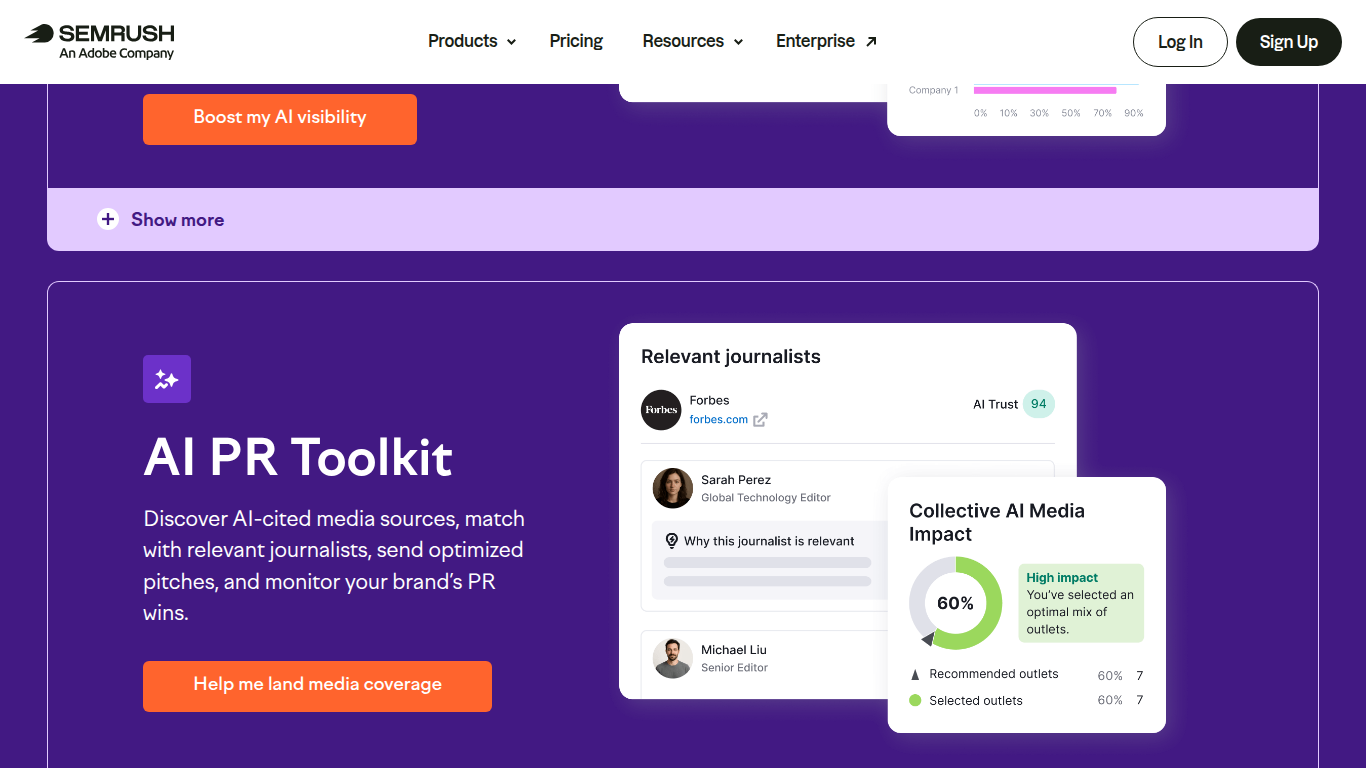
Semrush has integrated AI visibility tracking into its ecosystem through the AI Visibility Toolkit. For teams already invested in Semrush, this add-on provides a unified view of traditional SEO and AI search performance.
The toolkit offers AI Visibility Score benchmarking, prompt tracking (25-200 prompts based on plan), brand performance reports, and competitor comparison.
Pros: Seamless integration with Semrush; familiar interface; combines SEO and AI data
Cons: $99/mo per additional domain; limited to 3-4 AI engines; prompt limits can be restrictive
Bottom Line: Natural extension for Semrush users. Teams starting fresh may find purpose-built GEO tools offer more features for similar pricing.
4. Ahrefs Brand Radar — Best for Ahrefs Users
Pricing: $129/mo (Ahrefs Lite includes basic) | $199/mo per AI index | $699/mo (6-index bundle) Free Trial: Beta indexes currently free
Ahrefs Brand Radar takes a comprehensive approach to brand visibility, tracking mentions across AI answers, YouTube, TikTok, Reddit, and traditional web citations. With a database of 250M+ prompts, it offers significant research capabilities.
The platform provides competitive benchmarking, citation source analysis, and distinguishes between simple mentions and traffic-driving citations.
Pros: Largest prompt database (250M+); multi-channel tracking beyond AI; seamless for Ahrefs users
Cons: Full AI coverage requires expensive add-ons ($699/mo); still in beta; monitoring only—no optimization guidance
Bottom Line: Powerful for research but expensive for full access. Best suited for existing Ahrefs users.
5. Gauge — Best for Competitive Intelligence
Pricing: Custom (contact for pricing) Free Trial: Demo only
Gauge is a YC-backed platform built for data-driven teams wanting actionable competitive intelligence. The platform tracks ChatGPT, Perplexity, Gemini, and Google AI Overviews with deep competitor gap analysis.
Key differentiators include GA4 integration for traffic attribution, an action center with prioritized recommendations, and white-glove onboarding for all tiers. Gauge claims customers see 3-5x visibility uplift in the first month.
Pros: YC-backed; scientific approach; actionable recommendations; proven case studies
Cons: No public pricing; requires demo
Bottom Line: Excellent for growth-stage companies wanting data-driven competitive intelligence and willing to invest in a sales conversation.
6. Goodie AI — Best Comprehensive Enterprise GEO
Pricing: Starting at $495/mo Free Trial: No
Goodie AI positions itself as the most complete GEO platform, combining monitoring, optimization, attribution, and content intelligence. Built specifically for GEO from day one, it avoids the compromises of SEO tools adding AI features as afterthoughts.
The platform tracks visibility across ChatGPT, Gemini, Perplexity, Claude, Copilot, and DeepSeek with optimization guidance and citation gap analysis.
Pros: Purpose-built for GEO; comprehensive feature set; combines monitoring and optimization
Cons: Enterprise pricing excludes smaller teams; no free trial
Bottom Line: Serves enterprises wanting a dedicated GEO solution without the compliance overhead of Profound.
7. Bear AI — Best Mid-Market All-in-One
Pricing: Starting at $199/mo Free Trial: No
Bear AI combines monitoring with content generation, helping brands not just track visibility but actively improve it. The platform covers 6+ AI engines and includes automated outreach workflows.
A unique feature is AI traffic identification—Bear helps you recognize and convert visitors coming from ChatGPT and other AI sources.
Pros: Combines monitoring with content generation; broad engine coverage; helps convert AI traffic
Cons: Mid-tier pricing; less established than major SEO brands
Bottom Line: Strong choice for mid-market teams wanting monitoring plus content creation without juggling multiple tools.
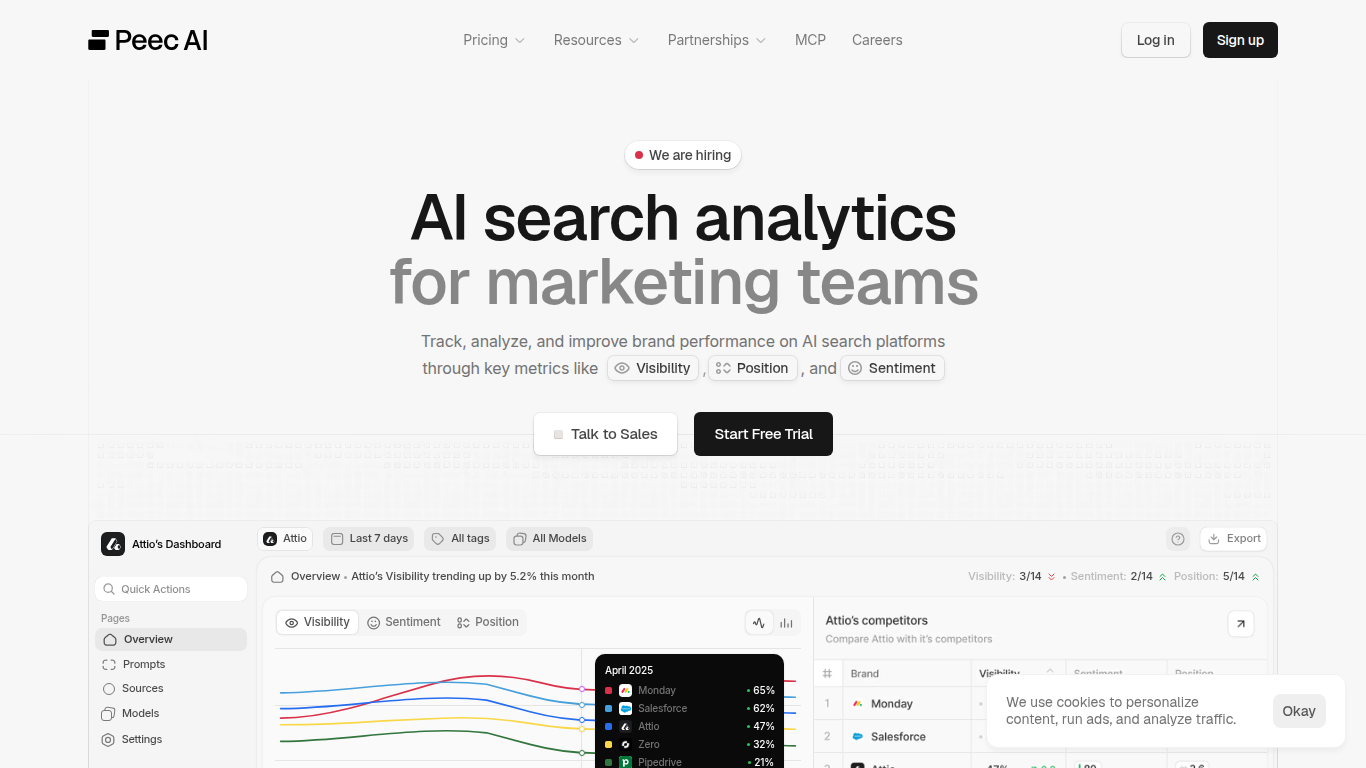
Peec AI delivers clean, intuitive dashboards for tracking brand visibility, position, and sentiment across AI search engines. The platform emphasizes actionable insights over raw data.
Notable features include AI-suggested prompts with search volume data, source analysis for citation opportunities, and unlimited seats on all plans.
Rankscale offers the most affordable entry into GEO tracking with a flexible credit-based model. The platform tracks ChatGPT, Claude, Perplexity, and Google AI Overviews with region and keyword-specific monitoring.
You get a brand dashboard with Visibility Score, citation analysis showing which sites get cited instead of yours, and AI Readiness Score audits. The founder-led team ships updates multiple times per week based on community feedback.
Pros: Most affordable ($20/mo); praised UX; specific regional tracking; pay-as-you-go flexibility
Cons: More technical than user-friendly; credits burn fast at scale
Bottom Line: Best option for teams testing GEO on a tight budget without committing to monthly subscriptions.
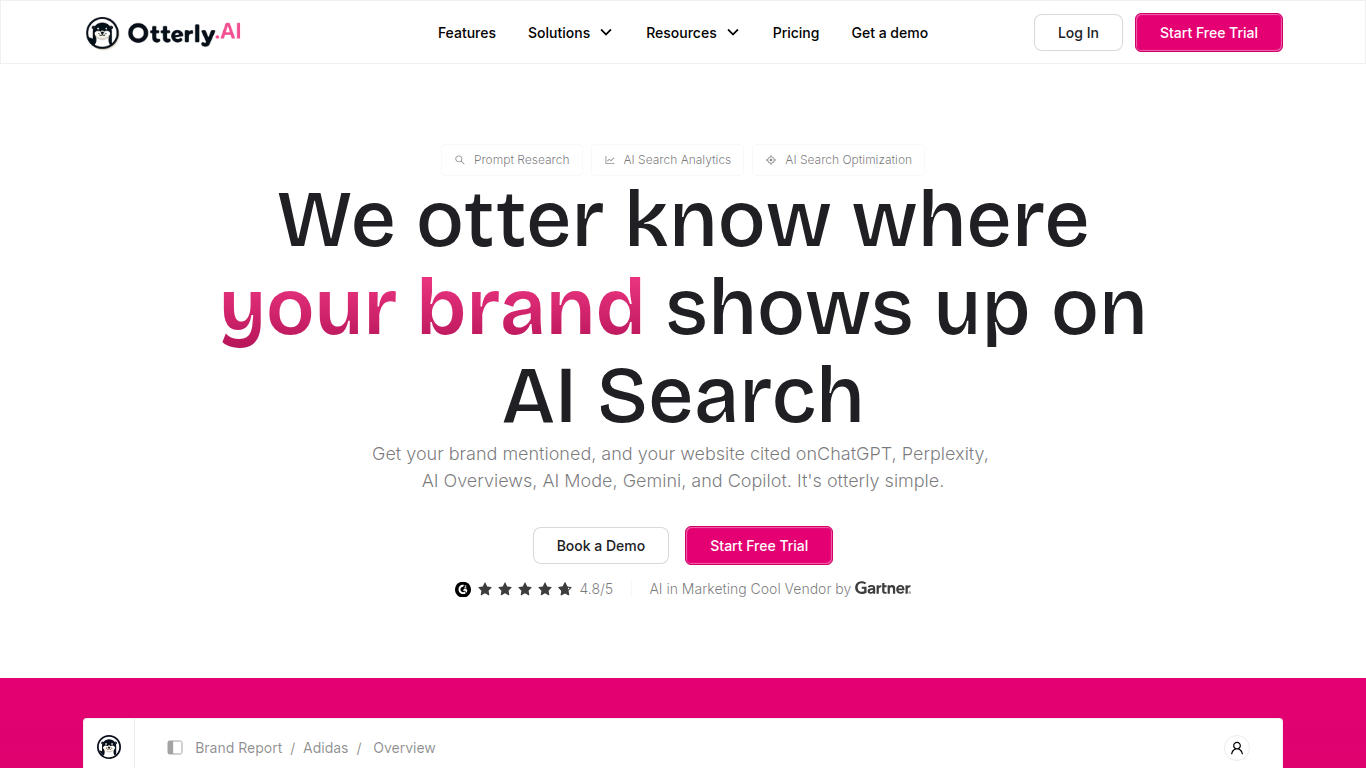
Otterly.AI makes GEO monitoring accessible with an entry-level plan at just $25/month. The platform tracks brand mentions and citations across six AI engines with automated weekly reports.
The GEO audit tool analyzes 25+ on-page factors, and integration with Semrush App Center makes it easy to add to existing workflows.
Cons: Lite plan limited to ~10 prompts; costs scale significantly with volume
Bottom Line: Excellent for teams testing GEO on a budget. The free trial makes it risk-free to start.
11. HubSpot AI Search Grader — Best Free Option
Pricing: Free
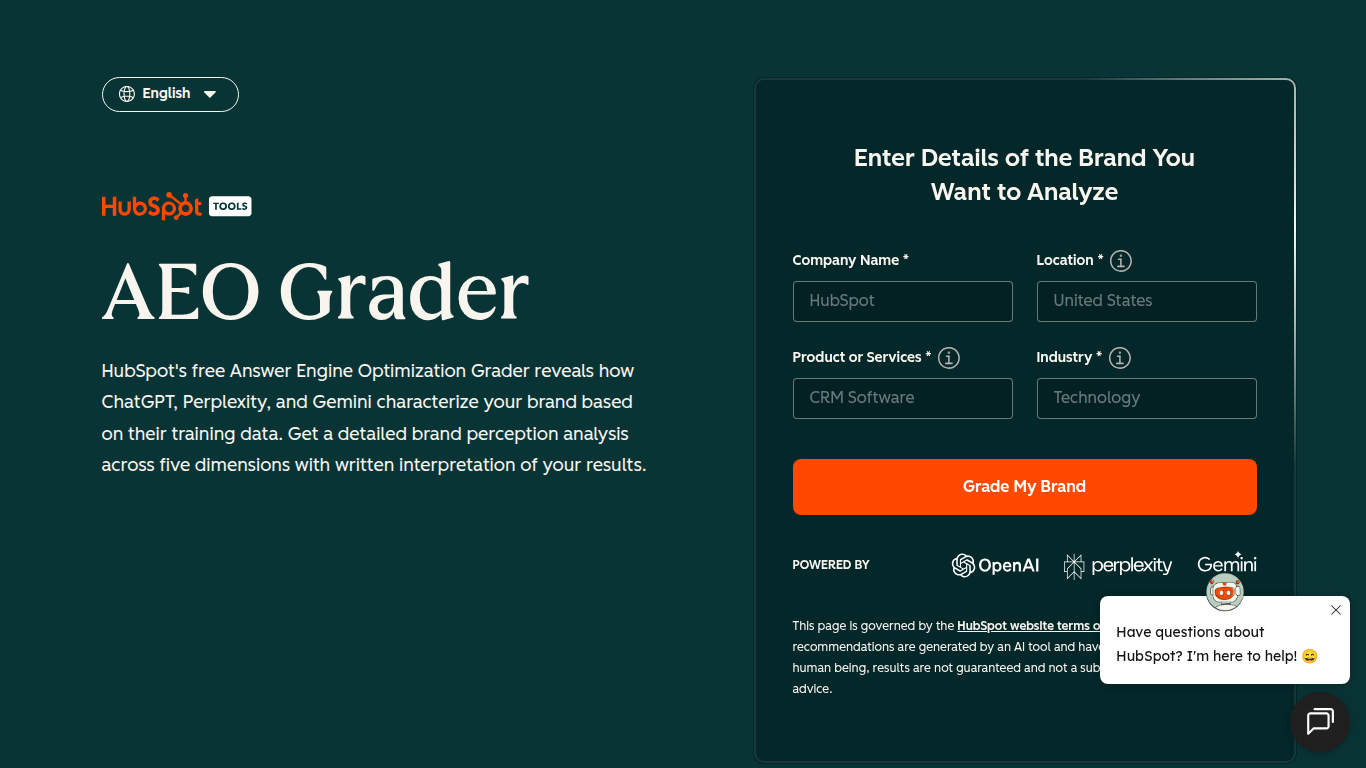
HubSpot’s AI Search Grader offers a free way to understand how your brand appears in AI-generated search results. It scans ChatGPT, Perplexity, and Gemini to evaluate mention frequency, sentiment, and competitive positioning.
Pros: Completely free; quick assessment; no commitment required
Cons: One-time assessment only; no ongoing monitoring; no optimization guidance
Bottom Line: Use as a free diagnostic before committing to paid tools. Great starting point for GEO beginners.
Frequently Asked Questions
What is the difference between GEO and traditional SEO?
Traditional SEO focuses on ranking web pages in Google search results. GEO (Generative Engine Optimization) focuses on getting your brand cited and recommended in AI-generated answers from ChatGPT, Perplexity, and Google AI Overviews. Both are important—traditional SEO drives clicks, while GEO drives brand mentions in the growing AI search channel.
Which GEO tool is best for beginners?
Geoptie is the best GEO tool for beginners due to its affordable $49/mo starting price, 14-day free trial, and seven free tools. HubSpot AI Search Grader is also useful as a free starting point to assess your current visibility.
How much do GEO tools cost?
GEO tools range from free (HubSpot) to $500+ per month for enterprise platforms. Budget options like Rankscale ($20/mo) and Otterly.AI ($25/mo) offer affordable entry points. Mid-tier tools run $100-200/mo, and enterprise solutions like Profound and Goodie AI cost $495-500/mo.
Do I need separate tools for monitoring and optimization?
Not necessarily. All-in-one platforms like Geoptie, Bear AI, and Goodie AI combine monitoring and optimization. However, many tools (Peec AI, Otterly.AI, Ahrefs Brand Radar) focus only on monitoring.
Can GEO tools guarantee I’ll appear in ChatGPT responses?
No tool can guarantee AI citations because AI responses are non-deterministic—they vary based on prompts, context, and model updates. However, GEO tools help you understand what content gets cited, identify gaps, and optimize to increase citation probability over time.
How long does it take to see results from GEO?
GEO results typically take 2-4 months as you optimize content and AI models update their knowledge. Some quick wins can show results faster. Gauge reports customers seeing 3-5x visibility improvements within the first month with proper implementation.
Is GEO replacing SEO?
No. GEO complements traditional SEO rather than replacing it. Strong SEO fundamentals actually improve your GEO performance because AI models often cite high-ranking, authoritative sources. The most effective strategy combines both.
Conclusion
The AI search landscape is evolving rapidly, and brands that invest in GEO now will have significant advantages as AI-generated answers become more prevalent.
Our top recommendations:
For most teams: Geoptie offers the best combination of features and value, delivering all-in-one GEO capabilities at $49/mo.
For enterprises: Profound provides the most comprehensive enterprise solution with compliance certifications, though at premium pricing ($499/mo).
For existing tool users: Semrush AI Toolkit and Ahrefs Brand Radar integrate well with their respective ecosystems.
For budget-conscious teams: Rankscale ($20/mo) and Otterly.AI ($25/mo) provide affordable entry points, while HubSpot AI Search Grader is completely free.
For competitive intelligence: Gauge delivers data-driven insights with proven results for growth-stage companies.
The most important step is starting. Use the free trials and assessment tools to understand your current AI visibility, then choose the platform that fits your budget and needs.
AI search is changing how customers discover brands. Instead of clicking through Google results, users now ask ChatGPT, Perplexity, and Google AI for direct answers — and your brand is either getting cited or getting ignored. We tested 25+ AI SEO tools to find which platforms actually help you show up in AI-generated responses. Here are the 12 that deliver real results.
What Are AI SEO Tools?
AI SEO tools help brands get discovered and cited by AI search engines like ChatGPT, Perplexity, Google AI Overviews, Claude, and Gemini. Unlike traditional SEO tools that focus on Google rankings, AI SEO tools optimize your content to appear in AI-generated answers.
This practice is called Generative Engine Optimization (GEO). As Gartner predicts traditional search volume will drop 25% by 2026 due to AI assistants, brands that ignore GEO risk becoming invisible in the new search landscape.
The best AI SEO tools combine two core functions: monitoring (tracking where and how your brand appears in AI answers) and optimization (improving your content to earn more citations). Most tools only offer monitoring, which is why all-in-one platforms deliver better ROI.
Geoptie is purpose-built for Generative Engine Optimization, combining AI visibility tracking with content optimization tools in a single platform. Unlike most competitors that only offer monitoring, Geoptie helps you both track and improve your AI search presence.
Key Features:
AI visibility tracking across major search engines
Competitor citation analysis and benchmarking
Detailed GEO audit reports with actionable recommendations
Content studio for AI-optimized content creation
Keyword finder for AI search opportunities
Rank tracker for monitoring progress
Free Tools Available: Geoptie offers seven free tools without requiring a subscription: GEO Audit, Content Checker, Keyword Finder, Rank Tracker, GEO Checklist, Cannibalization Checker, and Backlink Finder. This makes it easy to evaluate the platform before committing.
Pros: Most affordable all-in-one solution on the market; combines tracking and optimization (rare); generous 14-day trial; seven free tools available; unlimited audit reports and content analyses on all plans.
Cons: Newer platform compared to legacy SEO tools; focused specifically on GEO rather than traditional SEO metrics.
Bottom Line: Geoptie delivers the best value for teams that need both monitoring and optimization without enterprise pricing. At $49/mo, it costs 85-90% less than comparable all-in-one platforms like AthenaHQ ($295/mo) or Goodie AI ($495/mo).
2. Profound — Best for Enterprise Brands
Pricing: $99/mo (Starter) | $399/mo (Growth) | $499/mo (Lite) | Custom (Enterprise) Free Trial: No (demo required) | Best For: Fortune 500, regulated industries, large agencies
Profound has established itself as the market leader for enterprise AI visibility, backed by $35M in Series B funding from Sequoia Capital. The platform offers comprehensive monitoring across 10+ AI engines and includes advanced features like shopping visibility tracking and workflow automation.
Key Features:
Answer Engine Insights dashboard
Prompt volume research
Agent Analytics for crawler tracking
Shopping visibility for e-commerce
Workflow automation tools
SOC 2 Type II and HIPAA compliance
Pros: Most comprehensive enterprise solution; strongest security certifications; dedicated strategist support; proven case studies with Fortune 500 brands.
Cons: Expensive—Growth plan ($399/mo) required for multi-engine tracking; Starter plan limited to ChatGPT only; no free trial; requires demo and sales process.
Bottom Line: Profound is the right choice for enterprises with significant budgets and compliance requirements. However, mid-market teams will find the pricing prohibitive and may get better value from more affordable alternatives.
3. Semrush AI Visibility Toolkit — Best for Semrush Users
Pricing: $99/mo standalone | $199/mo+ (Semrush One bundle) Free Trial: 7-14 days (Semrush One only) | Best For: Teams already using Semrush for SEO
Semrush has integrated AI visibility tracking into its ecosystem through the AI Visibility Toolkit. For teams already invested in Semrush, this add-on provides a unified view of traditional SEO and AI search performance in one platform.
Key Features:
AI Visibility Score benchmarking
Prompt tracking (25-200 prompts based on plan)
Brand Performance reports
Competitor comparison
Site audit for AI crawlability
Pros: Seamless integration with existing Semrush workflows; familiar interface; combines SEO and AI data; strong competitive intelligence.
Cons: $99/mo per additional domain; limited to 3-4 AI engines currently; no free trial for standalone toolkit; prompt limits can be restrictive.
Bottom Line: If you already use Semrush for SEO, the AI Visibility Toolkit is a natural extension. However, teams starting fresh may find purpose-built GEO tools offer more features for similar or lower prices.
4. Ahrefs Brand Radar — Best for Ahrefs Users
Pricing: $129/mo (Ahrefs Lite includes basic access) | $199/mo per AI index add-on | $699/mo (6-index bundle) Free Trial: Beta indexes currently free | Best For: Teams using Ahrefs wanting brand visibility insights
Ahrefs Brand Radar takes a comprehensive approach to brand visibility, tracking mentions across AI answers, YouTube, TikTok, Reddit, and traditional web citations. With a database of 250M+ prompts, it offers significant research capabilities.
Key Features:
Massive prompt database (250M+)
Multi-channel tracking (AI, video, social, web)
Competitive benchmarking
Citation source analysis
Custom prompt tracking
Pros: Extensive data coverage; goes beyond just AI to track brand visibility everywhere; seamless for existing Ahrefs users; research-oriented approach.
Cons: Full AI coverage requires expensive add-ons ($699/mo for bundle); still in beta with reported accuracy issues; no optimization guidance—monitoring only.
Bottom Line: Brand Radar is powerful for research but expensive for full access. Teams needing optimization guidance alongside monitoring should consider alternatives.
5. Peec AI — Best for Visibility Analytics
Pricing: €89/mo Starter (~$104) | €199/mo Pro (~$232) | €499/mo Enterprise (~$580) Free Trial: Yes | Best For: Marketing teams focused on analytics and reporting
Peec AI delivers clean, intuitive dashboards for tracking brand visibility, position, and sentiment across AI search engines. The platform emphasizes actionable insights over raw data, making it accessible for teams new to GEO.
Key Features:
Visibility, position, and sentiment tracking
AI-suggested prompts with search volume data
Source analysis for citation opportunities
Competitor benchmarking
Looker Studio connector and API
Unlimited seats on all plans
Pros: Clean interface; sentiment tracking included in mid-tier plan; unlimited users even on Starter; strong reporting capabilities; European company with GDPR focus.
Cons: Primarily monitoring—no content optimization tools; additional engines (Claude, DeepSeek) require add-ons; pricing in Euros may fluctuate for US customers.
Bottom Line: Peec AI excels at analytics and reporting. Teams that need optimization guidance will need to pair it with other tools or choose an all-in-one platform.
6. Otterly.AI — Best Budget Monitoring Tool
Pricing: $29/mo (Lite) | $189/mo (Standard) | $989/mo (Pro) Free Trial: 14 days | Best For: SMBs and startups wanting affordable entry point
Otterly.AI makes AI search monitoring accessible with an entry-level plan at just $29/month. The platform focuses on brand mentions, citation tracking, and GEO auditing across six AI engines, earning recognition as a Gartner Cool Vendor in 2025.
Key Features:
Brand mention and citation tracking
GEO audit tool (25+ on-page factors)
Keyword-to-prompt conversion
Automated weekly reports
Semrush App Center integration
Pros: Most affordable entry point for AI monitoring; 14-day free trial; recognized by Gartner and G2; simple setup and interface.
Cons: Lite plan limited to ~10 prompts; costs scale significantly with prompt volume; optimization guidance is basic compared to dedicated tools.
Bottom Line: Otterly.AI is excellent for teams testing the GEO waters on a budget. Those needing comprehensive tracking or optimization should consider higher tiers or alternatives.
7. ZipTie.dev — Best for Google AI Overviews Focus
Pricing: Starting at $69/mo Free Trial: Yes | Best For: Teams prioritizing Google AI Overviews visibility
ZipTie.dev specializes in Google AI Overviews tracking, offering two years of specialized expertise in what AI engines reward. The platform combines monitoring with content optimization guidance at a competitive price point.
Key Features:
AI success scores for prioritization
Content optimization recommendations
Competitor tracking and benchmarking
Query categorization by topic
Site indexing monitoring
Pros: Strong Google AI Overviews expertise; combines monitoring with optimization; competitive pricing; content guidance included.
Cons: Limited to three AI engines (ChatGPT, AI Overviews, Perplexity); newer platform with smaller user base.
Bottom Line: ZipTie.dev offers solid value for teams focused specifically on Google AI visibility. Those needing broader engine coverage should look elsewhere.
8. Rankability AI Analyzer — Best for Agencies with Coaching
Pricing: $149/mo (includes AI Analyzer + Content Optimizer) Free Trial: Yes | Best For: Agencies wanting expert guidance alongside tools
Rankability bundles AI visibility tracking with content optimization tools and monthly coaching calls from SEO experts. This combination of software and guidance makes it unique among GEO platforms.
Key Features:
AI visibility tracking across 6+ engines
Real-time content scoring and optimization
Revenue attribution capabilities
Monthly expert coaching calls
Integrated with content optimizer
Pros: Expert coaching included—not just software; combines tracking with proven content tools; revenue attribution for ROI measurement; strong agency focus.
Cons: Higher price point than monitoring-only tools; coaching value depends on team needs; may be overkill for simple monitoring requirements.
Bottom Line: Rankability is ideal for agencies and consultants who want both tools and strategic guidance. The coaching calls add significant value for teams building GEO expertise.
9. AthenaHQ — Best for Technical Automation
Pricing: Starting at $295/mo Free Trial: Yes | Best For: Technical SEO agencies wanting workflow automation
AthenaHQ was one of the first purpose-built GEO platforms, featuring an Action Center that provides specific fix recommendations. The platform emphasizes automation and includes content optimization on all plans.
Key Features:
Multi-engine citation tracking
Action Center with recommended fixes
Real-time monitoring and alerts
Content optimization (credit-based)
Automated workflows
Pros: Actionable recommendations, not just data; automation capabilities for agencies; content optimization included; established platform with track record.
Cons: Credit-based optimization can get expensive at scale; starting price of $295/mo is steep for smaller teams; primarily ChatGPT-focused on lower tiers.
Bottom Line: AthenaHQ suits technical SEO agencies comfortable with automation workflows. Teams seeking simpler solutions or tighter budgets have more affordable options.
10. HubSpot AI Search Grader — Best Free Option
Pricing: Free Best For: Getting a baseline visibility assessment before investing in paid tools
HubSpot’s AI Search Grader offers a free way to understand how your brand appears in AI-generated search results. It scans ChatGPT, Perplexity, and Gemini to evaluate mention frequency, sentiment, and competitive positioning.
Key Features:
Brand mention frequency analysis
Sentiment evaluation
Competitor comparison
Basic visibility scoring
Pros: Completely free; quick assessment; no commitment required; good starting point for GEO beginners.
Cons: One-time assessment, not ongoing monitoring; no optimization guidance; limited depth compared to paid tools; no historical tracking.
Bottom Line: Use HubSpot AI Search Grader as a free diagnostic before committing to paid tools. It provides valuable baseline data but isn’t a replacement for comprehensive GEO platforms.
11. Goodie AI — Best Comprehensive Enterprise GEO
Pricing: Starting at $495/mo Free Trial: No | Best For: Enterprises wanting complete GEO solution
Goodie AI positions itself as the most complete GEO platform, combining monitoring, optimization, attribution, and content intelligence. Built specifically for GEO from day one, it avoids the compromises of SEO tools adding AI features as afterthoughts.
Key Features:
Cross-engine visibility tracking
Optimization guidance and recommendations
Attribution modeling
Content intelligence
Competitive analysis
Pros: Purpose-built for GEO; comprehensive feature set; combines all GEO functions in one platform; strong for enterprises serious about AI search.
Cons: $495/mo starting price excludes smaller teams; no free trial; less established than some competitors.
Bottom Line: Goodie AI serves enterprises wanting a dedicated, comprehensive GEO solution. The price point reflects its enterprise positioning.
12. Scrunch AI — Best for Deep Enterprise Analysis
Pricing: Custom (Enterprise) Free Trial: Demo only | Best For: Large organizations needing detailed segmentation and compliance
Scrunch AI offers enterprise-grade GEO capabilities with detailed segmentation, prompt-level analysis across all major engines, and SOC 2 Type II compliance. The platform is designed for organizations requiring deep, customizable analysis.
Key Features:
Detailed segmentation architecture
Prompt-level analysis across all major LLMs
Sentiment and share-of-voice tracking
Enterprise security compliance
Custom reporting and filters
Pros: Deepest analysis capabilities; enterprise-grade security; highly customizable; covers all major AI engines.
Cons: Enterprise-only pricing; requires demo and sales process; complex for smaller teams; overkill for basic monitoring needs.
Bottom Line: Scrunch AI fits large enterprises needing maximum analytical depth and compliance. Most teams will find more accessible options better suited to their needs.
Frequently Asked Questions
What is the difference between AI SEO and traditional SEO?
Traditional SEO focuses on ranking web pages in search engine results like Google. AI SEO (or GEO) focuses on getting your brand cited and recommended in AI-generated answers from platforms like ChatGPT, Perplexity, and Google AI Overviews. Both are important—traditional SEO drives clicks, while GEO drives brand mentions and recommendations in the growing AI search channel.
Which AI SEO tool is best for beginners?
Geoptie is the best AI SEO tool for beginners due to its affordable starting price ($49/mo), generous 14-day free trial, and seven free tools that let you explore GEO without commitment. HubSpot AI Search Grader is also useful as a free starting point to assess your current visibility.
How much do AI SEO tools cost?
AI SEO tools range from free (HubSpot AI Search Grader) to $500+ per month for enterprise platforms. Budget options like Otterly.AI start at $29/mo, mid-tier tools like Geoptie and Semrush AI Toolkit run $49-99/mo, and enterprise solutions like Profound and Goodie AI cost $400-500/mo or more.
Do I need separate tools for monitoring and optimization?
Not necessarily. All-in-one platforms like Geoptie, ZipTie.dev, and Rankability combine monitoring and optimization. However, many tools (Peec AI, Otterly.AI, Ahrefs Brand Radar) focus only on monitoring, requiring you to use separate tools or manual processes for optimization.
Can AI SEO tools guarantee I’ll appear in ChatGPT responses?
No tool can guarantee AI citations because AI responses are non-deterministic—they vary based on prompts, context, and model updates. However, AI SEO tools help you understand what content gets cited, identify gaps, and optimize your content to increase citation probability over time.
Which AI engines matter most for GEO?
ChatGPT and Google AI Overviews currently drive the most AI search traffic, making them priorities for most brands. Perplexity is growing rapidly among research-focused users. Claude, Gemini, and Copilot are also significant depending on your audience. Most AI SEO tools cover the major engines.
How long does it take to see results from GEO?
GEO results typically take 2-4 months to materialize as you optimize content and AI models update their knowledge. Some quick wins (fixing technical issues, optimizing existing high-authority content) can show results faster. Consistent monitoring helps you identify what’s working and adjust strategy accordingly.
Is GEO replacing SEO?
No. GEO complements traditional SEO rather than replacing it. Strong SEO fundamentals (quality content, technical optimization, authority building) actually improve your GEO performance because AI models often cite high-ranking, authoritative sources. The most effective strategy combines both disciplines.
Conclusion
The AI search landscape is evolving rapidly, and brands that invest in GEO now will have significant advantages as AI-generated answers become more prevalent.
Our top recommendations:
For most teams: Geoptie offers the best combination of features and value, delivering all-in-one GEO capabilities at $49/mo—a fraction of what competitors charge for similar functionality.
For enterprises: Profound provides the most comprehensive enterprise solution with compliance certifications and white-glove support, though at premium pricing.
For existing tool users: Semrush AI Toolkit and Ahrefs Brand Radar integrate well with their respective ecosystems, offering familiar workflows for teams already invested in those platforms.
For budget-conscious teams: Otterly.AI and HubSpot AI Search Grader provide affordable entry points to start understanding your AI visibility.
The most important step is starting. Use the free trials and assessment tools available to understand your current AI visibility, then choose the platform that best fits your budget and needs. The brands that act now will be the ones AI recommends tomorrow.
ChatGPT now has 800+ million weekly active users. That’s more than the population of Europe—and they’re not typing keywords into Google. They’re asking questions, getting synthesized answers, and making decisions without ever clicking a search result. [Source: TechCrunch]
The $80 billion SEO industry just cracked. [Source: Andreessen Horowitz]
If your content strategy is still built around ranking in Google’s ten blue links, you’re optimizing for a world that’s rapidly disappearing. The question is no longer whether AI will transform search—it’s whether you’ll be visible when it does.
This guide will walk you through everything you need to know about Generative Engine Optimization (GEO)—from its academic origins to actionable strategies you can implement today. You’ll learn how AI engines select sources, why traditional SEO tactics often fail in generative search, and how to measure success in this new paradigm. Whether you’re a marketer, content creator, or business owner, this is your roadmap to visibility in the age of AI search.
What Is Generative Engine Optimization?
Generative Engine Optimization (GEO) is the practice of optimizing digital content to achieve favorable visibility, accurate representation, and preferential citation in AI-generated search responses. Unlike traditional SEO, which focuses on ranking in search engine results pages (SERPs), GEO ensures your brand appears prominently when AI systems synthesize information to answer user queries.
When someone asks ChatGPT, Perplexity, Claude, or Google’s AI Mode a question about your industry, GEO determines whether your content influences the answer—and whether you receive attribution for it.
Think of the distinction this way: SEO gets you clicked; GEO gets you quoted.
Traditional search engines return a list of links and let users decide which to visit. Generative engines synthesize information from multiple sources into a single, conversational response. Your content doesn’t just need to rank—it needs to be compelling enough for an AI to extract, cite, and present to users as authoritative information.
The Origin of GEO
The term “Generative Engine Optimization” was formally introduced in a groundbreaking research paper published in November 2023 by researchers from Princeton University, Georgia Tech, The Allen Institute for AI, and IIT Delhi. The study, titled “GEO: Generative Engine Optimization” and authored by Pranjal Aggarwal, Vishvak Murahari, Tanmay Rajpurohit, Ashwin Kalyan, Karthik Narasimhan, and Ameet Deshpande, established the first academic framework for understanding how content creators can improve visibility in AI-generated responses. [Source: Princeton University/arXiv]
The researchers introduced GEO-bench, a comprehensive benchmark of 10,000 diverse user queries across nine datasets, allowing systematic evaluation of optimization strategies. Their findings were significant: GEO techniques can boost content visibility in generative engine responses by 30-40%. [Source: Aggarwal et al., 2023]
The paper identified nine specific optimization methods, with Statistics Addition, Cite Sources, and Quotation Addition showing the strongest performance improvements. Crucially, the study found that traditional SEO tactics like keyword stuffing performed poorly in generative contexts—a finding that has profound implications for content strategists.
The research was later presented at KDD 2024 (the 30th ACM SIGKDD Conference on Knowledge Discovery and Data Mining), cementing GEO’s place as a legitimate field of academic study and practical application.
Why GEO Matters in 2026: The Data Behind the Shift
The transition from traditional search to AI-powered discovery isn’t a gradual shift—it’s a seismic change already underway. Here’s the data that should concern every marketer:
User Adoption Has Exploded
ChatGPT reached 800+ million weekly active users by late 2025, doubling from 400 million in just months. [Source: TechCrunch]
Perplexity AI processed 780 million queries in May 2025 alone, up from 230 million in August 2024—a 239% increase in less than a year. [Source: Perplexity]
Google’s AI Overviews now appear in 15-60% of searches depending on query type and region, with over 2 billion monthly users engaging with AI-generated summaries globally. [Source: Semrush]
Search Behavior Has Fundamentally Changed
The way people search is different when using AI:
AI search queries average 23 words, compared to just 4 words for traditional Google searches. [Source: Andreessen Horowitz]
Search sessions on AI platforms average 6 minutes, indicating deeper engagement and more conversational interactions.
79.7% of consumers who use AI for shopping rely on it for at least half of their purchase decisions, fundamentally changing the buyer’s journey. [Source: Profound]
Traffic Predictions Are Sobering
Industry forecasts paint a stark picture:
Gartner predicts traditional search engine volume will drop 25% by 2026, with AI chatbots and virtual agents capturing that share. [Source: Gartner]
Organic search traffic is predicted to decrease by 50% or more as consumers embrace generative AI-powered search, according to Gartner’s extended forecast. [Source: Gartner]
58.5% of Google searches in the US already end without a click, rising to 75% on mobile. When AI Overviews are present, organic CTR drops by 61%. [Source: Seer Interactive]
The Business Impact Is Real
This isn’t theoretical—businesses are already feeling the effects:
Early GEO adopters report that 32% of their sales-qualified leads now come from generative AI search, compared to virtually none just months ago.
Traffic from AI platforms converts at significantly higher rates than traditional search, with some studies showing 5x higher conversion rates.
Reddit and YouTube are among the most-cited sources in AI Overviews and ChatGPT responses, demonstrating that AI engines favor user-generated, discussion-rich content.
GEO vs SEO vs AEO: Understanding the Differences
Understanding the distinctions between these optimization approaches is critical for developing an effective strategy.
Factor
Traditional SEO
Answer Engine Optimization (AEO)
Generative Engine Optimization (GEO)
Primary Goal
Rank in SERPs
Featured snippets, voice results
AI citations, brand mentions
Target Platforms
Google, Bing
Google Assistant, Alexa, Siri
ChatGPT, Perplexity, Claude, AI Overviews
Success Metrics
Position, CTR, traffic
Answer box presence, voice share
Citation rate, brand mentions, share of voice
Query Type
Short keywords (4 words avg.)
Question phrases
Conversational (23+ words avg.)
Content Format
Keyword-optimized pages
Q&A structured content
Comprehensive, authoritative resources
Link Building
Backlinks critical
Less emphasis
Authority signals across web
User Behavior
Click through to website
Receive voice answer
Get synthesized response, may not click
Measurement
Google Search Console, rank trackers
Featured snippet tracking
AI visibility platforms (Profound, Otterly)
How Traditional SEO Works
Traditional SEO optimizes content to rank highly in search engine results pages. Success is measured by position, click-through rate, and organic traffic. The strategy revolves around keyword research, on-page optimization, technical SEO, and building backlinks to signal authority.
The fundamental unit of success is the click: users see your listing, click through to your website, and potentially convert. Your website is the destination.
How Answer Engine Optimization (AEO) Works
AEO emerged as voice assistants like Alexa, Google Assistant, and Siri gained adoption. The goal shifted from driving clicks to becoming the single answer to a user’s question—appearing in featured snippets, answer boxes, and voice search results.
AEO emphasizes question-and-answer formatting, structured data, and concise responses that voice assistants can read aloud. While still focused on Google’s ecosystem, AEO recognized that zero-click results were becoming more common.
How Generative Engine Optimization Works
GEO represents a more fundamental shift. Generative engines don’t return links—they synthesize information from multiple sources into cohesive, conversational responses. Your content must be:
Discoverable by AI crawlers and retrieval systems
Comprehensible to large language models parsing your content
Authoritative enough to be selected over competing sources
Extractable—structured so AI can pull relevant passages
Citable—providing clear facts, statistics, and claims AI can reference
The metric that matters isn’t ranking—it’s reference rate: how often your brand or content is cited when AI systems generate responses in your domain.
How Generative AI Engines Process and Cite Content
Understanding how AI engines work under the hood helps explain why certain optimization strategies succeed.
The RAG Architecture
Most generative search engines use Retrieval-Augmented Generation (RAG), a two-stage process:
Retrieval: The system searches an index (often web content, sometimes proprietary databases) to find relevant documents matching the user’s query.
Generation: A large language model synthesizes the retrieved information into a coherent response, selecting which sources to cite.
This differs fundamentally from traditional search. Google’s algorithm ranks pages; generative engines read pages, extract information, and reformulate it. Your content doesn’t just need to rank—it needs to provide information the AI can understand, trust, and articulate.
What Makes AI Engines Cite Your Content
Research and industry experience suggest several factors influence whether AI systems cite specific sources:
Comprehensiveness: AI models favor content that thoroughly addresses topics. Single-keyword pages optimized for traditional SEO often lack the depth AI systems prefer.
Structural Clarity: Clear headings, logical organization, and explicit relationships between concepts help AI parse and extract information. Think of your content architecture as a knowledge graph.
Factual Specificity: Content with specific data points, statistics, quotes, and verifiable claims receives preferential citation. The Princeton GEO study found that adding statistics improved visibility by up to 40%. [Source: Aggarwal et al., 2023]
Source Attribution: Paradoxically, citing other credible sources within your content increases your likelihood of being cited by AI. It signals thoroughness and trustworthiness.
Entity Clarity: Clearly identifying who you are, what you do, and what topics you cover helps AI systems categorize and retrieve your content appropriately.
Cross-Platform Presence: AI engines assess authority holistically. Consistent information across Wikipedia, reviews, social media, industry publications, and your own site strengthens citation likelihood.
Core GEO Strategies: How to Optimize for AI Search
Moving from theory to practice, here are the essential strategies for improving your AI visibility.
1. Create Comprehensive, Authoritative Content
The Princeton research demonstrated that content depth matters more than keyword optimization for GEO success. AI systems are trained to recognize substantive, well-researched content.
Actionable tactics:
Create definitive resources that answer not just the primary question, but anticipate follow-ups. If you’re writing about project management software, don’t just compare features—explain implementation, address common challenges, and provide selection frameworks.
Include original data, research, and insights. First-hand experience signals authority that AI systems increasingly recognize. Share proprietary statistics, case study results, and expert perspectives unique to your organization.
Address topics from multiple angles. Content that explores a subject comprehensively—pros/cons, use cases, alternatives, implementation—provides more extractable value than narrow treatments.
Update content regularly. AI systems that access real-time information favor fresh, maintained resources over outdated pages.
2. Structure Content for AI Parsing
AI models excel at understanding relationships between concepts. Your content structure directly impacts retrievability.
Actionable tactics:
Use descriptive headings that clearly indicate what follows. Instead of “Our Approach,” use “How We Reduce Implementation Time by 40%.”
Implement FAQ sections that directly answer common queries. These provide AI with ready-made question-answer pairs to cite.
Create modular content blocks that work standalone. AI often extracts single passages—ensure each section provides complete, useful information independently.
Use summary paragraphs at section openings that encapsulate key points. These serve as extraction targets for AI systems.
Include glossaries and definitions for industry terms. When users ask “What is X?”, you want to be the cited definition.
Apply schema markup extensively: FAQ schema, HowTo schema, Article schema, Organization schema, and Product schema all help AI understand your content’s structure and purpose.
3. Build Entity Authority and Brand Signals
AI engines assess credibility across your entire digital presence, not just your website.
Actionable tactics:
Ensure your Wikipedia presence (if notable) or Wikipedia mentions are accurate. Wikipedia is among the most-cited sources in AI responses.
Claim and optimize Google Business Profile and knowledge panel information.
Maintain consistent NAP (Name, Address, Phone) across all platforms.
Build presence in authoritative industry publications. Guest posts, expert commentary, and research contributions in respected venues increase your entity’s authority.
Participate meaningfully in Reddit, Quora, and industry forums. These platforms are heavily cited by AI systems. Genuine expertise shared in community discussions often surfaces in AI responses.
Earn mentions and backlinks from high-authority domains—government sites (.gov), educational institutions (.edu), major publications, and industry leaders.
4. Implement Technical GEO Best Practices
Technical factors remain important for AI discoverability.
Actionable tactics:
Ensure content is crawlable and indexable. AI systems often use web crawling to build retrieval indices. Blocked pages won’t be cited.
Implement structured data (JSON-LD schema) to provide explicit context. This helps AI understand content type, author credentials, publication dates, and relationships.
Maintain fast page load speeds. When AI does drive referral traffic, user experience matters for brand perception.
Use clean, semantic HTML. Proper heading hierarchy, semantic tags, and accessible markup help AI parsers understand content structure.
Monitor your AI crawler logs. Tools like Profound track when AI bots visit your site, helping you understand which content AI systems are indexing.
Consider AI-specific meta descriptions that summarize your page’s key claims in extractable format.
5. Leverage Citations and External Validation
The Princeton research found that Cite Sources was among the top-performing GEO strategies. External validation strengthens your content’s citation worthiness.
Actionable tactics:
Cite credible sources within your content. Academic research, government data, and authoritative industry reports signal thoroughness.
Include expert quotes from recognized voices in your field. AI systems often extract quotations as evidence.
Reference specific studies, statistics, and data points with clear attribution. Vague claims get overlooked; specific, cited claims get cited themselves.
Build case studies with quantified results. “Increased revenue by 47% over 6 months” is more extractable than “significantly improved performance.”
Earn reviews and testimonials on third-party platforms. Aggregate sentiment across review sites influences how AI characterizes your brand.
6. Optimize for Conversational Queries
Remember: AI queries average 23 words compared to 4 for traditional search. Your content must match how people actually ask AI for help.
Actionable tactics:
Research question-based keywords using tools that reveal conversational queries. What are users asking AI about your industry?
Create content that answers compound questions: “What’s the best CRM for small businesses that integrates with Gmail and has good mobile support?”
Use natural language throughout. Write as if explaining to a colleague, not stuffing keywords.
Address intent comprehensively. AI queries often combine informational and commercial intent—users want to understand and decide simultaneously.
Include comparison content that helps AI answer “vs.” questions: “Slack vs. Teams for remote teams” type queries.
GEO Case Studies: Real Results from Real Brands
Case Study 1: How Zapier Increased AI Visibility Through Content Structure
Zapier, the automation platform, noticed declining organic traffic coinciding with AI Overview expansion. Their response exemplifies effective GEO strategy.
The approach: Zapier restructured existing content to feature clear, extractable summaries at the beginning of each integration guide. They added specific statistics about time saved and added FAQ sections addressing common follow-up questions.
The results: Within three months, Zapier’s content began appearing in AI-generated responses for automation-related queries. Their brand mentions in ChatGPT responses for “workflow automation” queries increased substantially, driving qualified traffic despite fewer traditional SERP clicks.
Key insight: They didn’t create new content—they restructured existing authority for AI comprehension.
Case Study 2: E-commerce Brand Visibility Transformation
A mid-sized e-commerce retailer in the outdoor equipment space found themselves invisible in AI shopping queries, despite strong traditional SEO rankings.
The challenge: When users asked ChatGPT for “best backpacking tents under $400,” competitors were consistently cited while they weren’t mentioned.
The approach: The team implemented comprehensive comparison content with specific product statistics, published video reviews to YouTube with detailed descriptions, engaged authentically in Reddit’s r/CampingGear community, and ensured product information was consistent across their site, Amazon listings, and review platforms.
The results: After six months, their brand began appearing in ChatGPT Shopping results. More importantly, the traffic arriving from AI-referred visitors showed significantly higher conversion rates than traditional organic traffic—these users arrived pre-informed and ready to purchase.
Key insight: AI visibility required presence across multiple platforms, not just on-site optimization.
Common GEO Mistakes to Avoid
As organizations rush to implement generative engine optimization, several pitfalls have emerged:
1. Over-Optimizing for Specific AI Models
Each AI model has nuances, but gaming one platform risks missing broader opportunities. Perplexity’s citation patterns differ from ChatGPT’s, which differ from Google’s AI Overviews. Focus on universal principles—comprehensive, authoritative content structured for AI comprehension—rather than exploiting temporary patterns in any single system.
2. Neglecting Traditional SEO
GEO supplements rather than replaces traditional SEO. Many AI systems still rely on web crawling, indexing, and traditional authority signals. Pages that rank poorly in Google often struggle in AI citations too. Maintain SEO fundamentals while layering GEO strategies on top.
3. Sacrificing User Experience for AI Optimization
Content overly structured for AI extraction—endless bullet points, robotic phrasing, repetitive formatting—frustrates human readers who find it through any channel. Balance AI comprehension with human readability. The best GEO content works for both audiences.
4. Ignoring E-E-A-T Principles
Google’s Experience, Expertise, Authoritativeness, and Trustworthiness principles matter even more in GEO. AI models are increasingly sophisticated at identifying authoritative sources and filtering low-quality content. Building genuine expertise—demonstrated through original research, expert credentials, and consistent thought leadership—remains essential.
5. Expecting Overnight Results
Unlike traditional SEO where ranking changes can occur within weeks, AI visibility builds over time as models are updated and retrained. GEO is a long-term investment. Organizations that maintain consistent efforts over 6-12 months see compounding returns as their content becomes established in AI knowledge bases.
6. Measuring with Wrong Metrics
Traditional SEO metrics—rankings, organic traffic, keyword positions—only partially capture GEO success. A page might generate significant brand influence through AI citations without driving direct traffic. Implement GEO-specific measurement including citation frequency, brand mention tracking, and sentiment analysis in AI responses.
7. Treating GEO as One-Time Optimization
AI platforms continuously update their models, retrieval systems, and citation patterns. What works today may be less effective tomorrow. Build systems for ongoing monitoring and optimization rather than treating GEO as a one-time project.
Best GEO Tools for 2026
The GEO tools market has matured rapidly. Here’s what’s available:
Free GEO Tools
Geoptie GEO Audit: Analyze your website’s AI readiness with comprehensive scoring across content structure, citation worthiness, and technical factors.
HubSpot AI Search Grader: Free assessment of your brand’s AI visibility across ChatGPT, Perplexity, and Gemini. Provides competitive benchmarking and actionable recommendations. Best for initial baseline measurement. [Source: HubSpot]
Manual Testing: Query ChatGPT, Perplexity, Claude, and Google’s AI Mode with searches relevant to your business. Document how your brand appears (or doesn’t) and track changes monthly.
Paid GEO Platforms
Geoptie Pro: Complete GEO platform including rank tracking across AI engines, content optimization recommendations, and competitor monitoring. Integrates with existing SEO workflows for unified reporting.
Profound: Enterprise-grade platform tracking brand citations across 9+ AI engines. Connects to Google Analytics for revenue attribution, showing how AI citations translate to business outcomes. Starts at $499/month. [Source: Profound]
Semrush AI Visibility Toolkit: Part of Semrush’s broader SEO suite, offering AI search market analysis, brand sentiment tracking, and competitive share-of-voice reporting. Priced at $99/month per domain. Strong for teams already using Semrush. [Source: Semrush]
Otterly.AI: Focused on prompt-level tracking and link citation detection. Monitor specific queries to see when your brand appears in AI responses. Plans start at $29/month. Best for teams focused on specific query visibility. [Source: Otterly.AI]
AthenaHQ: Combines prompt tracking, brand monitoring, competitive benchmarks, and an action center for fixing visibility gaps. Good for mid-market teams wanting guided optimization.
Geoptie Keyword Finder: Discover which queries your audience asks AI platforms, identifying content gaps and optimization opportunities.
How to Measure GEO Success
Traditional SEO metrics don’t fully capture GEO performance. Here’s what to track:
Key GEO Metrics
Citation Frequency: How often AI systems cite your content in relevant queries. This requires systematic testing or dedicated tools.
Brand Mention Rate: Percentage of AI responses in your category that mention your brand, regardless of citation links.
Share of Voice: Your brand’s mention frequency compared to competitors in AI responses for target queries.
Sentiment Analysis: How positively or negatively AI platforms characterize your brand when mentioning it.
Citation Position: Where in AI responses your content appears—early mentions carry more weight than afterthoughts.
Response Inclusion Rate: Percentage of relevant queries where your content influences the AI’s response.
Indirect Indicators
Branded Search Volume: Increases in users searching your brand name directly, suggesting discovery through AI responses.
Direct Traffic Growth: Users who heard about you through AI may type your URL directly rather than clicking a citation.
Referral Traffic from AI Platforms: Monitor Google Analytics for traffic from chat.openai.com, perplexity.ai, and similar sources.
Conversion Rate Changes: AI-referred traffic often converts at higher rates—users arrive pre-informed. Track whether conversion rates shift as AI visibility improves.
GEO Measurement Tools
Geoptie GEO Rank Tracker: Automated monitoring of your brand’s position across major AI platforms. Track changes over time and set alerts for significant movements.
Manual Query Testing: Test your top 30-50 queries monthly across ChatGPT, Perplexity, Google AI Overviews, and Claude. Document citations and brand mentions.
GA4 Integration: Configure Google Analytics to segment AI-referral traffic. Analyze behavior, conversion, and value metrics for this audience specifically.
The Future of Generative Engine Optimization
Emerging Trends
Multimodal Optimization: Future AI engines will seamlessly blend text, images, video, and audio. GEO strategy will need to encompass optimization across all content formats—ensuring your YouTube videos, podcast episodes, and infographics are discoverable and citable alongside text content.
AI Shopping Integration: ChatGPT’s Shopping feature and similar integrations are transforming product discovery. E-commerce brands must optimize product data, imagery, and descriptions for AI shopping interfaces specifically.
Agentic AI: The rise of autonomous AI agents that take actions (booking, purchasing, researching) on users’ behalf creates new optimization challenges. Your content may need to serve AI agents working on behalf of users, not just users directly.
Personalization: Advanced AI models will provide increasingly personalized responses based on user history, preferences, and context. GEO strategies may need to account for how content performs across different user segments.
Predictions for 2026-2027
AI search parity: Based on current growth trends, AI-driven search could deliver equal or greater economic value than traditional search by late 2027, even with lower raw volume, due to higher conversion rates. [Source: Multiple industry analysts]
Platform diversification: Apple’s integration of AI-native search engines like Perplexity into Safari signals the end of Google’s distribution monopoly. Brands will need visibility across an increasingly fragmented AI search landscape.
Measurement standardization: As the GEO market matures, standardized metrics and benchmarks will emerge, making it easier to measure and compare performance.
Traditional SEO integration: The distinction between SEO and GEO will blur as Google’s AI Overviews become the dominant SERP feature. Optimization strategies will need to address both paradigms simultaneously.
Regulatory attention: As AI search influences consumer decisions, expect increased scrutiny of how AI systems select and cite sources, potentially creating new requirements for transparency.
Getting Started with GEO: Your Action Plan
Ready to implement generative engine optimization? Here’s your step-by-step checklist:
Week 1: Baseline Assessment
[ ] Test your brand visibility manually across ChatGPT, Perplexity, Claude, and Google AI Overviews for your top 20 queries
[ ] Iterate based on what content gets cited and why
Frequently Asked Questions About GEO
What is generative engine optimization?
Generative engine optimization (GEO) is the practice of optimizing digital content to appear in AI-generated search responses from platforms like ChatGPT, Perplexity, Claude, and Google’s AI Overviews. Unlike traditional SEO which focuses on ranking in search results, GEO ensures your brand is cited when AI systems synthesize information to answer user queries.
What is the difference between GEO and SEO?
SEO optimizes content to rank highly in traditional search engine results pages (SERPs), driving clicks to your website. GEO optimizes content to be cited in AI-generated responses. SEO success is measured by rankings and traffic; GEO success is measured by citation frequency and brand mentions in AI answers. Both remain important—GEO supplements rather than replaces traditional SEO.
How do I optimize my content for ChatGPT?
To optimize for ChatGPT and similar AI engines: create comprehensive, authoritative content that thoroughly addresses topics; use clear structure with descriptive headings; include specific statistics, data, and citations; implement FAQ sections; ensure consistency across your web presence; and build authority through mentions on Wikipedia, Reddit, and authoritative publications.
Does GEO replace traditional SEO?
No. GEO and SEO work together. Many AI systems still rely on traditional search indices and authority signals. Content that ranks well in Google often performs better in AI citations. Maintain SEO fundamentals while adding GEO-specific optimizations for comprehensive visibility.
How long does it take to see GEO results?
GEO typically takes longer than traditional SEO to show results. AI models are updated periodically rather than continuously crawling, so visibility improvements may take 3-6 months to materialize. However, once established, AI visibility tends to be more stable than search rankings.
What are the best GEO tools?
For free assessment, try Geoptie’s GEO Audit or HubSpot’s AI Search Grader. For ongoing tracking, Geoptie Pro, Profound, Semrush AI Toolkit, and Otterly.AI offer comprehensive monitoring. For enterprise needs with revenue attribution, Profound leads the market.
How do I measure GEO success?
Track citation frequency across AI platforms, brand mention rate, share of voice versus competitors, and sentiment in AI responses. Also monitor indirect indicators: branded search volume, direct traffic, AI referral traffic in Google Analytics, and conversion rate changes.
Is GEO worth the investment?
Yes. With ChatGPT serving 800+ million weekly users and AI Overviews appearing in 15-60% of Google searches, AI-driven discovery is already mainstream. Early GEO adopters report 32% of qualified leads coming from AI search. As traditional organic traffic continues declining, GEO investment becomes increasingly critical for visibility.
What content formats work best for GEO?
Comprehensive guides, FAQ pages, glossaries, comparison articles, and content with specific statistics perform well. User-generated content platforms like Reddit and YouTube are heavily cited by AI. Original research and case studies with quantified results also earn strong citations.
How do AI engines decide what to cite?
AI engines using RAG (Retrieval-Augmented Generation) first retrieve relevant documents, then generate responses citing selected sources. Factors influencing citation include content comprehensiveness, structural clarity, factual specificity with verifiable data, source credibility, and consistency across platforms.
Conclusion
Generative Engine Optimization represents the most significant shift in digital marketing since Google’s inception. As AI-powered search tools become the primary way people discover information, businesses that master GEO will have a substantial competitive advantage.
The data is clear: ChatGPT’s 800+ million weekly users, Perplexity’s 780 million monthly queries, and Google AI Overviews appearing in up to 60% of searches signal that the transition is already happening. Traditional search traffic is projected to drop 25% by 2026, with AI capturing that share.
But this shift also presents opportunity. Early movers in GEO are already seeing results—higher-converting traffic, stronger brand perception, and visibility where their competitors are invisible. The brands that establish authority in AI responses today will own the conversations in their industries tomorrow.
The fundamentals of GEO—comprehensive content, clear structure, factual specificity, and cross-platform authority—align with creating genuinely valuable resources for your audience. It’s not about gaming algorithms; it’s about becoming the definitive source that AI systems should cite.
The revolution is here. Start optimizing for generative engines today.
Ready to transform your content strategy for the AI era?Try Geoptie today and discover how generative engine optimization can amplify your digital presence. Our platform provides the insights and tools you need to track your AI visibility, audit your content’s readiness, and ensure your brand gets discovered and cited by AI-powered search engines.
The search landscape is undergoing a seismic shift. As AI-powered search engines like Perplexity, ChatGPT with browsing, and Google’s AI Overviews become mainstream, the traditional rules of link building are being rewritten. AI search backlinks operate on fundamentally different principles than classic SEO backlinks – and understanding these differences is crucial for your content’s visibility in 2025 and beyond.
The Fundamental Shift: From PageRank to Citation Authority
Traditional SEO has long revolved around Google’s PageRank algorithm, where backlinks act as votes of confidence. More links from authoritative sites meant higher rankings. But AI search engines don’t crawl the web the same way Google does. Instead, they prioritize citation-worthy content that can be referenced as authoritative sources in conversational responses.
When someone asks ChatGPT or Perplexity a question, these AI engines don’t return a list of links – they synthesize information and cite their sources. This means AI search backlinks aren’t just about quantity or even traditional domain authority. They’re about becoming a primary source that AI models recognize as trustworthy and relevant.
What Makes Content Citation-Worthy for AI Search?
AI search engines evaluate content differently than traditional crawlers. Here’s what matters most for earning AI search backlinks:
1. Semantic Richness and Context
AI models excel at understanding context and relationships between concepts. Your content needs to provide comprehensive coverage of topics with clear semantic connections. Instead of keyword stuffing, focus on naturally covering related concepts, synonyms, and contextual variations that help AI understand your expertise depth.
2. Structured Data and Clear Information Architecture
While schema markup helps traditional SEO, AI engines particularly value well-structured content with clear hierarchies, definitions, and logical flow. Use headers strategically, implement FAQ sections, and ensure your content follows a logical progression that AI can easily parse and reference.
3. Original Research and Primary Sources
AI engines heavily favor original data, research studies, surveys, and first-hand expertise. Become the source others cite by publishing unique insights, case studies, or data that can’t be found elsewhere. This positions you as an authoritative reference point for AI search backlinks.
4. Freshness and Regular Updates
Unlike traditional backlinks that remain relatively static, AI search engines continuously update their knowledge bases. Regularly updating your content with new information, statistics, and insights increases the likelihood of being cited in AI-generated responses.
New Link Building Strategies for the AI Era
Traditional link building focused on guest posts, directory submissions, and outreach campaigns. For AI search backlinks, you need evolved strategies:
Strategy 1: Build Topic Clusters Around AI-Friendly Queries
Create comprehensive topic clusters that answer complex, conversational queries. AI engines favor sites that can provide complete answers to multi-faceted questions. Instead of targeting single keywords, build content ecosystems around topic areas.
Strategy 2: Optimize for Featured Snippets and Direct Answers
Content that already ranks in Google’s featured snippets is more likely to be cited by AI engines. Structure your content to directly answer questions in concise, authoritative paragraphs that AI can easily extract and cite.
Strategy 3: Develop API-Accessible Content
Some AI search engines can access content through APIs or structured feeds. Consider implementing JSON-LD markup, creating API endpoints for your content, or submitting to AI-friendly content databases to increase discoverability.
Strategy 4: Create Comparative and Analytical Content
AI engines excel at synthesis and comparison. Content that analyzes multiple viewpoints, compares solutions, or provides balanced perspectives is more likely to be referenced when AI generates comprehensive responses.
Measuring AI Search Backlink Success
Traditional backlink metrics like Domain Authority and referring domains don’t fully capture AI search visibility. New metrics to track include:
Citation frequency in AI-generated responses
Topic authority scores in AI knowledge bases
Semantic relevance ratings for target queries
Content freshness indicators relative to competitors
Cross-platform AI visibility across different AI search engines
Tools like Geoptie are emerging to help track these new metrics and optimize content specifically for AI search engines, providing insights that traditional SEO tools miss.
The Hybrid Approach: Balancing Traditional SEO with GEO
While AI search is growing rapidly, traditional search isn’t disappearing overnight. The most successful strategy combines both approaches:
Maintain traditional SEO fundamentals – Technical SEO, site speed, and mobile optimization still matter
Layer in GEO optimization – Add semantic richness, structured data, and AI-friendly formatting
Create dual-purpose content – Design content that ranks in traditional search while being citation-worthy for AI
Monitor both metrics – Track traditional rankings alongside AI citation metrics
Common Mistakes to Avoid with AI Search Backlinks
As the landscape evolves, several misconceptions about AI search backlinks have emerged:
Mistake 1: Treating AI Citations Like Traditional Backlinks
AI citations are contextual and query-dependent. A piece of content might be cited for one query but not another, even on the same topic. Focus on comprehensive coverage rather than targeting specific “link opportunities.”
Mistake 2: Ignoring Semantic Relationships
Keyword density matters less than semantic completeness. AI engines understand related concepts, so naturally incorporate synonyms, related terms, and contextual variations throughout your content.
Mistake 3: Neglecting Content Updates
Unlike traditional backlinks that persist, AI engines regularly refresh their training data. Outdated content loses citation potential quickly. Implement a regular content refresh schedule to maintain visibility.
Practical Implementation: Your 30-Day AI Search Backlink Plan
Ready to start building AI search backlinks? Here’s a practical roadmap:
Week 1: Audit and Assessment
Analyze current content for AI-friendliness
Identify gaps in semantic coverage
Research queries where AI engines currently lack good sources
Week 2: Content Optimization
Restructure existing content with clear hierarchies
Add structured data and schema markup
Enhance semantic richness with related concepts
Week 3: New Content Creation
Develop original research or data studies
Create comprehensive guides on underserved topics
Build topic clusters around core expertise areas
Week 4: Monitoring and Iteration
Track AI citation metrics using specialized tools
Analyze which content gets cited most frequently
Iterate based on performance data
The Future of AI Search Backlinks
As AI search engines evolve, we’re seeing early indicators of where AI search backlinks are headed:
Real-time citation tracking will become standard
Semantic authority scores will replace traditional domain authority
AI-specific content optimization tools will proliferate
Cross-platform citation strategies will become essential
Conclusion: Embracing the GEO Revolution
The shift from traditional backlinks to AI search backlinks represents more than a tactical change – it’s a fundamental evolution in how we think about content authority and discoverability. Success in this new landscape requires embracing semantic richness, structural clarity, and continuous optimization.
Traditional link building asked, “How can I get more sites to link to me?” AI search optimization asks, “How can I become the most authoritative, comprehensive source that AI engines want to cite?” This shift from quantity to quality, from links to citations, defines the new era of search optimization.
Ready to optimize your content for AI search engines? Geoptie provides the tools and insights you need to track, measure, and improve your AI search visibility. Start building your AI search backlinks strategy today and position your content for the future of search.
The search landscape has fundamentally changed. With more people turning to AI assistants for quick answers rather than browsing through search results, traditional SEO alone isn’t enough anymore. 58% of consumers now regularly use AI-powered search, and if your brand isn’t optimized for these platforms, you’re missing out on massive visibility opportunities.
The good news? You don’t need a huge budget to start optimizing for AI search. This comprehensive guide explores the best free GEO (Generative Engine Optimization) tools that can help you improve your visibility in ChatGPT, Claude, Perplexity, and other AI platforms without spending a dime.
What is Generative Engine Optimization (GEO)?
Generative Engine Optimization (GEO) is the practice of optimizing your content so that it gets cited in AI-generated answers from platforms like ChatGPT, Gemini, Perplexity, and Google AI Overviews. Unlike traditional SEO, which focuses on ranking in Google search results, GEO ensures that AI systems actually pull your brand, links, and insights into their responses.
The key difference? SEO gets you seen on Google, GEO gets you mentioned by AI. And with traditional search engine volume predicted to drop 25% by 2026 and 50% by 2028, mastering GEO is no longer optional—it’s essential for survival.
Top Free GEO Tools for AI Search Success
1. Geoptie: The Complete Free GEO Platform
Geoptie is the first platform to provide comprehensive monitoring and optimization tools for this new search paradigm – and during our open beta phase, everything is free. This makes it the most powerful free option available for businesses serious about AI search optimization.
Key Features:
Comprehensive Brand Monitoring: Track multiple brands while monitoring their performance across Google’s AI Overviews, Claude, ChatGPT, and Perplexity
Free GEO Audit Tool: Examines your website across six critical dimensions that determine how well your content performs in generative search engines
Content Checker: Evaluates your existing content across six specialized dimensions designed for optimal AI search performance
AI-Powered Keyword Finder: Identifies terms and phrases that perform exceptionally well across generative search engines
Real-Time Rank Tracking: Monitor your progress across AI platforms with detailed analytics
During the open beta phase, the entire Geoptie platform is free, making it an unbeatable value for businesses looking to establish their AI search optimization strategy. Access the platform at geoptie.com/app.
2. HubSpot’s AEO Grader
HubSpot’s AEO (AI Engine Optimization) Grader is a zero-cost tool that evaluates how leading AI platforms like ChatGPT, Perplexity, and Gemini interpret and represent your brand.
What You Get:
Overall AI visibility score, including brand recognition and AI share of voice
Sentiment analysis breaks down tone by context, source credibility, and narrative themes
Personalized recommendations based on competitor benchmarking and brand positioning
While it provides excellent snapshot insights, it lacks the ongoing monitoring capabilities of dedicated GEO platforms.
3. Mangools AI Search Grader
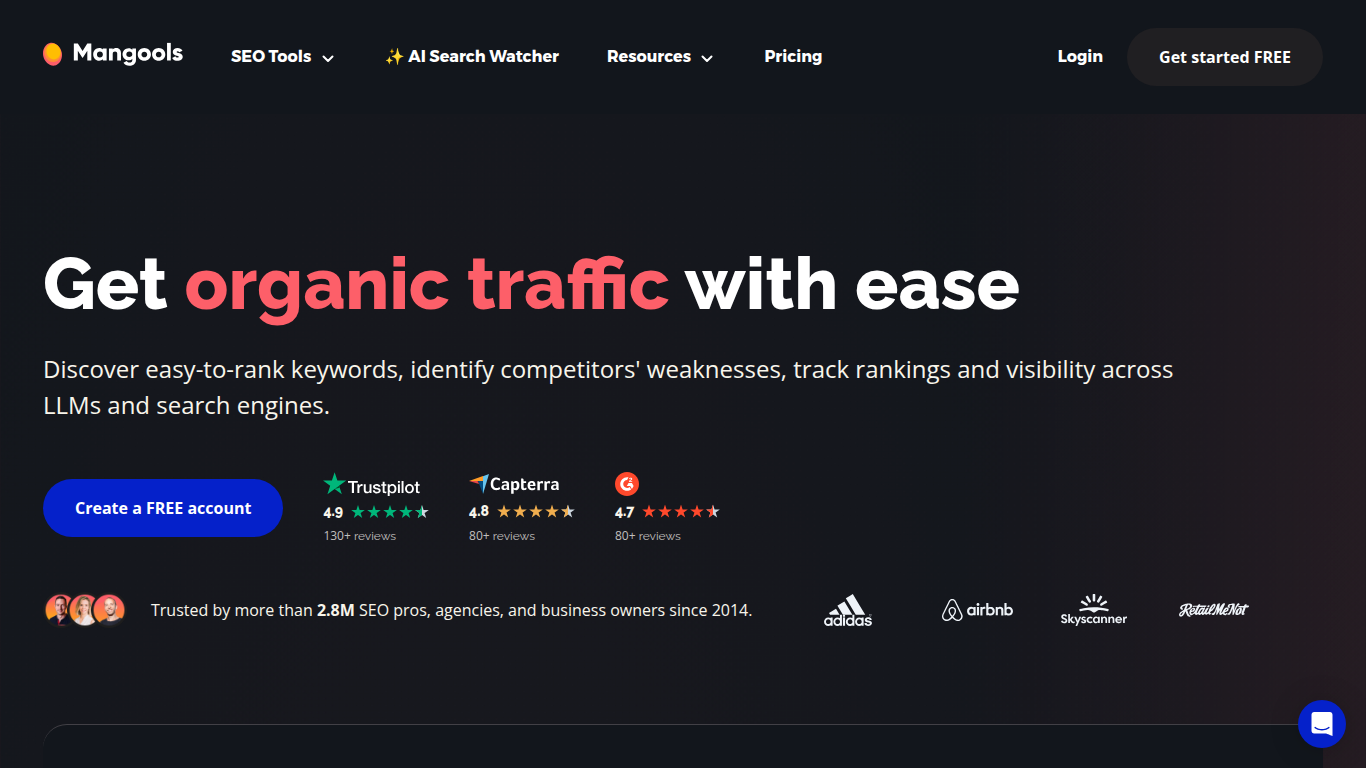
Mangools AI Search Grader is a free GEO tool designed to evaluate your brand’s visibility and performance within AI-powered search engines including OpenAI’s ChatGPT, Perplexity Sonar, DeepSeek V3, Claude by Anthropic, X-AI’s Grok, Google Gemini, Mistral AI, and Meta’s Llama 4.
Key Benefits:
Tests each prompt across eight different AI models to provide a comprehensive view
AI Search Score: A calculated score (0–100) combining visibility and ranking across all AI platforms
Competitor analysis to identify positioning opportunities
Integration with Mangools’ broader SEO toolkit
4. Free Trials from Premium Platforms
Several premium GEO tools offer generous free trials that can jumpstart your AI optimization efforts:
Search Party (Free Trial)
Search Party maps the citations influencing brand visibility, identifies high-impact opportunities, and launches workflows to help you show up accurately and authoritatively. Their free trial provides access to their full platform capabilities.
Otterly.AI (Free Trial)
Otterly.AI is an innovative AI search monitoring tool that helps to monitor critical content, brand, and links across AI tools like ChatGPT, Google AI Overviews, and Perplexity. The trial period lets you explore their intuitive dashboard and monitoring features.
Nightwatch (14-Day Free Trial)
Nightwatch is a comprehensive SEO tool that has also added AI tracking to meet the demands. Their 14-day trial includes both traditional SEO and GEO tracking features.
Essential Free SEO Tools That Support GEO
While specialized GEO tools are crucial, several free traditional SEO tools can support your AI optimization efforts:
Content Structure and Technical SEO
Google’s Rich Results Test
Essential for validating your structured data markup—a critical factor in helping AI systems understand your content. AI models rely heavily on schema markup to parse and comprehend information accurately.
Google Search Console
While it doesn’t track AI citations directly, Search Console helps ensure your content is technically sound and crawlable—prerequisites for AI visibility.
Keyword Research for GEO
All searches online start with a keyword. Because of this, you need a keyword research tool that can help you identify the keywords your target audience uses.
Google Keyword Planner
Provides search volume and competition data for keywords. While designed for traditional search, understanding search patterns helps you optimize for the questions people ask AI systems.
Answer The Public (Free Version)
Excellent for discovering question-based queries that people frequently ask AI assistants. The visual query map helps identify content opportunities for AI optimization.
Free GEO Optimization Strategies
1. Start with a Comprehensive Audit
Begin your GEO journey by running your website through Geoptie’s free audit tool at geoptie.com/app. Within seconds, you’ll receive a detailed GEO score, specific optimization opportunities, content structure analysis, and technical recommendations for AI visibility.
2. Focus on Citation Gaps
Citation gaps are the highest-leverage strategy most brands miss. A citation gap is when AI platforms cite web pages that mention your competitors but not you. Use free tools to identify these gaps and create content that fills them.
3. Optimize for Multiple AI Platforms
Different AI systems have varying preferences and algorithms. By analyzing both your brand and competitors across multiple AI platforms, you can gain actionable insights to optimize your presence in AI search engines.
4. Create AI-Friendly Content Structure
Properly structuring content for machine comprehension rather than just human readability is the challenge. Use clear headings, bullet points, FAQ sections, and structured data to make your content easily parseable by AI systems.
Measuring Your GEO Success
Key Metrics to Track
Using free tools like Geoptie, monitor these essential metrics:
AI Visibility Score: How often your brand appears in AI-generated responses
Citation Frequency: The number of times AI platforms reference your content
Sentiment Analysis: How positively or negatively AI presents your brand
Competitive Share of Voice: Your visibility compared to competitors
Prompt Coverage: Which queries trigger mentions of your brand
Setting Realistic Expectations
Early adopters now attribute 32% of their sales-qualified leads to generative AI search—up from zero just months ago. While results vary by industry and effort level, consistent GEO optimization can yield significant visibility improvements within 60-90 days.
Common GEO Mistakes to Avoid
1. Ignoring Technical Prerequisites
AI crawlers often struggle to execute JavaScript, which can prevent them from processing and rendering JS-based content. Ensure your site is technically accessible to AI systems.
2. Focusing Only on Google’s AI
While Google’s AI Overviews are important, users increasingly ask questions of ChatGPT, Google’s SGE, Perplexity, Claude, and similar platforms. Optimize for the entire AI ecosystem.
3. Neglecting Content Updates
Monitoring for content decay should be integral to your content optimization strategy. Regularly update your content to maintain AI visibility.
Getting Started Today: Your Free GEO Action Plan
Day 1-2: Audit and Assessment
Sign up for Geoptie’s free platform at geoptie.com/app
Run your initial GEO audit
Use Mangools AI Search Grader for additional insights
Document your baseline metrics
Day 3-4: Competitive Analysis
Analyze top competitors using free tools
Identify citation gaps and content opportunities
Map high-value prompts in your industry
Day 5-7: Initial Optimization
Implement quick technical fixes identified in audits
Update your most important pages with AI-friendly structure
Add structured data markup using Google’s free testing tools
Begin monitoring your progress
The Future of Search is AI-Powered
Don’t wait for AI search to become mainstream – it already is. Every day without GEO is a day your competitors could be capturing valuable AI visibility. The tools and strategies outlined in this guide give you everything you need to start optimizing for AI search without spending a dollar.
The shift from traditional search to AI-powered discovery represents the most significant change in digital marketing since mobile optimization. By leveraging these free GEO tools—especially comprehensive platforms like Geoptie during their free beta period—you can position your brand for success in this new era.
Take Action Now
Ready to dominate AI search results? Here’s your immediate next steps:
Visit geoptie.com/app to access the most comprehensive free GEO platform available
Run your free audit to understand your current AI visibility
Set up brand monitoring to track your progress
Join the GEO community at r/Geoptie to connect with other forward-thinking marketers
Remember, while your competitors are still focusing solely on Google rankings, Geoptie users are optimizing for the entire AI search ecosystem. Don’t get left behind in the AI revolution—start your free GEO journey today.
Want to stay ahead of the AI search curve? Bookmark this guide and check back regularly as we update it with new free tools and strategies. The GEO landscape is evolving rapidly, and we’re committed to keeping you informed of the latest developments.
In today’s AI-driven digital landscape, appearing prominently in ChatGPT responses isn’t just an advantage—it’s becoming essential for business survival. As millions of users turn to AI assistants for recommendations, competitive AI optimization has emerged as the critical frontier for digital marketing success.
Understanding Competitive AI Optimization
Competitive AI optimization goes beyond traditional SEO. While search engines rank web pages, AI models synthesize information to create responses that often recommend specific brands, products, or services. When ChatGPT suggests your competitor instead of you, you’re losing customers you never knew existed.
The stakes are high. Recent studies indicate that over 100 million users interact with ChatGPT weekly, and many treat its recommendations as authoritative. If your brand isn’t part of the AI’s consideration set, you’re invisible to this massive and growing audience.
Why Traditional SEO Isn’t Enough Anymore
Search engine optimization remains important, but competitive AI optimization requires a fundamentally different approach. AI models don’t crawl websites in real-time or consider meta tags. Instead, they rely on training data patterns, contextual relevance, and the digital footprint your brand has created across the entire internet.
Consider this scenario: A user asks ChatGPT for “the best project management software for small teams.” The AI’s response isn’t based on who has the best SEO, but on patterns it learned about brand authority, user sentiment, and contextual relevance across millions of data points.
Key Strategies for Competitive AI Optimization
1. Analyze Your AI Visibility Gap
Start by understanding where you stand. Test various prompts related to your industry and document when competitors appear instead of your brand. This competitive AI optimization audit reveals your visibility gaps and opportunities.
Use tools like Geoptie to systematically track how often your brand appears in AI responses versus competitors. This data becomes your baseline for improvement.
2. Build Authoritative Digital Presence
AI models favor brands with strong, consistent digital footprints. Focus on:
Creating high-quality, informative content that positions your brand as an industry authority
Earning mentions on reputable third-party sites
Maintaining consistent brand messaging across all digital channels
Engaging in industry discussions and forums where AI training data is likely sourced
3. Optimize for Contextual Relevance
Competitive AI optimization requires understanding context. Don’t just mention your product—explain when, why, and how it solves specific problems. AI models learn from patterns, so create content that clearly associates your brand with specific use cases and solutions.
For example, instead of simply stating “Our software has great features,” write detailed case studies explaining “How Company X reduced project delays by 40% using our software’s automated timeline adjustment feature.”
4. Leverage Structured Data and Knowledge Graphs
While AI models don’t directly read schema markup like search engines, they benefit from the clearer information architecture it creates. Structured data helps establish entity relationships that AI models can better understand and reference.
Advanced Competitive AI Optimization Techniques
Sentiment and Association Management
AI models pick up on sentiment patterns. Monitor and manage how your brand is discussed online. Address negative feedback promptly and publicly, and encourage satisfied customers to share detailed experiences.
Comparative Content Strategy
Create content that directly compares your solution to competitors—fairly and factually. This helps AI models understand your unique value proposition and when to recommend you over alternatives.
Temporal Relevance Optimization
Stay current. AI models are periodically retrained, and recent, relevant content carries weight. Regularly update your content and maintain an active presence in industry conversations.
Measuring Competitive AI Optimization Success
Track these key metrics:
AI Mention Rate: How often your brand appears in relevant AI responses
Competitive Share of Voice: Your mentions versus competitors in AI outputs
Context Quality Score: Whether mentions are positive and in relevant contexts
Recommendation Position: Where you appear in lists or comparative responses
Common Pitfalls to Avoid
Over-Optimization
Trying to game AI systems with repetitive, unnatural content patterns can backfire. Focus on genuine value and authentic brand building.
Neglecting User Intent
Competitive AI optimization isn’t about appearing everywhere—it’s about appearing for the right queries where your solution truly fits.
Ignoring Indirect Competitors
AI models might recommend alternative solution types. Monitor and optimize against both direct competitors and substitute products.
The Future of Competitive AI Optimization
As AI assistants become primary information sources for consumers, competitive AI optimization will become as crucial as SEO is today. Early adopters who master these techniques now will have significant advantages as AI adoption accelerates.
The landscape is evolving rapidly. New AI models emerge regularly, each with unique characteristics. Successful competitive AI optimization requires continuous adaptation and monitoring.
Take Action: Start Your Competitive AI Optimization Journey
Don’t let competitors dominate AI conversations about your industry. Here’s how to begin:
Audit your current AI visibility using specialized tools
Identify gaps where competitors outrank you
Implement targeted optimization strategies based on your findings
Monitor and adjust your approach based on results
Conclusion
Competitive AI optimization represents the next frontier in digital marketing. While your competitors focus solely on traditional SEO, you can gain a decisive advantage by optimizing for AI visibility now.
The brands that master competitive AI optimization today will be the ones AI assistants recommend tomorrow. With millions of users relying on AI for decisions, can you afford to be invisible in these conversations?
Ready to dominate AI search results? Start your competitive AI optimization journey with Geoptie and ensure your brand gets the AI visibility it deserves. Track your AI mentions, analyze competitor performance, and implement data-driven optimization strategies that put you ahead of the competition.
Transform your AI visibility today. Discover how Geoptie’s advanced competitive AI optimization tools can help you outrank rivals in ChatGPT and other AI platforms. Start your free trial and take control of your AI presence.
Voice search has fundamentally transformed how consumers find products and services online. With over 50% of adults now using voice search daily and smart speaker ownership reaching critical mass, AI search marketing represents the next frontier for businesses seeking to capture high-intent customers at the exact moment they’re ready to buy.
The convergence of artificial intelligence and voice technology isn’t just changing search behavior—it’s creating entirely new revenue opportunities for businesses that understand how to optimize for conversational queries. This comprehensive guide explores how to transform voice search traffic into measurable revenue growth through strategic AI search marketing techniques.
Understanding the AI-Powered Voice Search Revolution
Voice search queries differ fundamentally from traditional text searches. While someone might type “best Italian restaurant NYC,” they’re more likely to ask their voice assistant, “Where can I get authentic Italian pasta near Times Square tonight?” This shift toward conversational, intent-rich queries creates unprecedented opportunities for businesses leveraging AI search marketing strategies.
The intelligence layer provided by AI doesn’t just interpret these queries—it understands context, intent, and even emotional nuance. Modern AI systems analyze factors like search history, location data, time of day, and user preferences to deliver hyper-personalized results. For marketers, this means the ability to intercept customers at precisely the right moment with exactly the right message.
Consider how voice commerce has exploded: consumers now make purchases directly through voice commands, from reordering household essentials to booking restaurant reservations. Smart speakers alone are projected to drive $40 billion in commerce by 2025. The businesses winning this race aren’t just optimizing for voice search—they’re building entire AI search marketing ecosystems designed to convert conversational queries into transactions.
The Revenue Impact of Voice Search Optimization
The financial implications of voice search cannot be overstated. Research shows that voice search users exhibit significantly higher purchase intent than traditional searchers. They’re often further along in the buying journey, asking specific questions about products, comparing options, or seeking immediate solutions to pressing problems.
Local businesses particularly benefit from voice search optimization. Nearly 60% of voice searches have local intent, with users seeking nearby services, store hours, or directions. A pizza restaurant optimizing for “order pizza delivery near me” through effective AI search marketing can see immediate revenue impact, especially when integrated with voice-activated ordering systems.
The key lies in understanding voice search behavior patterns. Voice searchers typically use longer, more specific queries that reveal clearer intent. Someone asking “What’s the best waterproof running shoe for marathon training under $150?” is significantly more likely to make a purchase than someone simply searching “running shoes.” By targeting these high-intent conversational queries, businesses can achieve conversion rates up to 3x higher than traditional search traffic.
Building Your AI Search Marketing Foundation
Creating an effective AI search marketing strategy begins with understanding how artificial intelligence interprets and ranks voice search results. Unlike traditional SEO, voice search optimization requires a multi-layered approach that combines technical optimization, content strategy, and AI-powered tools.
Start by implementing structured data markup across your website. Schema markup helps AI systems understand your content’s context, making it more likely to appear in voice search results. For e-commerce sites, product schema including price, availability, and reviews becomes critical for voice commerce queries. Local businesses should prioritize local business schema, including hours, location, and service offerings.
Natural language processing (NLP) optimization represents another crucial element. Your content must align with how people actually speak, not just how they type. This means incorporating conversational phrases, question-based headers, and long-tail keywords that mirror natural speech patterns. Tools powered by AI can analyze your existing content and suggest conversational variations that better match voice search queries.
Featured snippets, often called “position zero,” become even more valuable in voice search. Voice assistants frequently read these snippets as answers to user queries. Structuring your content to target featured snippets—using clear definitions, numbered lists, and concise answers to common questions—directly impacts your voice search visibility and subsequent revenue potential.
Advanced Techniques for Voice Search Revenue Generation
Moving beyond basic optimization, advanced AI search marketing strategies focus on creating seamless voice-to-purchase pathways. This involves developing voice apps or Actions for Google Assistant and Skills for Amazon Alexa that allow direct transactions through voice commands. Businesses that create branded voice experiences see average order values 30% higher than traditional channels.
Conversational AI chatbots bridge the gap between voice search discovery and conversion. When voice search drives traffic to your site, AI-powered chatbots can continue the conversational experience, answering questions, providing recommendations, and guiding users toward purchase. These chatbots should be trained on your voice search data to understand and respond to the same conversational patterns that brought users to your site.
Dynamic content optimization using AI takes personalization to new levels. By analyzing voice search queries and user behavior, AI systems can automatically adjust landing page content, product recommendations, and calls-to-action to match the specific intent revealed in voice searches. A user arriving via “best organic dog food for senior dogs with allergies” sees entirely different content than someone searching for “cheapest dog food bulk purchase.”
Voice search advertising represents an emerging frontier with massive revenue potential. Platforms are beginning to offer voice-activated ad formats that allow users to engage with ads through voice commands. Early adopters of these formats report cost-per-acquisition rates 40% lower than traditional display advertising, with higher engagement rates due to the interactive nature of voice.
Measuring and Optimizing Voice Search Performance
Tracking voice search performance requires sophisticated analytics approaches that go beyond traditional SEO metrics. Implement voice search tracking through Google Search Console by monitoring question-based queries and conversational long-tail keywords. Set up custom analytics segments to identify traffic likely originating from voice searches based on query characteristics and user behavior patterns.
Revenue attribution for voice search demands multi-touch attribution models that account for the complex customer journey. Voice search often initiates the buying process, with users later returning through different channels to complete purchases. AI-powered attribution tools can analyze these patterns and properly credit voice search for its role in driving revenue.
A/B testing for voice search optimization should focus on conversational elements. Test different question formats in your headers, varying lengths of featured snippet content, and different approaches to natural language in your body copy. AI tools can automatically generate and test multiple content variations, identifying which conversational styles drive the highest conversion rates from voice search traffic.
Continuous optimization through machine learning ensures your AI search marketing strategy evolves with changing voice search patterns. Implement AI systems that automatically adjust content based on emerging voice search trends, seasonal patterns, and competitive landscape changes. These systems can predict future voice search trends and proactively optimize content before competitors identify opportunities.
Future-Proofing Your Voice Search Revenue Strategy
The future of voice search intertwines with emerging technologies that will further transform how consumers discover and purchase products. Augmented reality (AR) voice search, where users can point their phone at objects and ask questions, creates new opportunities for visual commerce. Businesses preparing for this shift by optimizing product imagery and implementing visual search capabilities position themselves for next-generation revenue streams.
Multimodal search experiences combining voice, visual, and text inputs require holistic optimization strategies. Users might start with a voice search, refine with text, and complete purchases through visual selection. Your AI search marketing strategy must seamlessly support these fluid user journeys while maintaining consistent messaging and conversion optimization across all touchpoints.
Privacy-first voice search optimization becomes increasingly critical as regulations tighten and consumer awareness grows. Develop strategies that deliver personalized experiences while respecting user privacy preferences. This includes implementing consent management platforms, offering voice search experiences that work without extensive data collection, and transparently communicating how voice data improves user experience.
Taking Action: Your Voice Search Revenue Roadmap
Transforming voice search into revenue requires systematic implementation of AI search marketing strategies. Begin with a comprehensive voice search audit of your current digital presence. Identify gaps in conversational content, technical optimization issues, and missed opportunities for voice-specific features. Prioritize quick wins that can deliver immediate revenue impact while building toward long-term voice search dominance.
Invest in the right AI-powered tools and platforms that accelerate your voice search optimization efforts. From content optimization platforms that suggest conversational improvements to analytics tools that track voice search performance, the right technology stack multiplies your team’s effectiveness. Consider partnering with AI search marketing specialists who understand the nuances of voice search optimization and can accelerate your time to revenue.
The businesses that master voice search today will dominate tomorrow’s conversational commerce landscape. As voice becomes the primary interface for digital interactions, those with established AI search marketing strategies will capture disproportionate market share and revenue growth.
Ready to transform your voice search presence into a revenue-generating machine? Geoptie’s AI-powered optimization platform provides the tools and intelligence you need to dominate voice search and convert conversational queries into customers. Our advanced AI analyzes your content, identifies voice search opportunities, and automatically optimizes for maximum revenue impact.
Voice search isn’t just changing how people find information—it’s revolutionizing how they buy. With the right AI search marketing strategy, voice search becomes your most powerful revenue channel. Start optimizing today and position your business at the forefront of the conversational commerce revolution.
The game has changed. While SEO still matters, there’s a new frontier in content optimization: making your content AI-friendly. As millions of users turn to ChatGPT, Claude, Perplexity, and other AI assistants for answers, ensuring your content gets cited by these AI engines has become crucial for digital visibility.
This comprehensive checklist will show you exactly how to optimize content for AI systems, helping you capture traffic from this rapidly growing discovery channel.
Why Optimizing for AI Matters Now
AI assistants are becoming the primary research tool for many users. When someone asks ChatGPT about your industry, will your content be part of the answer? If not, you’re missing out on a massive opportunity.
Unlike traditional SEO where you compete for rankings, AI optimization focuses on becoming a trusted source that AI systems reference. This means your content needs to be structured, authoritative, and easily digestible by large language models.
Understanding How AI Engines Process Content
Before diving into optimization tactics, it’s essential to understand how AI systems evaluate and select content:
Content Clarity and Structure
AI models excel at processing well-structured information. They look for clear hierarchies, logical flow, and explicit connections between ideas. Ambiguous or poorly organized content gets overlooked.
Factual Accuracy and Authority
AI systems prioritize content from authoritative sources with verifiable information. They cross-reference facts and favor content that aligns with established knowledge bases.
Semantic Richness
Unlike keyword-stuffing for traditional SEO, AI optimization requires naturally incorporating related concepts and terminology that help AI understand context and relevance.
The Essential Checklist to Optimize Content for AI
1. Structure Your Content for Maximum Clarity
Use Clear Hierarchical Headers
Implement proper H1, H2, H3 tags that create a logical outline
Each section should address one specific aspect of your topic
Avoid clever or ambiguous headlines—be descriptive and direct
Create Scannable Paragraphs
Keep paragraphs focused on single ideas
Use 2-3 sentences per paragraph when possible
Start each section with the main point (inverted pyramid style)
Implement Lists and Tables
Convert complex information into bulleted or numbered lists
Use tables for comparisons and data presentation
These formats help AI quickly extract and understand key information
2. Enhance Semantic Signals
Natural Language Optimization
Write as you would explain to an intelligent colleague
Include synonyms and related terms naturally throughout your content
Answer the “who, what, when, where, why, and how” comprehensively
Entity Recognition
Clearly identify and define key concepts, people, places, and organizations
Use full names on first mention, then abbreviations
Link entities to authoritative sources when relevant
3. Build Unquestionable Authority
Cite Credible Sources
Link to research papers, official statistics, and recognized experts
Include publication dates for time-sensitive information
Avoid linking to outdated or questionable sources
Showcase Expertise
Include author bios with relevant credentials
Reference your own case studies and original research
Display social proof through testimonials or client logos
Update Regularly
Keep statistics and examples current
Add timestamps to show when content was last reviewed
Archive or redirect outdated content appropriately
4. Optimize for Featured Snippet Potential
Direct Answer Formatting
Begin sections with concise definitions or answers
Use the target question as a header when appropriate
Provide the essential answer in 40-60 words before elaborating
FAQ Sections
Include a dedicated FAQ addressing common queries
Format questions as users would naturally ask them
Provide comprehensive yet concise answers
5. Technical Optimization for AI Crawlers
Schema Markup Implementation
Use Article, FAQ, or HowTo schema where appropriate
Include author and organization markup
Implement breadcrumb navigation schema
Meta Data Optimization
Write clear, descriptive meta titles and descriptions
Include publication and modification dates
Use Open Graph tags for better content understanding
Site Performance
Ensure fast loading times (AI crawlers have timeouts)
Implement proper SSL certificates
Maintain consistent URL structures
6. Create Comprehensive Topic Coverage
Topic Clusters
Develop pillar content that covers topics exhaustively
Create supporting articles that link back to main topics
Show topical authority through comprehensive coverage
Answer Related Questions
Research and address related queries within your content
Use tools to find “People Also Ask” questions
Create sections that anticipate follow-up questions
7. Format for Multi-Modal Understanding
Image Optimization
Use descriptive file names and alt text
Include captions that add context
Ensure images support and enhance textual content
Video and Audio Content
Provide accurate transcriptions
Include timestamps for key sections
Create summaries of multimedia content
Testing Your AI Optimization
Once you’ve implemented these strategies, test how well you’ve optimized your content for AI:
Query Testing: Ask various AI assistants questions related to your content
Citation Tracking: Monitor when and how AI systems reference your content
Competitor Analysis: Compare how AI responds to queries about your competitors
Iterate and Improve: Refine based on what generates citations
Common Mistakes to Avoid
When working to optimize content for AI, avoid these pitfalls:
Over-optimization: Don’t sacrifice readability for AI—humans still need to engage with your content
Keyword stuffing: AI systems recognize and penalize unnatural language patterns
Neglecting traditional SEO: AI systems often reference content that already ranks well
Ignoring user intent: Focus on genuinely answering questions, not gaming the system
The Future of AI Content Optimization
As AI technology evolves, so will optimization strategies. Stay ahead by:
Monitoring AI platform updates and documentation
Testing new content formats and structures
Building genuine expertise in your niche
Creating original research and data that AI systems will want to cite
Take Action with Geoptie
Ready to optimize content for AI engines systematically? Geoptie helps you analyze, optimize, and track your content’s AI-friendliness. Our platform provides:
Real-time AI optimization scoring
Automated content structure analysis
Competitive intelligence on AI citations
Actionable recommendations for improvement
Conclusion
Learning how to optimize content for AI isn’t just about staying current—it’s about positioning yourself for the future of digital discovery. By following this checklist and consistently creating high-quality, well-structured content, you’ll increase your chances of becoming a go-to source for AI engines.
The shift from traditional SEO to AI optimization represents a fundamental change in how people discover information online. Those who adapt early will reap the benefits of increased visibility and authority in the AI-driven landscape.
Start implementing these strategies today, and watch as your content becomes increasingly citation-worthy across AI platforms. The future of content discovery is here—make sure your content is ready for it.
Want to streamline your AI optimization process? Try Geoptie free for 14 days and see how we can help you optimize content for AI engines effectively.
The search landscape is undergoing its most significant transformation since Google’s inception. As AI-powered search engines like ChatGPT, Claude, Perplexity, and Google’s SGE reshape how users find information, executives face a critical question: Is your AI search strategy ready for this fundamental shift?
Traditional SEO won’t save you here. The companies winning in 2025 aren’t just optimizing for keywords—they’re architecting content specifically for AI comprehension, building what we call Generative Engine Optimization (GEO) strategies that put them at the forefront of AI-generated responses.
The $15.7 Trillion Question: Why Your AI Search Strategy Matters Now
McKinsey projects that generative AI will add between $2.6 and $4.4 trillion annually to the global economy. Yet most businesses remain unprepared for how AI search fundamentally changes customer acquisition. When potential customers ask AI assistants for recommendations, will your company appear in the response?
Consider this: AI search engines don’t display ten blue links. They synthesize information and present definitive answers, often mentioning only 2-3 brands. If your AI search strategy doesn’t position you among those select few, you’re invisible to an exponentially growing user base.
Understanding GEO: The Foundation of Your AI Search Strategy
Generative Engine Optimization represents a paradigm shift from traditional SEO. While SEO optimizes for search algorithms that rank pages, GEO optimizes for AI models that generate comprehensive answers. This distinction fundamentally changes how executives must think about digital visibility.
Your AI search strategy needs to account for how these models evaluate and synthesize information:
Authoritative positioning matters more than keyword density
The Executive Framework: Building Your AI Search Strategy
1. Assess Your Current AI Visibility
Before crafting your AI search strategy, understand where you stand. Ask your team:
How often does our brand appear in AI-generated responses about our industry?
Which competitors consistently show up in AI search results?
What topics in our domain lack authoritative AI-friendly content?
How well does our content structure align with AI comprehension patterns?
This baseline assessment reveals gaps your AI search strategy must address. Many executives discover their decades of SEO investment haven’t translated to AI visibility—a sobering but crucial realization.
2. Define Clear GEO Objectives
Your AI search strategy should align with broader business goals while recognizing the unique dynamics of AI search. Strategic objectives might include:
Revenue Protection: Ensure your brand maintains visibility as traffic shifts from traditional to AI search Market Expansion: Target new AI-first audiences who primarily use conversational search Competitive Advantage: Establish authority in emerging AI search spaces before competitors Thought Leadership: Position executives and experts as go-to sources for AI models
3. Implement Strategic GEO Initiatives
Executing your AI search strategy requires coordinated efforts across multiple fronts:
Content Architecture Revolution Transform your content from SEO-optimized pages to AI-comprehensible knowledge bases. This means creating comprehensive topic clusters that provide complete context rather than targeting individual keywords.
Authority Building Through Expertise AI models favor content from recognized experts. Your AI search strategy should emphasize building and showcasing genuine expertise through detailed case studies, original research, and expert commentary.
Technical Infrastructure for AI Implement structured data markup, knowledge graphs, and API-accessible content that helps AI models understand and reference your information accurately.
Strategic Partnership Development Form alliances with other authoritative sources in your industry. AI models often validate information across multiple sources, making strategic citations and partnerships crucial for your AI search strategy.
The Competitive Edge: Advanced AI Search Strategy Tactics
Claim Your AI Knowledge Territory
Identify topics where you can become the definitive source. Your AI search strategy should focus on owning specific knowledge domains rather than competing broadly. When AI models consistently encounter your brand as the authority on particular subjects, you become their default reference.
Create AI-First Content Experiences
Develop content specifically designed for AI consumption:
Structured Q&A formats that directly answer common queries
Comprehensive guides that serve as single-source references
Data-rich resources that AI models can cite with confidence
Regular updates that maintain temporal relevance
Build Defensive GEO Moats
Your AI search strategy must protect against competitive displacement. Create content moats through:
Proprietary data and research that competitors can’t replicate
Exclusive expert insights and interviews
Historical performance data and case studies
Unique methodologies and frameworks
Measuring Success: AI Search Strategy KPIs
Traditional SEO metrics don’t capture AI search performance. Your AI search strategy needs new KPIs:
AI Mention Share: Percentage of AI responses in your category that mention your brand Response Prominence: Average position and context when your brand appears Topic Authority Score: Frequency of citation for specific subject areas Competitive Visibility Index: Your AI visibility relative to key competitors Conversion Attribution: Revenue traced to AI search referrals
The Implementation Roadmap: 90-Day AI Search Strategy Sprint
Days 1-30: Foundation Setting
Conduct AI visibility audit
Identify quick-win optimization opportunities
Establish baseline metrics
Align stakeholder expectations
Days 31-60: Content Transformation
Restructure existing content for AI comprehension
Launch authority-building content initiatives
Implement technical GEO requirements
Begin partnership outreach
Days 61-90: Optimization and Scale
Analyze initial performance data
Refine content strategy based on AI response patterns
Expand successful tactics
Document learnings and establish ongoing processes
Common AI Search Strategy Pitfalls (And How to Avoid Them)
Pitfall 1: Treating GEO Like Traditional SEO Many executives assume their SEO strategy translates directly to AI search. This leads to keyword-stuffed content that AI models recognize as low-quality.
Solution: Focus on comprehensive, authoritative content that thoroughly addresses user intent.
Pitfall 2: Neglecting Competitive Intelligence Without monitoring how competitors appear in AI responses, you’re flying blind.
Solution: Regularly audit AI search results in your industry and adjust your AI search strategy accordingly.
Pitfall 3: Underinvesting in Expertise AI models increasingly favor content from recognized experts and authoritative sources.
Solution: Invest in building genuine expertise and ensuring your experts are visible and citable.
The Future-Proof AI Search Strategy
As AI search continues evolving, your strategy must remain adaptable. Build flexibility into your approach by:
Maintaining platform agnosticism: Optimize for multiple AI search engines
Embracing continuous learning: Stay updated on AI model changes
Investing in quality: Prioritize valuable content over volume
Building direct relationships: Cultivate audiences beyond search dependency
Take Action: Transform Your AI Search Strategy Today
The window for establishing AI search dominance is narrowing. While competitors debate the importance of GEO, forward-thinking executives are already implementing comprehensive AI search strategies that will define market leadership for the next decade.
Your AI search strategy determines whether your business thrives or merely survives in the AI-powered future. The companies that act now—optimizing content for AI comprehension, building authoritative positions, and establishing strong GEO foundations—will capture the massive value creation opportunity ahead.
Ready to revolutionize your AI search strategy? Geoptie provides the tools and insights you need to dominate AI search results. Our platform analyzes your current AI visibility, identifies optimization opportunities, and guides your team through implementing a winning GEO strategy.
[Visit Geoptie to start your free AI visibility assessment and discover how to transform your AI search strategy into a competitive advantage.]
Key Takeaways: Your AI Search Strategy Checklist
✓ Recognize that AI search requires a fundamentally different approach than traditional SEO
✓ Assess your current AI visibility to establish a baseline
✓ Build comprehensive, authoritative content designed for AI comprehension
✓ Implement new KPIs to measure AI search performance
✓ Stay ahead of competitors by acting now, not waiting for market maturity
✓ Use specialized GEO tools to accelerate your AI search strategy implementation
The AI search revolution isn’t coming—it’s here. Make sure your AI search strategy positions your business at the forefront of this transformation.
If you’ve noticed your Google traffic declining over the past year, you’re not alone. Recent data shows that Google’s search dominance is facing its biggest challenge yet, with millions of users migrating to AI-powered search alternatives. But here’s the good news: your customers haven’t stopped searching – they’ve just started searching differently.
The Numbers Behind Google’s Traffic Decline
Google’s market share in search has dropped from 91.9% to 89.3% in just 12 months – that might seem small, but it represents billions of searches now happening elsewhere. The Google traffic decline isn’t just a blip; it’s a fundamental shift in how people find information online.
Key statistics revealing the Google traffic decline:
40% of Gen Z now starts product searches on TikTok or Instagram instead of Google
ChatGPT receives over 3 billion visits monthly, with many users treating it as their primary search tool
Perplexity AI has grown 900% year-over-year in search queries
Microsoft’s Bing (powered by AI) has captured an additional 1.2% market share
Where Your Customers Are Actually Searching Now
1. AI Chat Interfaces
ChatGPT, Claude, and Perplexity aren’t just chatbots – they’re becoming the new search engines. Users are asking complex questions and getting immediate, conversational answers without clicking through multiple links. Your traditional SEO strategy won’t reach these users unless you adapt.
2. Social Search Platforms
TikTok’s search volume has exploded, with users searching for everything from recipes to software reviews. Instagram’s search functionality now rivals many dedicated search engines for lifestyle and product queries. Pinterest processes 5 billion searches monthly, many of which would have previously gone to Google.
3. Vertical Search Engines
Amazon has become the starting point for 60% of product searches. LinkedIn sees 1 billion professional searches weekly. Reddit’s internal search (despite its reputation) processes millions of queries from users seeking authentic discussions and reviews.
Why Traditional SEO Is Failing You
The Google traffic decline exposes a harsh truth: traditional SEO tactics are becoming less effective. Here’s why:
Algorithm Volatility: Google’s constant updates have made ranking stability nearly impossible. Sites that ranked #1 for years are suddenly on page three.
AI Overviews: Google’s own AI summaries are keeping users on the search page instead of clicking through to websites, causing traffic to plummet even when rankings remain steady.
Search Intent Evolution: Users now expect immediate answers, not lists of links. They’re gravitating toward platforms that understand this need.
The New Rules of Search Visibility
Optimize for AI Discovery
Your content needs to be structured for AI comprehension, not just Google’s crawlers. This means:
Clear, factual statements that AI can easily extract and cite
Structured data that helps AI understand your content’s context
Natural language that matches how people ask questions in chat interfaces
Multi-Platform Presence
The Google traffic decline means you can’t put all your eggs in one basket. Your content strategy needs to span:
Traditional search engines (yes, still important)
AI chat platforms through strategic partnerships and citations
Social platforms with native content
Vertical search engines in your industry
Focus on Answer Engine Optimization (AEO)
Instead of just ranking for keywords, you need to become the definitive answer to questions. This shift from SEO to AEO is crucial for capturing traffic from AI-powered search alternatives.
How to Capture Traffic from New Search Channels
1. Create Platform-Native Content
Don’t just repurpose your blog posts. Create content specifically for each platform:
Short-form videos for TikTok search
Infographics for Pinterest
Detailed discussions for Reddit
Professional insights for LinkedIn
2. Build AI Visibility
Get your content referenced by AI systems:
Ensure your content appears in training data through high-authority publications
Create comprehensive, factual content that AI systems prefer to cite
Use structured data markup to help AI understand your expertise
3. Leverage Community Platforms
Authentic engagement on Reddit, Discord, and niche forums drives more qualified traffic than many Google searches:
Participate genuinely in discussions
Provide valuable answers without over-promoting
Build reputation as a trusted expert
The Competitive Advantage of Early Adoption
While your competitors panic about Google traffic declining, you can capture market share by being early to these new channels. Companies that adapted quickly to social media in 2010 dominated for a decade. The same opportunity exists now with AI and alternative search platforms.
Consider these advantages:
Less Competition: Most businesses haven’t adapted to these platforms yet
Lower Costs: Organic reach is still possible on emerging platforms
Higher Engagement: Users on new platforms are more engaged and willing to try new solutions
Future-Proofing: Building presence now ensures you’re ready for the continued Google traffic decline
Measuring Success Beyond Google Analytics
Your measurement strategy needs evolution too. Track:
AI Mentions: How often AI systems reference your brand or content
Social Search Performance: Views and engagement from platform search results
Multi-Touch Attribution: Understanding how various search channels contribute to conversions
Brand Search Volume: Direct searches across all platforms, not just Google
Take Action: Your 30-Day Plan
Here’s how to start capturing traffic from new search channels:
Week 1: Audit where your audience actually searches. Survey customers, analyze platform demographics, and identify top channels.
Week 2: Create platform-specific content strategies. Develop templates and workflows for each channel.
Week 3: Begin publishing and engaging. Start with 2-3 platforms where your audience is most active.
Week 4: Analyze and optimize. Review performance data and double down on what works.
Turn the Google Traffic Decline into Your Opportunity
The Google traffic decline isn’t a crisis – it’s an opportunity to reach customers where they actually are. By diversifying your search strategy and embracing new platforms, you can capture more qualified traffic than ever before.
Ready to optimize for the future of search?Geoptie helps you track and optimize your presence across all search platforms, not just Google. Our generative engine optimization tools ensure your content ranks wherever your customers are searching.
Don’t let the Google traffic decline leave you behind. Start optimizing for tomorrow’s search landscape today with Geoptie – your complete generative engine optimization solution.