Category: GEO Tools & Resources

  • 10 Best AI Search Visibility Tools in 2026 (Compared & Reviewed)

    10 Best AI Search Visibility Tools in 2026 (Compared & Reviewed)

    Buyers no longer shortlist brands from a list of blue links. They ask ChatGPT “what’s the best CRM for a 10-person sales team?” or open Perplexity and type “alternatives to HubSpot under $50 a user,” and they get three to five named companies back. If your brand is not in that shortlist, you do not exist for that buyer.

    That shift created an entire software category in under two years. More than eighteen AI search visibility tools launched in the last twelve months. Entry pricing now ranges from $29 a month at Otterly to $499 a month at Profound’s Starter tier. The marketing copy on every homepage reads the same — “track your AI visibility,” “win in generative search,” “outrank competitors in ChatGPT.” Founders trying to pick one are drowning in look-alike feature lists.

    This article is an honest, hands-on comparison of the ten ai search visibility tools that are actually worth your money in 2026. All pricing is current as of May 2026. Customer counts and funding figures come from each company’s public reporting. Strengths and weaknesses reflect real product testing, customer reviews, and what each platform can and cannot do — not marketing claims.

    If you only have thirty seconds: Geoptie at $49 a month is the best value for agencies and growing brands that want to do something about their AI visibility, not just measure it.

    At-a-glance comparison of the top AI search visibility tools

    Tool Starting price Engines tracked Best for Free trial Notable feature
    Geoptie $49/mo 4 Agencies and growing brands Yes — free GEO audit Unlimited audit reports at every tier
    Profound $499/mo 10 (Enterprise) Fortune 500 with data teams No Real prompt volume data
    Peec AI €75/mo (~$87) 4+ PLG B2B SaaS teams Yes Prompt-centric dashboard
    AIclicks $59/mo 10+ SEO and content agencies Yes UI-scraped (not API) results
    Spotlight Free; $199/mo paid 8 WordPress content teams Yes — full free audit Country-level VPN tracking
    Otterly AI $29/mo 4 (+2 add-ons) Solo founders and freelancers Yes — free plan Cheapest entry tier
    Scrunch AI ~€89/mo (~$95) 3 Reputation teams Yes Hallucination detection alerts
    AthenaHQ $295/mo 8 Enterprise PR and brand teams No Narrative positioning analysis
    ZipTie Tiered 3 Technical SEO teams Yes Indexation audits for LLM bots
    Brandlight $500+/mo Multiple Multi-brand enterprises No Multi-brand analytics

    How we evaluated these AI visibility tools

    Six criteria drove the scoring for every tool below:

    • Engine coverage — how many of the major LLMs are tracked, and at what tier
    • Entry-tier accessibility — what the cheapest usable plan actually includes
    • Action versus monitoring — whether the platform helps you fix what it finds, or only reports it
    • Multi-language and multi-region support — table stakes for any non-US brand
    • Customer traction — funding, named customers, and review-site signal
    • Team fit — agency, in-house marketing, technical SEO, or enterprise PR

    Every claim about pricing, funding, and customer base in the reviews below is sourced from each company’s public reporting and verified at the time of writing.

    The 10 best AI search visibility tools in 2026

    1. Geoptie
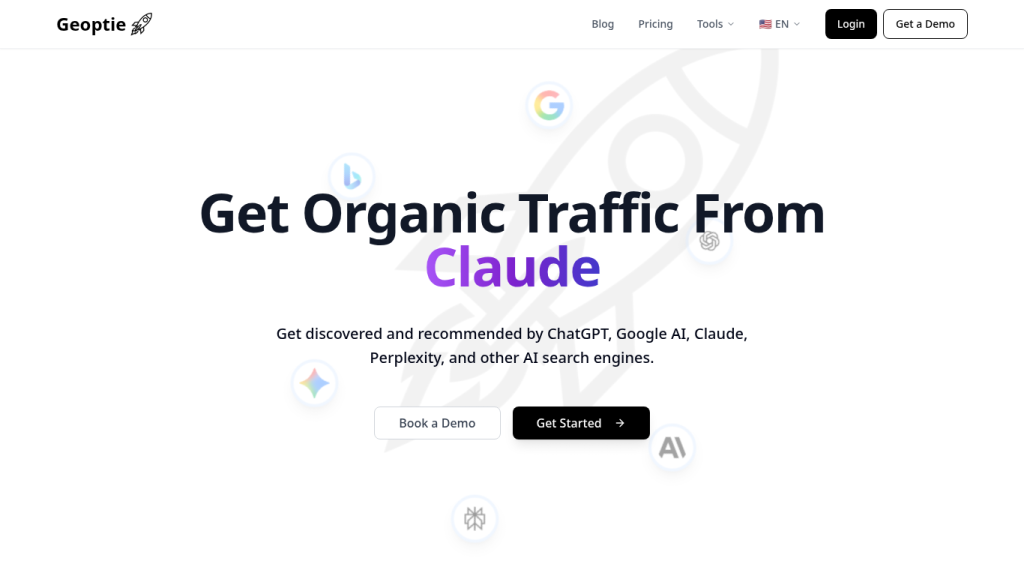
    Geoptie landing page — multi-engine AI visibility and rank tracking platform

    Best for: Agencies and growing brands that need execution — content production and audits — alongside AI search monitoring.

    Pricing: $49/mo Starter (15 prompts, 2 brands); $99/mo Pro (100 prompts, 10 brands); $199/mo Enterprise (400 prompts, unlimited brands). A free GEO audit is available with no credit card.

    What it does: Geoptie tracks brand mentions across four AI engines — ChatGPT, Claude, Perplexity and Gemini — and pairs that monitoring with a Content Studio that produces AI-optimized articles. Every paid plan includes unlimited audit reports, which is unusual at this price.

    Key features:

    Strengths:

    • Lowest entry price among full-featured tools in this comparison — $49/mo versus $295 at AthenaHQ and $499 at Profound
    • The only sub-$50 tool that combines monitoring with content production
    • Unlimited audit reports on every plan, including Starter

    Where it falls short:

    • Less brand recognition than Profound or Peec AI
    • Smaller customer logo book than VC-funded competitors

    Verdict: Pick Geoptie if you need to do something about what you find, not just measure it. The combination of multi-engine tracking, a built-in Content Studio, and unlimited audits at $49/mo is what places it at the top of this list. Run a free GEO audit before paying for anything to confirm the data is useful for your category.

    Visit Geoptie →


    2. Profound

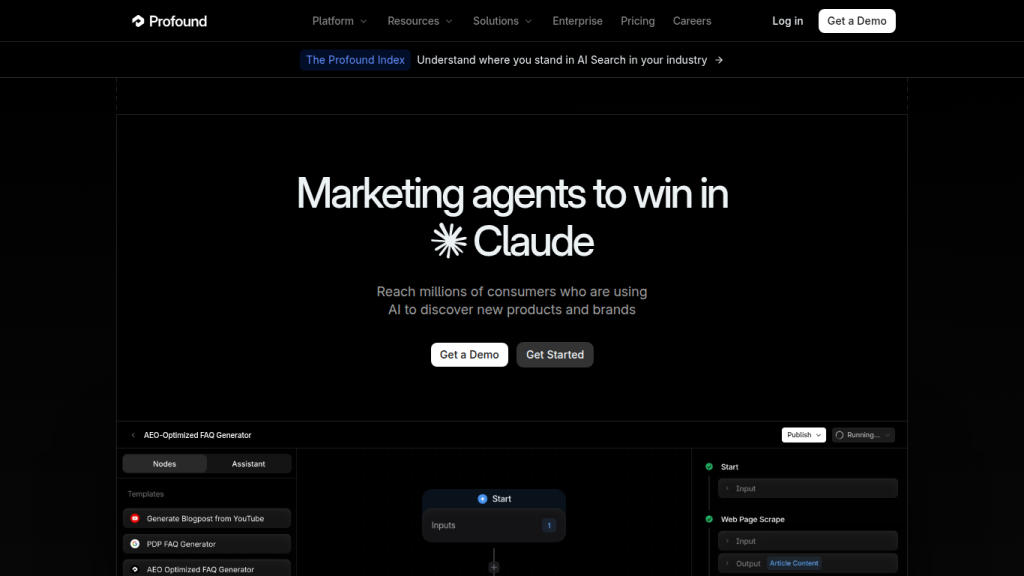
    Profound landing page — enterprise AI visibility and citation analytics

    Best for: Fortune 500 brands with dedicated data and analytics teams and a five-figure annual budget for visibility tooling.

    Pricing: $499/mo Starter (50 prompts, ChatGPT only); $399/mo Growth (100 prompts, 3 engines, $332.50/mo billed annually); Enterprise on request.

    What it does: Profound is the most heavily funded company in this category — $155M raised at a $1B valuation as of February 2026, with Sequoia, Kleiner Perkins, Khosla Ventures, and Lightspeed on the cap table. It tracks visibility across ten engines (ChatGPT, Perplexity, Google AI Mode, Gemini, Microsoft Copilot, Meta AI, Grok, DeepSeek, Anthropic Claude, and Google AI Overviews — full coverage on Enterprise tier only) and adds two features competitors do not have: Prompt Volumes for real AI search volume data, and Agent Analytics for AI crawler tracking.

    Key features:

    • Prompt Volumes — actual search volume for buyer prompts across LLMs
    • Agent Analytics — tracks AI crawler hits to your site
    • Conversation Explorer — example queries that surface your brand and competitors
    • Content Agents for AI-targeted content production
    • Agency mode for white-label resale

    Strengths:

    • Most comprehensive engine coverage in the category
    • The only platform with real prompt volume data at this scale
    • Anchor customers including Ramp, US Bank, Indeed, MongoDB, DocuSign, Chime, Target, Walmart, Figma, and Charlotte Tilbury

    Where it falls short:

    • Starter tier at $499/mo covers ChatGPT only — locking SMBs out of the multi-engine view they actually need
    • No free trial — you commit to a plan before testing
    • Some users report a fragmented UX across Agent Analytics, Prompt Volumes, and Conversation Explorer

    Verdict: If you have a $6,000+ annual budget, a data team, and Fortune 500–scale stakes, Profound is defensible. For everyone else, the entry price alone disqualifies it. Looking for a more accessible alternative with similar engine coverage? Start with a free GEO audit or compare ChatGPT rank tracker options before committing.

    Visit Profound →


    3. Peec AI

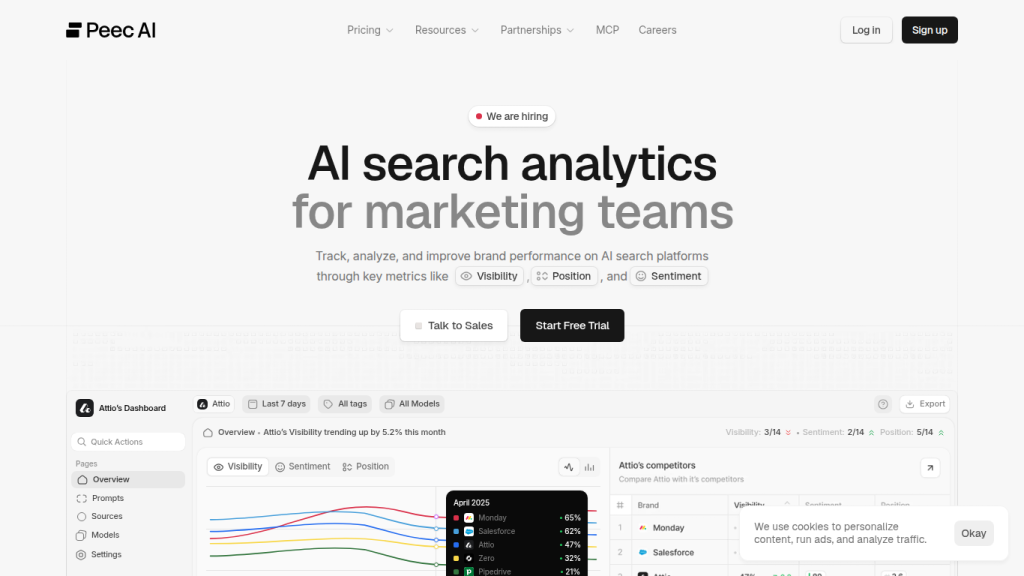
    Peec AI landing page — brand sentiment tracking across AI search engines

    Best for: Fast-growing B2B SaaS brands that want the leanest, fastest-iterating prompt-tracking dashboard.

    Pricing: €75/mo (~$87, 25 prompts); €169/mo (~$196, 100 prompts); €424/mo (~$493) Enterprise.

    What it does: Peec AI is the breakout product of 2025–2026 — €7M seed in July 2025, $21M Series A in November 2025 led by Singular ($29M total), and a customer count past 1,300 brands and agencies including n8n, Attio, ElevenLabs, Chanel, TUI, Axel Springer, Peak Ace, and DEPT. The product is built around prompts rather than keywords, with strong sentiment and source-citation analysis.

    Key features:

    • Prompt-centric dashboard (not keyword-centric)
    • Sentiment analysis and source insights
    • Reddit and community recommendation tracking
    • Multi-language tracking across major markets
    • Clean, design-led UI consistently praised in reviews

    Strengths:

    • Hypergrowth — 300+ new customers a month and $4M+ ARR in ten months
    • Opinionated, simple interface
    • One of the better source-citation analyses in the category

    Where it falls short:

    • Young product (launched February 2025) — fewer integrations than older suites
    • Less enterprise data depth than Profound at the high end
    • No on-platform content production — you still need a tool like the GEO Content Checker to act on the data

    Verdict: Best for PLG-focused B2B SaaS teams who want a clean monitoring dashboard and trust a product team that is shipping fast. Pair it with content tooling — Perplexity rank tracking and a writing workflow — for end-to-end execution.

    Visit Peec AI →


    4. AIclicks

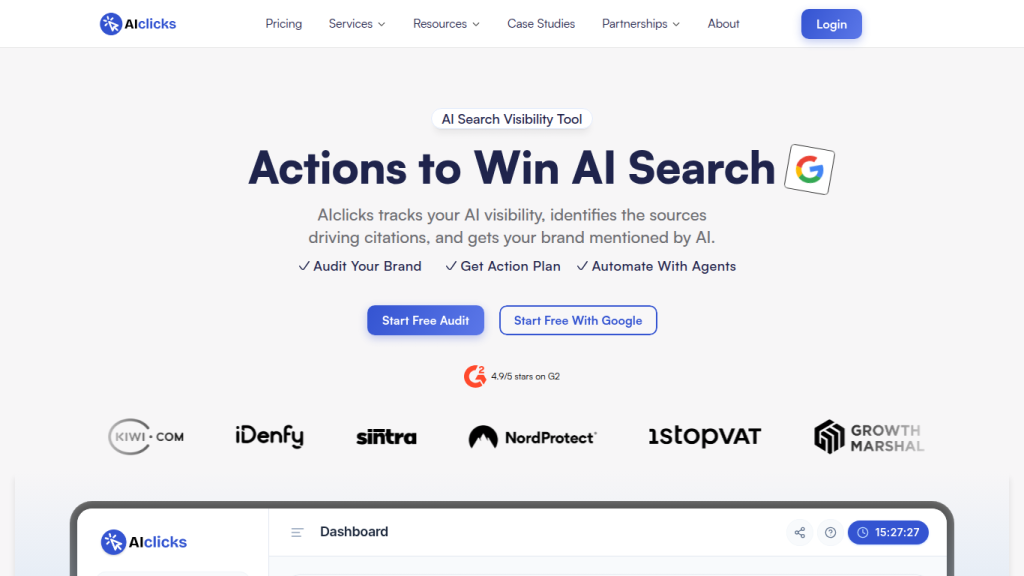
    aiclicks landing page — AI search click and visibility analytics platform

    Best for: SEO and content marketing agencies managing multiple client accounts who need the most accurate ChatGPT data.

    Pricing: $59/mo Starter (30 prompts, 3 platforms); $189/mo Pro (150 prompts, 4 platforms); $499/mo Business (300+ prompts, 6 platforms); custom Enterprise.

    What it does: AIclicks tracks ten-plus engines (ChatGPT, Perplexity, Gemini, Google AI Overviews, Google AI Mode, Claude, Grok, DeepSeek, Meta AI, and Microsoft Copilot) by scraping the actual user interfaces rather than calling APIs. Self-reported customer base is 1,000+ brands and 400+ agencies. The Recommendations Tab surfaces content, source, and Reddit ideas for fixing visibility gaps.

    Key features:

    • UI scraping — queries platforms through real user interfaces, not APIs, which often produces results closer to what users actually see
    • Recommendations Tab with content, source, and Reddit suggestions
    • GA4 integration
    • Agency partner program with revenue share
    • Active founder-led brand presence on LinkedIn

    Strengths:

    • UI-scraped data is typically more representative than API responses on ChatGPT
    • Strong agency channel program with rev-share
    • Multi-client workspaces at a price agencies can pass through

    Where it falls short:

    • No usage-based pricing — locked into preset tiers
    • Limited historical data depth
    • No public API
    • Smaller team than VC-backed rivals — execution risk on roadmap

    Verdict: Best for SEO and marketing agencies that need multi-client workspaces and the most accurate ChatGPT data without enterprise pricing. If you also want execution tooling alongside monitoring, compare against Geoptie’s pricing — both are agency-friendly, but the bundles are different.

    Visit AIclicks →


    5. Spotlight

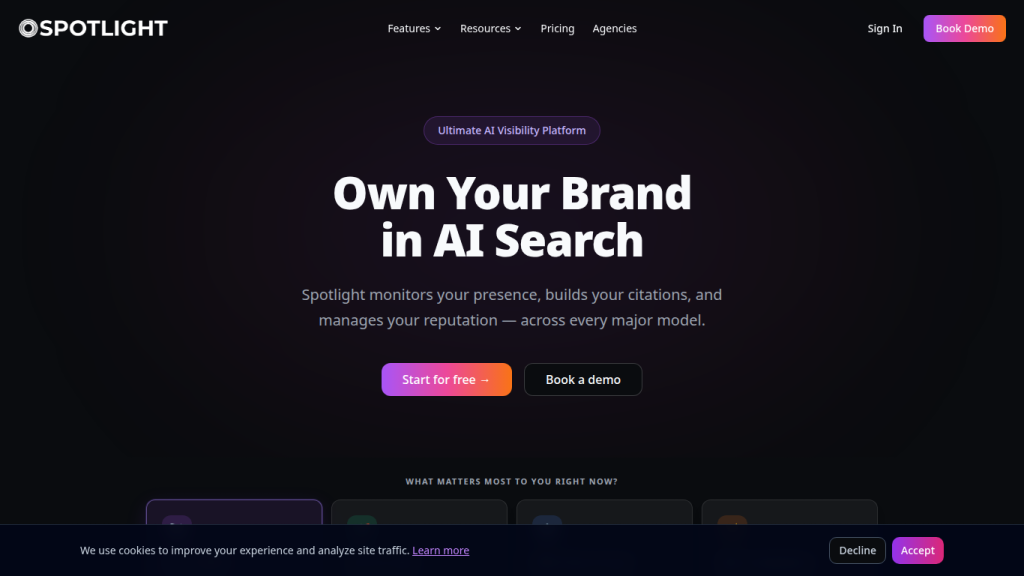
    Spotlight landing page — AI brand visibility and market intelligence platform

    Best for: Content-focused brands and WordPress publishers who want a free tier to test AI visibility before committing.

    Pricing: Free tier with a full audit; $199/mo self-serve; full managed service on request.

    What it does: Spotlight is led by Michael Hermon, formerly head of Innovation and AI at monday.com. It tracks eight platforms — ChatGPT, Google AI Overviews, Google AI Mode, Grok, Gemini, Claude, Perplexity, and Copilot — and stands out for two things: a proprietary prompt volume index built on Google Search Console, Trends, and AdWords data, and country-level VPN tracking that returns true local results rather than US-defaulted ones.

    Key features:

    • Free tier with a complete audit (real value, not a teaser)
    • Proprietary prompt volume index from GSC, Trends, AdWords
    • Country-level VPN tracking for local results
    • 47-feature content analysis
    • Free WordPress plugin for one-click AI-optimized publishing

    Strengths:

    • Genuinely generous free tier — useful as a standalone audit, not just a sales tool
    • Only tool offering true country-level VPN tracking
    • Tight content marketing distribution and a credible founder

    Where it falls short:

    • Less established brand than the top-funded competitors
    • Smaller team than Profound or Peec
    • Less actionable execution layer outside the WordPress plugin

    Verdict: Best for content teams that publish on WordPress and want a free tier to test before paying anyone. Use it to triangulate findings against a tool with deeper content workflows — Geoptie’s GEO Content Checker is a natural pair if you publish outside WordPress as well.

    Visit Spotlight →


    6. Otterly AI

    Otterly AI landing page — AI search visibility tracking for SEO teams

    Best for: Solopreneurs, freelancers, and budget-conscious teams of one to three.

    Pricing: Free plan available; paid plans from $29/mo.

    What it does: Otterly is the cheapest entry point into the category. The free plan covers basic mention tracking across four engines (ChatGPT, Claude, Perplexity, Gemini), with two more available as add-ons. Paid features include citation analysis, sentiment, keyword research, prompt generation, and a GEO audit tool.

    Key features:

    • Free plan with real tracking, not a trial
    • Brand mention and citation analysis
    • Sentiment scoring
    • Keyword research and prompt generation
    • Built-in GEO audit tool

    Strengths:

    • Cheapest entry price in the category
    • Simple, low-bloat interface
    • Frictionless free plan — useful for confirming the category before spending

    Where it falls short:

    • Only four engines on the base plan
    • No content production workflow
    • No dedicated agency plan or multi-workspace features
    • Feature set is shallow compared to $99+/mo competitors

    Verdict: Best lightweight option for solo founders, freelance marketers, or teams who want to test the AI visibility category before investing more. As you grow past one brand and a handful of prompts, compare against the broader best GEO tools roundup to see what you’re missing.

    Visit Otterly AI →


    7. Scrunch AI

    Scrunch landing page — AI citation tracking and crawler log monitoring

    Best for: Reputation management teams whose primary concern is AI hallucinations and misinformation about their brand.

    Pricing: ~€89/mo (~$95).

    What it does: Scrunch AI has been operating since 2023 and has raised $19M. The product covers ChatGPT, Perplexity, and DeepSeek, with a customer base of 500+ brands. It is the only major platform with dedicated hallucination detection alerts — the system flags when an LLM says something factually wrong about your company.

    Key features:

    • Hallucination detection alerts (unique to Scrunch)
    • Content gap analysis
    • Misinformation flagging with source tracing
    • GA4 integration
    • Multi-platform brand monitoring

    Strengths:

    • The only major platform purpose-built for hallucination detection
    • Longer operating history than most competitors (since 2023)
    • Strong fit for regulated and high-stakes industries

    Where it falls short:

    • Engine coverage is limited to three platforms
    • Less developed UX than newer competitors
    • Lacks the actionable optimization recommendations you get from AIclicks, Peec, or Geoptie

    Verdict: Worth buying when your primary concern is AI accuracy and misinformation, not pure visibility growth. Pair it with a visibility-focused tool — a Claude rank tracker or full GEO platform — to cover the growth side too.

    Visit Scrunch AI →


    8. AthenaHQ

    Athena HQ landing page — AI search visibility and brand monitoring platform

    Best for: Mid-to-large enterprises, PR teams, and brand teams who care more about how AI describes them than whether it mentions them.

    Pricing: $295/mo Self-Serve (3,500 credits, 8 LLMs); $545/mo Growth (10,000 credits); Enterprise from $2,000/mo; $100 per 1,250 extra credits.

    What it does: AthenaHQ’s positioning is narrative-first. It does not just count mentions — it analyzes the language LLMs use to describe your brand, your competitors, and your category. The product covers eight LLMs and integrates with major analytics and BI tools.

    Key features:

    • Narrative positioning analysis (how AI describes you)
    • Share-of-voice analytics against competitors
    • Prompt-level monitoring with deep filtering
    • Strong analytics and BI integration
    • Credit-based usage model

    Strengths:

    • The clearest “narrative framing” view in the category
    • Strong for strategic communications, PR, and category-creation teams
    • Good fit for enterprises measuring brand perception, not just mentions

    Where it falls short:

    • Pricing skews premium for the value if you only need monitoring
    • Some reviews flag AI-generated content quality issues
    • Smaller integration ecosystem than older suites
    • Credit-based pricing can produce unpredictable monthly bills

    Verdict: Best for enterprise PR and brand teams that care about how AI describes them, not just whether. If you mainly need visibility tracking plus content execution, save the money and start with a free GEO audit before evaluating AthenaHQ.

    Visit AthenaHQ →


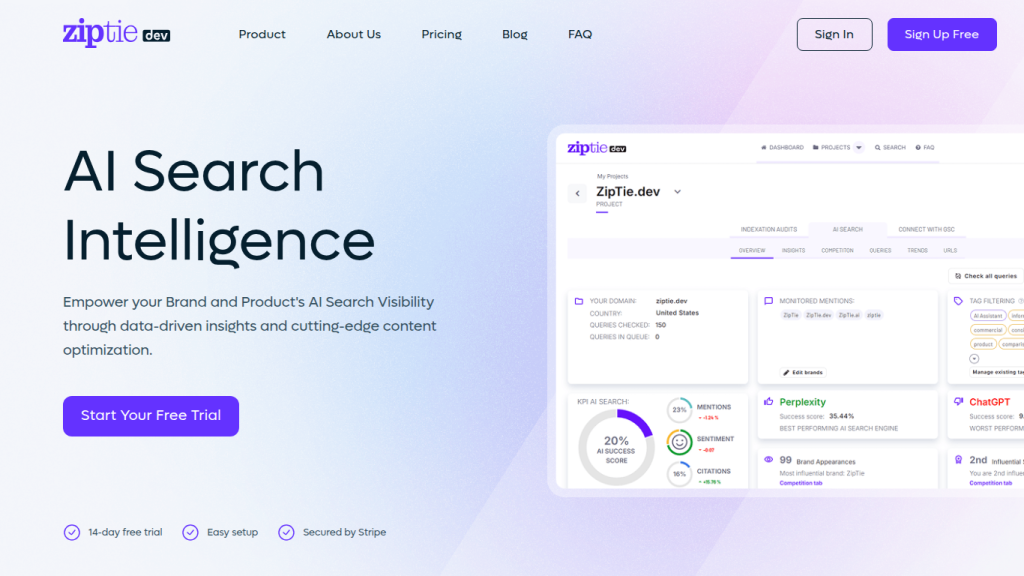
    9. ZipTie

    Ziptie landing page — AI search visibility tracking across ChatGPT, Perplexity, and AI Overviews

    Best for: Technical SEO teams who want indexation auditing for AI crawlers as much as visibility tracking.

    Pricing: Tiered — check the site for current numbers.

    What it does: ZipTie covers three engines — Google AI Overviews, ChatGPT, and Perplexity — and is the most technical product in this list. It uses real-user-mimicking methods rather than pure API calls, runs LLM-bot indexation audits, and produces a proprietary AI Success Score on top of mention and sentiment tracking.

    Key features:

    • Proprietary AI Success Score
    • LLM-bot indexation audits (which pages AI crawlers can and cannot see)
    • In-platform content optimization
    • Mentions and sentiment tracking
    • Real-user-mimicking query methods

    Strengths:

    • The most technically rigorous data collection in the category
    • Strong indexation and crawler-accessibility tooling
    • Good fit for technical SEO practitioners

    Where it falls short:

    • Only three engines tracked
    • No conversation data or prompt volume metrics
    • No add-on engines available — you cannot expand coverage

    Verdict: Best for technical SEO practitioners willing to trade engine breadth for technical depth. If your team also runs traditional rank tracking, compare against a unified GEO Rank Tracker that covers more engines.

    Visit ZipTie →


    10. Brandlight

    Brandlight landing page — enterprise AI visibility platform for brand monitoring across AI search engines

    Best for: Large enterprises with extensive monitoring and multi-brand requirements.

    Pricing: $500+/mo, custom enterprise quotes.

    What it does: Brandlight came out of stealth in April 2025 with $5.75M raised. It targets enterprises that operate portfolios of brands and need analytics, reporting, and integrations at scale. Engine coverage spans the major AI platforms.

    Key features:

    • Multi-brand portfolio management
    • Advanced analytics and reporting
    • Deep integrations with enterprise stacks
    • Enterprise-grade access controls

    Strengths:

    • Enterprise-grade analytics and reporting depth
    • Multi-brand capability for holding companies and portfolio operators

    Where it falls short:

    • Premium-only pricing — no SMB tier
    • Smaller customer base than Profound
    • Younger company than most enterprise competitors

    Verdict: Worth evaluating if Profound feels too monitoring-focused but you still need enterprise-tier analytics across multiple product brands. For single-brand teams, the price is hard to justify against a $49 starting tier elsewhere.

    Visit Brandlight →


    How to choose the right AI search visibility tool for your team

    The right tool depends less on feature comparison than on what you plan to do with the data. A short decision framework:

    • Enterprise with budget and a data team → Profound. The price is high, but the prompt volume data and engine coverage justify it at Fortune 500 scale.
    • SEO agency or content team → AIclicks or Geoptie. AIclicks for the most accurate ChatGPT scraping; Geoptie for monitoring plus a built-in Content Studio at a lower entry tier.
    • Budget-conscious startup → Otterly or Geoptie. Otterly at $29 is the cheapest start; Geoptie at $49 unlocks meaningfully more.
    • You need execution, not just monitoring → Geoptie. It is the only sub-$50 platform that includes content production alongside tracking.
    • Reputation and hallucination concerns → Scrunch AI. It is the only major platform purpose-built for misinformation detection.
    • Pure monitoring with a clean UI → Otterly for solo use, Peec AI for B2B SaaS at scale.
    • WordPress publishers → Spotlight. The free WordPress plugin is unique.
    • Enterprise PR and brand teams → AthenaHQ for narrative analysis; Brandlight for multi-brand portfolios.
    • Technical SEO → ZipTie for indexation auditing.

    For a wider comparison that includes specialist tools, see the best GEO tools roundup and the primer on GEO vs SEO.

    FAQ: AI search visibility tools in 2026

    What is an AI visibility tool?

    An AI visibility tool tracks whether and how your brand appears in answers from AI search engines like ChatGPT, Claude, Perplexity, and Gemini. Unlike traditional SEO tools that monitor keyword rankings on Google, an ai visibility tracker queries LLMs with buyer prompts (“best CRM for startups,” “alternatives to HubSpot”) and records whether your brand is mentioned, what is said about it, and which sources are cited. Most tools also track sentiment, share of voice against competitors, and the URLs that LLMs cite when describing your brand.

    How is AI search visibility different from traditional SEO?

    Traditional SEO ranks pages in a list of ten blue links. AI search produces a synthesized answer that names three to five brands and cites a handful of sources. Winning in AI search means being one of those three to five brands, which depends on what the LLM has read about you across the web — third-party reviews, listicles, Reddit threads, and your own pages — not your position in a ranked list. The GEO vs SEO primer covers the differences in more depth.

    Which AI platforms should I track for visibility?

    The four that matter most in 2026 are ChatGPT, Google Gemini (and AI Overviews), Perplexity, and Anthropic’s Claude. ChatGPT drives the most volume by a wide margin, but Perplexity converts above average for B2B and Gemini owns most mobile searches via Android. Beyond those four, Microsoft Copilot, Grok, DeepSeek, and Meta AI are worth tracking if your audience uses them. Most paid tools cover the top four; tracking eight or more usually requires a higher tier.

    How much does an AI visibility tool cost?

    Entry pricing in 2026 ranges from free (Otterly’s free plan, Spotlight’s free audit, Geoptie’s free GEO audit) to $499 a month at Profound’s Starter tier. Most usable paid plans sit between $49 and $199 a month. Pricing scales with three things: the number of prompts you track, the number of brands or workspaces, and the number of AI engines covered. Enterprise tiers run $500 to $2,000+ a month and add API access, custom reporting, and account management.

    Do I need an AI visibility tool if I’m a small business?

    If your buyers ask LLMs for recommendations in your category, yes — even at small scale. The cost of being invisible compounds. A free GEO audit or a $29–$49 tier from Otterly, Spotlight, or Geoptie will tell you whether you appear for your top ten prompts. If you do not, you have a concrete content and PR problem to solve. If you do, monitor monthly and reinvest the budget elsewhere. Small businesses rarely need the $300+ enterprise tiers.

    What’s the difference between AEO and GEO?

    AEO stands for Answer Engine Optimization and refers to optimizing for direct-answer features — featured snippets, voice assistants, and AI Overviews — where one answer wins. GEO stands for Generative Engine Optimization and refers specifically to optimizing for generative AI engines that produce paragraph-length, multi-source answers. In practice the two overlap heavily and most current “ai visibility tools” cover both. Use AEO when talking to SEO teams and GEO when talking to founders or marketers building for ChatGPT and Perplexity. The GEO definitive guide goes deeper.

    Can I track AI visibility with Google Analytics?

    Partially. GA4 will show referral traffic from chat.openai.com, perplexity.ai, and gemini.google.com, but it does not tell you which prompts surfaced your brand, whether competitors were named alongside you, or what the AI said about you. The visibility — the share of voice inside the answer itself — is invisible to GA4. That is the gap AI visibility tools fill. Several (AIclicks, Scrunch AI, Profound) integrate with GA4 so you can correlate visibility data with downstream conversion.

    How long does it take to see improvement in AI visibility?

    LLMs refresh their training data on long cycles and their retrieval indexes on shorter ones. New content typically surfaces in Perplexity within days, in ChatGPT search within weeks, and in core ChatGPT and Claude answers within one to three months, depending on retrieval signals. Backlinks from authoritative third parties and mentions in well-indexed listicles accelerate this. Plan for a 60- to 90-day cycle to see measurable change, not the 6- to 12-month timeline of traditional SEO.

    Is there a free AI visibility tool?

    Yes. Otterly AI offers a free plan with limited prompts. Spotlight provides a full free audit before any paid commitment. Geoptie offers a free GEO audit with no credit card. These are good starting points to understand your current visibility before paying for ongoing tracking. Fully free tools that match the depth of paid monitoring do not exist yet — the API costs of running queries against ChatGPT, Claude, and Perplexity make a fully free product economically difficult to sustain.

    Should I use one tool or combine multiple?

    For most teams, one tool is enough. Combining tools is worth it only when there is a specific gap — pairing a monitoring-only product with a content tool, or running Scrunch AI alongside another monitor specifically for hallucination detection. Watch for duplicate prompt-tracking costs: you do not need two tools querying the same 100 prompts against ChatGPT. Most agencies and brands settle on one primary tool within six months and use companion utilities (a Keyword Finder, a Rank Tracker) around it.

    Start with your own data

    The best way to understand AI search visibility is to see your own. Run a free GEO audit on Geoptie to see where your brand stands across ChatGPT, Perplexity, Gemini, and more — no credit card required. Once you know what is missing, the decisions in this guide get a lot easier to make.

  • 11 Best GEO Tools in 2026: We Tested & Ranked Them

    11 Best GEO Tools in 2026: We Tested & Ranked Them

    AI search is changing how customers discover brands. Instead of clicking through Google results, users now ask ChatGPT, Perplexity, and Google AI for direct answers, and your brand is either getting cited or getting ignored.

    We reviewed 20+ GEO tools to find which platforms actually help you show up in AI-generated responses. Here are the 11 that deliver real results.

    What Are GEO Tools?

    GEO tools help brands get discovered and cited by AI search engines like ChatGPT, Perplexity, Google AI Overviews, Claude, and Gemini. Unlike traditional SEO tools that focus on Google rankings, GEO tools optimize your content to appear in AI-generated answers.

    This practice is called Generative Engine Optimization (GEO). As Gartner predicts traditional search volume will drop 25% by 2026 due to AI assistants, brands that ignore GEO risk becoming invisible in the new search landscape.

    The best GEO tools combine two core functions: monitoring (tracking where and how your brand appears in AI answers) and optimization (improving your content to earn more citations).

    One thing worth checking before you buy: engine coverage is usually tiered. Several platforms on this list advertise Claude, Grok, or Copilot at the platform level but unlock them only on custom-priced enterprise contracts. The sections below say which engines you actually get at the entry price.


    Best GEO Tools 2026: Quick Comparison

    RankToolBest ForStarting PriceFree Trial
    1GeoptieTeams wanting tracking and optimization in one place$49/moNo
    2Brandi AIPR, content, and brand strategy teams$349/moNo
    3ProfoundEnterprise brands with compliance requirements$99/moYes (Growth)
    4RankshiftTeams wanting every model without tier gating$92/mo30 days
    5Ahrefs Brand RadarResearchers who want real search-derived prompts$398/moNo
    6GaugeTeams buying high daily prompt volume$599/mo7 days
    7Goodie AIRetail and CPG brands tracking shopping assistants$479/mo7 days
    8Peec AIMultilingual and multi-country visibility analytics$95/mo7 days
    9RankscaleTeams wanting the widest engine list with flexible volume$99/moYes (Pro)
    10Otterly.AILean teams wanting simple monitoring$29/mo14 days
    11HubSpot AEO GraderA free one-time diagnostic before buyingFreeN/A

    Top 11 GEO Tools Reviewed

    1. Geoptie: Best All-in-One GEO Platform

    Geoptie landing page — multi-engine AI visibility and rank tracking platform

    Pricing:

    • Starter: $49/mo ($41/mo billed annually) for 15 prompts, 2 brands
    • Professional: $99/mo ($83/mo billed annually) for 100 prompts, 10 brands
    • Enterprise: $399/mo ($333/mo billed annually) for 400 prompts, unlimited brands
    • Unlimited audit reports and unlimited content generations on every tier
    • Extra prompts: +100 for $99/mo on Enterprise
    • Unlimited seats on every plan

    Geoptie is purpose-built for Generative Engine Optimization, combining AI visibility tracking with content optimization in a single platform. Most competitors at this price only monitor. Geoptie tracks and then gives you the work to do next.

    The platform covers seven engines: ChatGPT, Claude, Perplexity, Gemini, Google AI Overviews, Google AI Mode, and Microsoft Copilot, with any four selectable per brand on every paid tier and no per-engine surcharge. Claude on the $49 plan is unusual in this category, where most platforms route it to an enterprise conversation or charge for it separately. Engine selection is per brand, so two clients on one account can track different mixes. On the monitoring side you get citation tracking alongside brand-mention tracking, competitor share of voice across the same prompt set, sentiment scoring on every tracked answer, and GEO audit reports. White-label report branding (your logo, name, and color) is available on Professional and Enterprise.

    The optimization side is what earns the all-in-one label. Tracked visibility feeds a prioritized list of recommended actions, so the dashboard answers what to do next rather than just what happened. From there you can score an existing page against the prompts you are losing and see what to change, or generate new content aimed at the gaps. Both audits and content generation are unmetered on every plan, which is rare here: Profound sells its content engine as a monthly credit pool, Goodie caps optimization actions at 10 a month on its $479 entry tier, and Gauge includes 18 articles a month at $599.

    Free Tools Available: GEO Audit, Content Checker, Keyword Finder, Rank Tracker (with dedicated trackers for ChatGPT, Perplexity, and Claude), GEO Checklist, Cannibalization Checker, and Backlink Finder, all available without a subscription.

    Pros: Most affordable all-in-one option; Claude selectable on every tier including the $49 plan; unmetered audits, recommendations, and content generation; unlimited seats on every plan

    Cons: Four engines per brand at a time out of the seven covered; no free trial; no scheduled report delivery

    Bottom Line: Geoptie delivers the best value for teams that need both monitoring and optimization without enterprise pricing. Tracking Claude alone costs $439/mo as an add-on at comparable prompt volume elsewhere.


    2. Brandi AI: Best for PR and Brand Strategy Teams

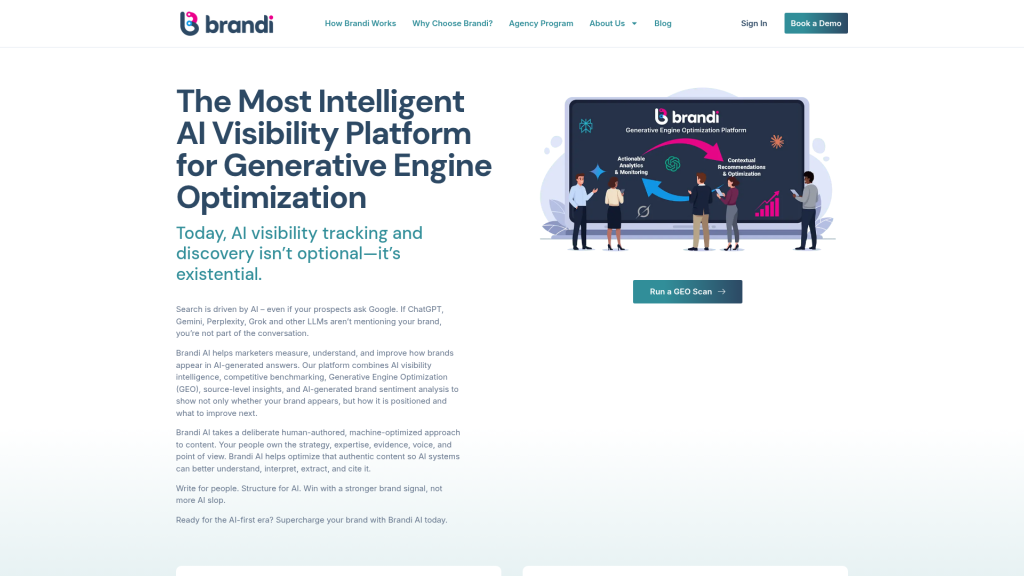
    Brandi AI landing page featuring GEO analytics and brand visibility tracking for PR and content teams

    Pricing: Starting at $349/mo (contact for plan details)

    Brandi AI approaches GEO from the brand and communications side rather than technical SEO. The platform combines four layers: GEO analytics and insights, market and competitive intelligence, content optimization guidance, and technical GEO checks. It tracks brand presence across ChatGPT, Gemini, Perplexity, Grok, and Claude.

    What differentiates Brandi is the buyer context it surfaces alongside the visibility numbers, including the specific prompts and pain points shaping vendor shortlists, which maps to how PR and content teams plan narrative work. Brandi reports GEO share-of-voice gains within four to six weeks and won the 2025 Intellyx Digital Innovator Award.

    Pros: Built around PR, content, and brand strategy workflows; five engines including Claude and Grok; pairs visibility data with prompt-level buyer insight

    Cons: No published pricing beyond the starting price; sales-led onboarding; premium entry point for smaller teams

    Bottom Line: Strong fit for enterprise and agency teams where PR or brand strategy owns the AI narrative. Teams that only need monitoring will find cheaper options further down this list.


    3. Profound: Best for Enterprise Brands

    Profound GEO platform landing page for enterprise brand optimization

    Pricing:

    • Starter: $99/mo for 50 prompts, ChatGPT only, 1 seat
    • Growth: $399/mo for 100 prompts, 3 answer engines, 3 seats
    • Enterprise: custom, up to 9 answer engines, multiple company workspaces
    • Annual billing on Starter and Growth is two months free

    Profound is the most established enterprise platform in AI visibility, backed by Sequoia. Its Enterprise tier tracks up to nine answer engines and is the only place Claude appears. The self-serve tiers are much narrower: Starter covers ChatGPT alone, and Growth covers three engines.

    What sets Profound apart is depth of data rather than breadth of plan. You get AI crawler analytics through its Agent Analytics module with Cloudflare integration, a Conversation Explorer built on a large real-prompt dataset, and a credit-metered content and optimization engine (400 credits per month on Growth). SOC 2, SSO/SAML, multiple company workspaces, and a dedicated specialist with a 24-hour SLA all sit on Enterprise.

    Prompt volume is where the price lands. Growth is $399 for 100 prompts across three engines, and there is no published step above that, so scaling volume means moving to a custom Enterprise contract. For comparison, $399 is Geoptie’s Enterprise price for 400 prompts across any four of seven engines. The gap buys you Profound’s crawler and conversation datasets, which nothing else on this list matches, so the question is whether you need that data or more prompts.

    Pros: Deepest crawler and conversation data in the category; up to nine engines at Enterprise; strongest compliance posture; self-serve trial available on Growth

    Cons: Claude and compliance features are Enterprise-only; the $99 Starter is single-engine; 100 prompts is the ceiling before custom pricing; users on G2 report a steep learning curve and occasional dashboard slowdowns

    Bottom Line: The right choice for enterprises that need crawler-level data and have the budget for it. Teams optimizing for prompt volume or Claude coverage will pay considerably less elsewhere.


    4. Rankshift AI: Best for Multi-Engine Tracking with Built-in Optimization

    Rankshift landing page featuring AI visibility tracking across nine LLMs with citation and sentiment analytics

    Pricing:

    • Starter: $92/mo ($82/mo billed annually) for 150 prompts per day and 9,500 credits
    • Professional: $210/mo ($189/mo billed annually) for 350 prompts per day and 22,000 credits, adding crawler analytics, the Looker Studio connector, and MCP and API access
    • Business: $473/mo ($425/mo billed annually) for 850 prompts per day and 53,000 credits
    • Enterprise: custom, adding custom prompt tracking, SSO, a dedicated account manager, and an SLA
    • 30-day free trial, no credit card required

    Rankshift is a Belgian platform built specifically for AI visibility and GEO rather than adapted from an SEO suite. It uses prompt-based tracking to analyze how brands surface inside AI answers, and it tracks every major model on every paid tier: ChatGPT, Gemini, Google AI Overviews, AI Mode, Copilot, Perplexity, Claude, Meta AI, and Mistral.

    Every paid tier tracks all LLMs, so Claude is available at the $92 Starter price rather than reserved for enterprise, and the credit pool (9,500 on Starter, rising to 22,000 and 53,000 above it) governs how often you refresh across models.

    Pros: Tracks every major LLM including Claude, Meta AI, and Mistral on every paid tier rather than gating models behind enterprise; unlimited projects and seats on all plans; combines monitoring with optimization through content briefs, an AI writer, and a prioritized Action Center

    Cons: Credit-based pricing means model selection and prompt frequency need planning to control usage; crawler analytics, Looker Studio, and MCP/API access require the $210 Professional tier rather than Starter; purpose-built for AI visibility and GEO rather than a full traditional SEO suite; a newer entrant founded in 2025 with a shorter public track record than incumbents

    Bottom Line: A strong pick for teams that want every major model, Claude included, tracked from the entry tier while keeping content optimization in the same platform. Budget around the credit model, and note that crawler data and integrations start one tier up at Professional.


    5. Ahrefs Brand Radar: Best for Prompt Research

    Ahrefs Brand Radar landing page featuring AI visibility tracking on a 470M+ prompt dataset

    Pricing:

    • Select platforms: $398/mo
    • All platforms: $699/mo, including 2,500 custom-prompt checks per month
    • Custom-prompt tracking is now bundled into every paid Ahrefs plan, from 150 checks per month on Lite at $129
    • No free trial, though a single-lookup AI Visibility Checker is free

    Brand Radar’s real differentiator is its dataset. Ahrefs tracks 470M+ monthly prompts derived from real search queries rather than synthetic prompt sets, the largest such index in this category and the only one built from actual search behavior. The $398 tier covers AI Overviews, AI Mode, ChatGPT, Perplexity, Copilot, and Gemini; the $699 tier adds Grok, plus YouTube, TikTok, and Reddit tracking while those remain in beta.

    You get brand mentions, citations, share-of-voice benchmarking, sentiment across brand variations, and 90-day historical reporting, all sitting alongside Ahrefs’ keyword and backlink data. Claude is the notable gap: Brand Radar does not track it on any plan.

    Pros: Largest search-derived prompt dataset; multi-channel tracking beyond AI answers; unlimited projects; strong for competitive research

    Cons: No Claude coverage; $398 buys the prompt index rather than prompt tracking, which now comes with any paid Ahrefs plan; monitoring rather than optimization guidance

    Bottom Line: Best for research-heavy teams already paying for Ahrefs. The prompt dataset justifies the price if competitive intelligence is the job, and it is expensive if you only need brand tracking.


    6. Gauge: Best for High Prompt Volume

    Gauge AI visibility platform landing page featuring competitive intelligence and GEO analytics dashboard

    Pricing:

    • Growth: $599/mo for 600 prompts run daily, 6 platforms, 18 articles per month, 10 seats
    • Enterprise: custom, adds Claude and Grok, unlimited articles and seats, API and BI integration
    • 1-week free trial on Growth

    Gauge, a Y Combinator S24 company, sells on throughput. Growth runs 600 prompts every day across ChatGPT, Google AI Overviews, Google AI Mode, Gemini, Perplexity, and Copilot, which works out to roughly 108,000 tracked answers a month. Its own pricing argument is cost per answer rather than cost per prompt, which is how it justifies sitting above cheaper trackers.

    The platform bundles a content engine that turns visibility gaps into publish-ready articles, plus GA4, Search Console, and DataForSEO integrations and an agent chat that queries across all of it. Claude and Grok require Enterprise, since both need API access rather than front-end scraping.

    Pros: Highest daily prompt throughput at a published price; content engine and agent chat included rather than sold as add-ons; unlimited domains and competitors; genuine self-serve trial

    Cons: $599 entry with no lower tier; Claude and Grok are Enterprise-only; single location on Growth

    Bottom Line: Good economics for teams that genuinely need hundreds of prompts tracked daily. Overkill for a brand monitoring a few dozen.


    7. Goodie AI: Best for Shopping Assistant Coverage

    Goodie AI landing page for enterprise generative engine optimization

    Pricing:

    • Explorer: $479/mo for 100 prompts, 3 engines, 3,000 AI responses, 10 optimization actions, 3 seats
    • Pro: demo-only, 250 prompts, 6 engines, 7,500 responses, 30 optimization actions, 5 seats
    • Enterprise: demo-only, 500+ prompts, up to 11 engines, unlimited seats
    • 20% annual discount; 7-day free trial on Explorer

    Goodie is an enterprise AEO and GEO platform built for AI search from the start rather than retrofitted from an SEO suite. Its genuine differentiator is Agentic Commerce coverage: it tracks Amazon Rufus and Walmart Sparky, which no other platform on this list does, making it the obvious candidate for retail and CPG brands whose buyers start inside a shopping assistant. Revenue attribution through Google Analytics and MCP server access come standard on every tier.

    Engine coverage climbs steeply, and so does the price. The $479 Explorer plan buys three engines: ChatGPT, AI Overviews, and Perplexity. Pro adds Gemini, Copilot, and Amazon Rufus for six. The eleven-engine list advertised on the homepage is true only at Enterprise, which is where Claude, Meta AI, Grok, DeepSeek, and Google AI Mode unlock. Data retention also scales by tier, from three months to twelve.

    Pros: Only platform here covering Amazon Rufus and Walmart Sparky; published entry price with a real trial; revenue attribution and MCP access on every tier

    Cons: $479 for three engines is the steepest entry-to-coverage ratio on this list; Pro and Enterprise are still demo-only; Claude requires Enterprise; agentic commerce needs Pro

    Bottom Line: The clear pick if you sell physical products and shopping-assistant visibility matters, since nothing else here tracks Rufus or Sparky. Just note that the feature you are buying it for sits on Pro, which has no published price.


    8. Peec AI: Best for Multilingual Visibility Analytics

    Peec AI landing page showcasing visibility analytics for AI search engines

    Pricing:

    • Starter: $95/mo for 50 prompts, 1 project
    • Pro: $245/mo for 150 prompts, 2 projects
    • Advanced: $495/mo for 350 prompts, 5 projects
    • Enterprise: custom, all models, unlimited projects
    • Separate agency plans from $245/mo on a shared credit pool
    • 15% annual discount; 7-day free trial, no credit card

    Peec is a Berlin-built platform with clean dashboards for brand visibility, position, and sentiment. Its sentiment scoring is frequently cited as the most granular in the category, and country-level citation share plus analytics across 14+ languages make it the strongest option here for brands operating outside a single English-speaking market.

    The constraint is engine choice. Every self-serve tier lets you pick three models from a pool of seven (ChatGPT, AI Mode, AI Overviews, Copilot, Perplexity, Gemini, Grok), and tracking a fourth costs $35 to $165 per month depending on tier. Claude sits outside that pool entirely and requires Enterprise. Unlimited seats on every plan partly offsets this.

    Pros: Best-in-class sentiment scoring; multilingual and multi-country analytics; unlimited seats; separate agency plans with white-label reporting

    Cons: Only three of seven models per self-serve tier, with add-ons to widen it; Claude is Enterprise-only; low project counts on lower tiers

    Bottom Line: Excellent for analytics and reporting, especially across languages. Teams that need broad engine coverage at a fixed price will hit the three-model cap quickly.


    9. Rankscale: Best for Engine Breadth

    Rankscale GEO platform landing page showing AI search visibility tracking and brand monitoring dashboard

    Pricing:

    • Pro: $99/mo for 1,200 credits, 10 brand dashboards, 50 page audits, up to 4,800 AI responses
    • Growth: $385/mo for 5,500 credits, 50 dashboards, 22,000 responses
    • Enterprise: $780/mo for 12,000 credits, 100 dashboards, 48,000 responses
    • 15% annual discount; unused credits roll over; free trial on Pro

    Rankscale covers more engines than anything else on this list, including ChatGPT, Perplexity, Google AI Mode, AI Overviews, Gemini, DeepSeek, Mistral, Claude, Grok, and Copilot. You get a Visibility Score dashboard, citation analysis showing which sites get cited instead of yours, page audits, scheduling from hourly to monthly, and unlimited seats on every tier. Growth adds white-label dashboard links, REST API access, and an agency program with a partner directory listing.

    Credits are where the real cost lives, because engines do not bill equally. ChatGPT, Gemini, Perplexity, and Google AI Mode run 0.25 credits per check. DeepSeek and AI Overviews cost 1. Claude costs 2, eight times the base rate. On Pro’s 1,200 credits, 50 weekly prompts across the four cheap engines uses around 217 credits a month, and adding Claude at the same cadence roughly triples that.

    Pros: Broadest engine list; credits roll over up to 2x on Pro and 3x above; unlimited seats on every tier; genuine agency program on Growth; frequently praised UX

    Cons: Claude burns credits eight times faster than base engines, so the pool depletes quickly; forecasting a monthly bill takes credit math that flat plans do not; more technical than beginner-friendly

    Bottom Line: The widest engine coverage available at $99, and the right pick if you want to track unusual engines like Mistral or DeepSeek. Run the credit calculator against your real prompt set first, because Claude changes the math substantially.


    10. Otterly.AI: Best Budget Monitoring Tool

    Otterly.AI landing page for AI search performance monitoring

    Pricing:

    • Lite: $29/mo ($25/mo billed annually) for 15 prompts
    • Standard: $189/mo ($160/mo annually) for 100 prompts
    • Premium: $489/mo ($422/mo annually) for 400 prompts
    • Enterprise: from $1,000/mo, adding SSO, custom prompt tracking, and a dedicated CSM
    • Engine add-ons: Gemini and AI Mode from $9/mo, Claude from $29/mo on Lite up to $439/mo on Premium
    • 14-day free trial on every tier; unlimited team members

    Otterly is a Gartner Cool Vendor 2025 and the simplest tool here to get running. Four engines are included on every paid tier: ChatGPT, Google AI Overviews, Perplexity, and Copilot. Daily tracking, real-time alerts, sentiment analysis, GEO crawlability audits, and citation analysis come standard on every plan, along with unlimited team members, which is rare at this price. The Looker Studio connector, API and MCP access, AI crawler analytics, and multiple client workspaces start on the $189 Standard plan; Lite is a single workspace.

    Three engines cost extra. Gemini, Google AI Mode, and Claude are all paid add-ons rather than base coverage, and the Claude add-on scales sharply with plan size, reaching $439/mo on the 400-prompt Premium tier. Otterly does not offer DeepSeek, Grok, or Meta AI at all.

    Pros: Cheap entry at $29/mo; unlimited team members on every tier; 14-day trial; simple setup; Looker Studio connector

    Cons: Gemini, AI Mode, and Claude are all paid add-ons; the $29 Lite plan is one workspace with no connector or API; costs scale steeply with volume; users on G2 note dashboard clutter at higher prompt counts

    Bottom Line: A solid pick for lean teams that want monitoring and nothing more. Add up the engine add-ons before comparing the headline price against all-in-one platforms.


    11. HubSpot AEO Grader: Best Free Option

    HubSpot AEO Grader landing page featuring a free AI visibility diagnostic across ChatGPT, Perplexity, and Gemini

    Pricing: The AEO Grader is free. HubSpot AEO, the continuous version, is $50/mo with no HubSpot subscription required, and is bundled into Marketing Hub Pro and Enterprise.

    HubSpot’s AEO Grader runs a free one-time check of how ChatGPT, Perplexity, and Gemini describe your brand from their training data, with no account required. It returns a score out of 100 across five weighted dimensions: sentiment (40 points), presence quality (20), brand recognition (20), share of voice (10), and market competition (10), plus a written interpretation of what the scores mean. It accepts any brand name, so it doubles as a quick competitor probe, and results come back in under two minutes.

    For ongoing tracking, HubSpot AEO monitors the same three engines week over week with competitor comparison and prioritized recommendations at $50 a month. Three engines is the narrowest coverage on this list, and neither product tracks Claude, Copilot, Grok, or Google AI Mode.

    Pros: Genuinely free with no account needed; fast; works on any brand including competitors; cheap upgrade path at $50/mo

    Cons: Only three engines; the grader reads what models recall rather than what they cite live, so it will not show you citation wins; no Claude coverage on either product

    Bottom Line: The best free starting point for measuring where you stand. Treat it as a diagnostic, then move to a real tracker once you know you have a gap.


    Frequently Asked Questions

    What is the difference between GEO and traditional SEO?

    Traditional SEO focuses on ranking web pages in Google search results. GEO (Generative Engine Optimization) focuses on getting your brand cited and recommended in AI-generated answers from ChatGPT, Perplexity, and Google AI Overviews. Both matter: traditional SEO drives clicks, while GEO drives brand mentions in the growing AI search channel.

    Which GEO tool is best for beginners?

    Geoptie suits beginners best, with a $49/mo entry price and a set of free tools you can run before subscribing, no credit card required. HubSpot’s free AEO Grader is also a useful no-cost way to see where you currently stand.

    How much do GEO tools cost?

    GEO tools range from free to $700 or more per month. Otterly is the cheapest paid entry at $29/mo. All-in-one platforms run $49 to $99. Research-heavy and enterprise platforms sit between $349 and $699, and several vendors publish a price only on their entry tier or not at all.

    Which GEO tools actually track Claude?

    Fewer than the marketing suggests. Claude is selectable on every paid tier at Geoptie, included on every paid tier at Rankshift, and appears on Brandi’s engine list. Everywhere else it is gated: Profound, Peec, Goodie, and Gauge all reserve it for custom-priced enterprise plans, Otterly sells it as an add-on costing up to $439/mo, and Rankscale charges eight times its base credit rate for it. Ahrefs Brand Radar and HubSpot do not track it at all.

    Do I need separate tools for monitoring and optimization?

    Not necessarily. Geoptie, Rankshift, Brandi, Goodie, and Gauge combine monitoring with content optimization. Others (Peec, Otterly, Ahrefs Brand Radar) focus on monitoring, so you would pair them with a separate content workflow.

    Can GEO tools guarantee I’ll appear in ChatGPT responses?

    No tool can guarantee AI citations. Answers are non-deterministic and vary with the phrasing of the prompt, the context, and whatever the engine retrieves at that moment. GEO tools show you which sources are being cited for the prompts you care about, so you can work on becoming one of them.

    How long does it take to see results from GEO?

    Faster than SEO timelines would suggest, because most brand answers are assembled from live web results rather than recalled from training data. Once a page is crawled and starts getting picked up as a citation, the answers it feeds can shift within days. What moves slowly is the other layer: how a model describes your brand from memory with no search involved, which only changes when that model is retrained. So expect quick movement where citations are the lever, and a much longer horizon for correcting an entrenched description that lives in training data.

    Is GEO replacing SEO?

    No. GEO complements traditional SEO. Strong SEO fundamentals improve GEO performance, because AI models often cite high-ranking, authoritative sources. The most effective strategy runs both.


    Conclusion

    The AI search landscape is moving quickly, and brands investing in GEO now will hold an advantage as AI-generated answers become the default discovery layer.

    Our top recommendations:

    For most teams: Geoptie offers the best combination of coverage and value, with seven engines, any four per brand, and optimization tooling from $49/mo.

    For PR and brand teams: Brandi AI focuses on the narrative and communications side of GEO, starting at $349/mo.

    For enterprises: Profound provides the deepest crawler and conversation data with the strongest compliance posture, at Enterprise pricing.

    For every model on the entry plan: Rankshift tracks nine models including Claude on its $92 tier, with a 30-day trial.

    For existing tool users: Ahrefs Brand Radar integrates with the suite you already pay for.

    For budget-conscious teams: Otterly at $29/mo is the cheapest paid entry, and HubSpot’s AEO Grader is free.

    For high prompt volume: Gauge tracks 600 prompts daily across six platforms, the best cost per answer at that scale.

    The most important step is starting. Run a free diagnostic to establish your baseline, then pick the platform that matches your budget, your engines, and the number of brands you need to track.

  • 12 Best AI SEO Tools in 2026: We Tested & Ranked Them

    12 Best AI SEO Tools in 2026: We Tested & Ranked Them

    AI search is changing how customers discover brands. Instead of clicking through Google results, users now ask ChatGPT, Perplexity, and Google AI for direct answers — and your brand is either getting cited or getting ignored. We tested 25+ AI SEO tools to find which platforms actually help you show up in AI-generated responses. Here are the 12 that deliver real results.

    What Are AI SEO Tools?

    AI SEO tools help brands get discovered and cited by AI search engines like ChatGPT, Perplexity, Google AI Overviews, Claude, and Gemini. Unlike traditional SEO tools that focus on Google rankings, AI SEO tools optimize your content to appear in AI-generated answers.

    This practice is called Generative Engine Optimization (GEO). As Gartner predicts traditional search volume will drop 25% by 2026 due to AI assistants, brands that ignore GEO risk becoming invisible in the new search landscape.

    The best AI SEO tools combine two core functions: monitoring (tracking where and how your brand appears in AI answers) and optimization (improving your content to earn more citations). Most tools only offer monitoring, which is why all-in-one platforms deliver better ROI.


    Best AI SEO Tools 2026: Quick Comparison

    Rank Tool Best For Starting Price Free Trial
    1 Geoptie All-in-one GEO platform $49/mo 14 days
    2 Profound Enterprise brands $399/mo No
    3 Semrush AI Toolkit Semrush users $99/mo No
    4 Ahrefs Brand Radar Ahrefs users $129/mo+ Beta free
    5 Peec AI Visibility analytics €89/mo Yes
    6 Otterly.AI Budget monitoring $29/mo 14 days
    7 ZipTie.dev Google AI Overviews $69/mo Yes
    8 Rankability Agencies with coaching $149/mo Yes
    9 AthenaHQ Technical automation $295/mo Yes
    10 HubSpot AI Search Grader Free assessment Free N/A
    11 Goodie AI Enterprise GEO $495/mo No
    12 Scrunch AI Deep enterprise analysis Custom Demo

    Top 12 AI SEO Tools Reviewed

    1. Geoptie — Best All-in-One AI SEO Platform

    Geoptie dashboard showing AI search visibility metrics and brand monitoring analytics

    Pricing: $49/mo (Starter) | $99/mo (Professional) | $199/mo (Enterprise)
    Annual: $41/mo | $83/mo | $166/mo
    Free Trial: 14 days | Best For: SMBs, agencies, marketers wanting complete GEO solution

    Geoptie is purpose-built for Generative Engine Optimization, combining AI visibility tracking with content optimization tools in a single platform. Unlike most competitors that only offer monitoring, Geoptie helps you both track and improve your AI search presence.

    Key Features:

    • AI visibility tracking across major search engines
    • Competitor citation analysis and benchmarking
    • Detailed GEO audit reports with actionable recommendations
    • Content studio for AI-optimized content creation
    • Keyword finder for AI search opportunities
    • Rank tracker for monitoring progress

    Free Tools Available: Geoptie offers seven free tools without requiring a subscription: GEO Audit, Content Checker, Keyword Finder, Rank Tracker, GEO Checklist, Cannibalization Checker, and Backlink Finder. This makes it easy to evaluate the platform before committing.

    Pros: Most affordable all-in-one solution on the market; combines tracking and optimization (rare); generous 14-day trial; seven free tools available; unlimited audit reports and content analyses on all plans.

    Cons: Newer platform compared to legacy SEO tools; focused specifically on GEO rather than traditional SEO metrics.

    Bottom Line: Geoptie delivers the best value for teams that need both monitoring and optimization without enterprise pricing. At $49/mo, it costs 85-90% less than comparable all-in-one platforms like AthenaHQ ($295/mo) or Goodie AI ($495/mo).


    2. Profound — Best for Enterprise Brands

    Profound GEO platform landing page for enterprise brand optimization

    Pricing: $99/mo (Starter) | $399/mo (Growth) | $499/mo (Lite) | Custom (Enterprise)
    Free Trial: No (demo required) | Best For: Fortune 500, regulated industries, large agencies

    Profound has established itself as the market leader for enterprise AI visibility, backed by $35M in Series B funding from Sequoia Capital. The platform offers comprehensive monitoring across 10+ AI engines and includes advanced features like shopping visibility tracking and workflow automation.

    Key Features:

    • Answer Engine Insights dashboard
    • Prompt volume research
    • Agent Analytics for crawler tracking
    • Shopping visibility for e-commerce
    • Workflow automation tools
    • SOC 2 Type II and HIPAA compliance

    Pros: Most comprehensive enterprise solution; strongest security certifications; dedicated strategist support; proven case studies with Fortune 500 brands.

    Cons: Expensive—Growth plan ($399/mo) required for multi-engine tracking; Starter plan limited to ChatGPT only; no free trial; requires demo and sales process.

    Bottom Line: Profound is the right choice for enterprises with significant budgets and compliance requirements. However, mid-market teams will find the pricing prohibitive and may get better value from more affordable alternatives.


    3. Semrush AI Visibility Toolkit — Best for Semrush Users

    Semrush AI Toolkit landing page featuring generative engine optimization tools

    Pricing: $99/mo standalone | $199/mo+ (Semrush One bundle)
    Free Trial: 7-14 days (Semrush One only) | Best For: Teams already using Semrush for SEO

    Semrush has integrated AI visibility tracking into its ecosystem through the AI Visibility Toolkit. For teams already invested in Semrush, this add-on provides a unified view of traditional SEO and AI search performance in one platform.

    Key Features:

    • AI Visibility Score benchmarking
    • Prompt tracking (25-200 prompts based on plan)
    • Brand Performance reports
    • Competitor comparison
    • Site audit for AI crawlability

    Pros: Seamless integration with existing Semrush workflows; familiar interface; combines SEO and AI data; strong competitive intelligence.

    Cons: $99/mo per additional domain; limited to 3-4 AI engines currently; no free trial for standalone toolkit; prompt limits can be restrictive.

    Bottom Line: If you already use Semrush for SEO, the AI Visibility Toolkit is a natural extension. However, teams starting fresh may find purpose-built GEO tools offer more features for similar or lower prices.


    4. Ahrefs Brand Radar — Best for Ahrefs Users

    Ahrefs Brand Radar landing page for AI search brand monitoring

    Pricing: $129/mo (Ahrefs Lite includes basic access) | $199/mo per AI index add-on | $699/mo (6-index bundle)
    Free Trial: Beta indexes currently free | Best For: Teams using Ahrefs wanting brand visibility insights

    Ahrefs Brand Radar takes a comprehensive approach to brand visibility, tracking mentions across AI answers, YouTube, TikTok, Reddit, and traditional web citations. With a database of 250M+ prompts, it offers significant research capabilities.

    Key Features:

    • Massive prompt database (250M+)
    • Multi-channel tracking (AI, video, social, web)
    • Competitive benchmarking
    • Citation source analysis
    • Custom prompt tracking

    Pros: Extensive data coverage; goes beyond just AI to track brand visibility everywhere; seamless for existing Ahrefs users; research-oriented approach.

    Cons: Full AI coverage requires expensive add-ons ($699/mo for bundle); still in beta with reported accuracy issues; no optimization guidance—monitoring only.

    Bottom Line: Brand Radar is powerful for research but expensive for full access. Teams needing optimization guidance alongside monitoring should consider alternatives.


    5. Peec AI — Best for Visibility Analytics

    Peec AI landing page showcasing visibility analytics for AI search engines

    Pricing: €89/mo Starter (~$104) | €199/mo Pro (~$232) | €499/mo Enterprise (~$580)
    Free Trial: Yes | Best For: Marketing teams focused on analytics and reporting

    Peec AI delivers clean, intuitive dashboards for tracking brand visibility, position, and sentiment across AI search engines. The platform emphasizes actionable insights over raw data, making it accessible for teams new to GEO.

    Key Features:

    • Visibility, position, and sentiment tracking
    • AI-suggested prompts with search volume data
    • Source analysis for citation opportunities
    • Competitor benchmarking
    • Looker Studio connector and API
    • Unlimited seats on all plans

    Pros: Clean interface; sentiment tracking included in mid-tier plan; unlimited users even on Starter; strong reporting capabilities; European company with GDPR focus.

    Cons: Primarily monitoring—no content optimization tools; additional engines (Claude, DeepSeek) require add-ons; pricing in Euros may fluctuate for US customers.

    Bottom Line: Peec AI excels at analytics and reporting. Teams that need optimization guidance will need to pair it with other tools or choose an all-in-one platform.


    6. Otterly.AI — Best Budget Monitoring Tool

    Otterly.AI landing page for AI search performance monitoring

    Pricing: $29/mo (Lite) | $189/mo (Standard) | $989/mo (Pro)
    Free Trial: 14 days | Best For: SMBs and startups wanting affordable entry point

    Otterly.AI makes AI search monitoring accessible with an entry-level plan at just $29/month. The platform focuses on brand mentions, citation tracking, and GEO auditing across six AI engines, earning recognition as a Gartner Cool Vendor in 2025.

    Key Features:

    • Brand mention and citation tracking
    • GEO audit tool (25+ on-page factors)
    • Keyword-to-prompt conversion
    • Automated weekly reports
    • Semrush App Center integration

    Pros: Most affordable entry point for AI monitoring; 14-day free trial; recognized by Gartner and G2; simple setup and interface.

    Cons: Lite plan limited to ~10 prompts; costs scale significantly with prompt volume; optimization guidance is basic compared to dedicated tools.

    Bottom Line: Otterly.AI is excellent for teams testing the GEO waters on a budget. Those needing comprehensive tracking or optimization should consider higher tiers or alternatives.


    7. ZipTie.dev — Best for Google AI Overviews Focus

    ZipTie.dev landing page for Google AI Overviews tracking

    Pricing: Starting at $69/mo
    Free Trial: Yes | Best For: Teams prioritizing Google AI Overviews visibility

    ZipTie.dev specializes in Google AI Overviews tracking, offering two years of specialized expertise in what AI engines reward. The platform combines monitoring with content optimization guidance at a competitive price point.

    Key Features:

    • AI success scores for prioritization
    • Content optimization recommendations
    • Competitor tracking and benchmarking
    • Query categorization by topic
    • Site indexing monitoring

    Pros: Strong Google AI Overviews expertise; combines monitoring with optimization; competitive pricing; content guidance included.

    Cons: Limited to three AI engines (ChatGPT, AI Overviews, Perplexity); newer platform with smaller user base.

    Bottom Line: ZipTie.dev offers solid value for teams focused specifically on Google AI visibility. Those needing broader engine coverage should look elsewhere.


    8. Rankability AI Analyzer — Best for Agencies with Coaching

    Rankability landing page featuring GEO tools and agency coaching services

    Pricing: $149/mo (includes AI Analyzer + Content Optimizer)
    Free Trial: Yes | Best For: Agencies wanting expert guidance alongside tools

    Rankability bundles AI visibility tracking with content optimization tools and monthly coaching calls from SEO experts. This combination of software and guidance makes it unique among GEO platforms.

    Key Features:

    • AI visibility tracking across 6+ engines
    • Real-time content scoring and optimization
    • Revenue attribution capabilities
    • Monthly expert coaching calls
    • Integrated with content optimizer

    Pros: Expert coaching included—not just software; combines tracking with proven content tools; revenue attribution for ROI measurement; strong agency focus.

    Cons: Higher price point than monitoring-only tools; coaching value depends on team needs; may be overkill for simple monitoring requirements.

    Bottom Line: Rankability is ideal for agencies and consultants who want both tools and strategic guidance. The coaching calls add significant value for teams building GEO expertise.


    9. AthenaHQ — Best for Technical Automation

    AthenaHQ landing page for technical GEO automation platform

    Pricing: Starting at $295/mo
    Free Trial: Yes | Best For: Technical SEO agencies wanting workflow automation

    AthenaHQ was one of the first purpose-built GEO platforms, featuring an Action Center that provides specific fix recommendations. The platform emphasizes automation and includes content optimization on all plans.

    Key Features:

    • Multi-engine citation tracking
    • Action Center with recommended fixes
    • Real-time monitoring and alerts
    • Content optimization (credit-based)
    • Automated workflows

    Pros: Actionable recommendations, not just data; automation capabilities for agencies; content optimization included; established platform with track record.

    Cons: Credit-based optimization can get expensive at scale; starting price of $295/mo is steep for smaller teams; primarily ChatGPT-focused on lower tiers.

    Bottom Line: AthenaHQ suits technical SEO agencies comfortable with automation workflows. Teams seeking simpler solutions or tighter budgets have more affordable options.


    10. HubSpot AI Search Grader — Best Free Option

    HubSpot AI Search Grader landing page offering free brand visibility assessment

    Pricing: Free
    Best For: Getting a baseline visibility assessment before investing in paid tools

    HubSpot’s AI Search Grader offers a free way to understand how your brand appears in AI-generated search results. It scans ChatGPT, Perplexity, and Gemini to evaluate mention frequency, sentiment, and competitive positioning.

    Key Features:

    • Brand mention frequency analysis
    • Sentiment evaluation
    • Competitor comparison
    • Basic visibility scoring

    Pros: Completely free; quick assessment; no commitment required; good starting point for GEO beginners.

    Cons: One-time assessment, not ongoing monitoring; no optimization guidance; limited depth compared to paid tools; no historical tracking.

    Bottom Line: Use HubSpot AI Search Grader as a free diagnostic before committing to paid tools. It provides valuable baseline data but isn’t a replacement for comprehensive GEO platforms.


    11. Goodie AI — Best Comprehensive Enterprise GEO

    Goodie AI landing page for enterprise generative engine optimization

    Pricing: Starting at $495/mo
    Free Trial: No | Best For: Enterprises wanting complete GEO solution

    Goodie AI positions itself as the most complete GEO platform, combining monitoring, optimization, attribution, and content intelligence. Built specifically for GEO from day one, it avoids the compromises of SEO tools adding AI features as afterthoughts.

    Key Features:

    • Cross-engine visibility tracking
    • Optimization guidance and recommendations
    • Attribution modeling
    • Content intelligence
    • Competitive analysis

    Pros: Purpose-built for GEO; comprehensive feature set; combines all GEO functions in one platform; strong for enterprises serious about AI search.

    Cons: $495/mo starting price excludes smaller teams; no free trial; less established than some competitors.

    Bottom Line: Goodie AI serves enterprises wanting a dedicated, comprehensive GEO solution. The price point reflects its enterprise positioning.


    12. Scrunch AI — Best for Deep Enterprise Analysis

    Scrunch AI landing page for enterprise AI search analysis platform

    Pricing: Custom (Enterprise)
    Free Trial: Demo only | Best For: Large organizations needing detailed segmentation and compliance

    Scrunch AI offers enterprise-grade GEO capabilities with detailed segmentation, prompt-level analysis across all major engines, and SOC 2 Type II compliance. The platform is designed for organizations requiring deep, customizable analysis.

    Key Features:

    • Detailed segmentation architecture
    • Prompt-level analysis across all major LLMs
    • Sentiment and share-of-voice tracking
    • Enterprise security compliance
    • Custom reporting and filters

    Pros: Deepest analysis capabilities; enterprise-grade security; highly customizable; covers all major AI engines.

    Cons: Enterprise-only pricing; requires demo and sales process; complex for smaller teams; overkill for basic monitoring needs.

    Bottom Line: Scrunch AI fits large enterprises needing maximum analytical depth and compliance. Most teams will find more accessible options better suited to their needs.


    Frequently Asked Questions

    What is the difference between AI SEO and traditional SEO?

    Traditional SEO focuses on ranking web pages in search engine results like Google. AI SEO (or GEO) focuses on getting your brand cited and recommended in AI-generated answers from platforms like ChatGPT, Perplexity, and Google AI Overviews. Both are important—traditional SEO drives clicks, while GEO drives brand mentions and recommendations in the growing AI search channel.

    Which AI SEO tool is best for beginners?

    Geoptie is the best AI SEO tool for beginners due to its affordable starting price ($49/mo), generous 14-day free trial, and seven free tools that let you explore GEO without commitment. HubSpot AI Search Grader is also useful as a free starting point to assess your current visibility.

    How much do AI SEO tools cost?

    AI SEO tools range from free (HubSpot AI Search Grader) to $500+ per month for enterprise platforms. Budget options like Otterly.AI start at $29/mo, mid-tier tools like Geoptie and Semrush AI Toolkit run $49-99/mo, and enterprise solutions like Profound and Goodie AI cost $400-500/mo or more.

    Do I need separate tools for monitoring and optimization?

    Not necessarily. All-in-one platforms like Geoptie, ZipTie.dev, and Rankability combine monitoring and optimization. However, many tools (Peec AI, Otterly.AI, Ahrefs Brand Radar) focus only on monitoring, requiring you to use separate tools or manual processes for optimization.

    Can AI SEO tools guarantee I’ll appear in ChatGPT responses?

    No tool can guarantee AI citations because AI responses are non-deterministic—they vary based on prompts, context, and model updates. However, AI SEO tools help you understand what content gets cited, identify gaps, and optimize your content to increase citation probability over time.

    Which AI engines matter most for GEO?

    ChatGPT and Google AI Overviews currently drive the most AI search traffic, making them priorities for most brands. Perplexity is growing rapidly among research-focused users. Claude, Gemini, and Copilot are also significant depending on your audience. Most AI SEO tools cover the major engines.

    How long does it take to see results from GEO?

    GEO results typically take 2-4 months to materialize as you optimize content and AI models update their knowledge. Some quick wins (fixing technical issues, optimizing existing high-authority content) can show results faster. Consistent monitoring helps you identify what’s working and adjust strategy accordingly.

    Is GEO replacing SEO?

    No. GEO complements traditional SEO rather than replacing it. Strong SEO fundamentals (quality content, technical optimization, authority building) actually improve your GEO performance because AI models often cite high-ranking, authoritative sources. The most effective strategy combines both disciplines.


    Conclusion

    The AI search landscape is evolving rapidly, and brands that invest in GEO now will have significant advantages as AI-generated answers become more prevalent.

    Our top recommendations:

    • For most teams: Geoptie offers the best combination of features and value, delivering all-in-one GEO capabilities at $49/mo—a fraction of what competitors charge for similar functionality.
    • For enterprises: Profound provides the most comprehensive enterprise solution with compliance certifications and white-glove support, though at premium pricing.
    • For existing tool users: Semrush AI Toolkit and Ahrefs Brand Radar integrate well with their respective ecosystems, offering familiar workflows for teams already invested in those platforms.
    • For budget-conscious teams: Otterly.AI and HubSpot AI Search Grader provide affordable entry points to start understanding your AI visibility.

    The most important step is starting. Use the free trials and assessment tools available to understand your current AI visibility, then choose the platform that best fits your budget and needs. The brands that act now will be the ones AI recommends tomorrow.

  • Best Free GEO Tools in 2026: Tested & Compared by Use Case

    Best Free GEO Tools in 2026: Tested & Compared by Use Case

    Most GEO platforms charge $50-$500 per month. That makes sense once you’ve committed to an AI search strategy but it’s a tough sell when you’re still figuring out whether your brand even shows up in ChatGPT.

    The good news is there are enough free tools now to run a complete GEO audit, track your AI rankings, research keywords, and identify gaps without spending anything. Some are fully free forever, some are free tiers of paid products, and some are traditional SEO tools that happen to be useful for GEO. (New to GEO? Start with our generative engine optimization guide for the full background.)

    We’ve tested them all. Here’s what’s actually worth your time, organized by what you need to do.

    Audit your AI search readiness

    Before optimizing anything, you need a baseline. These tools tell you how your site currently performs in AI search.

    Geoptie GEO Audit

    Scans your site across six weighted dimensions: answer-first content, citation authority, technical optimization, AI comprehension, content freshness, and competitive context. Answer-first content carries the most weight, since how directly a page answers the question is what decides whether an engine can lift a citation from it. You get a score per dimension plus specific recommendations, in about 30 seconds with no signup.

    This is the most comprehensive free audit we’ve found. Most other audit tools give you a single score — Geoptie breaks it down into the specific factors that determine whether AI engines will cite your content.

    → Run a free GEO audit

    HubSpot AEO Grader

    Evaluates how ChatGPT, Perplexity, and Gemini perceive your brand, scoring five weighted dimensions: sentiment results, presence quality, brand recognition, share of voice, and market competition. Formerly called the AI Search Grader. HubSpot’s strength is the sentiment angle — it doesn’t just tell you whether you appear, it tells you how AI engines describe you.

    The limitation is that it’s a snapshot tool. You can’t drill into specific keywords or track changes over time. Think of it as a second opinion alongside a more detailed audit.

    Mangools AI Search Grader

    Checks your brand across seven models: ChatGPT, DeepSeek, Claude, Gemini, Mistral, and Llama among them. Three run without an account (ChatGPT, Mistral, Llama) and the rest need a free Mangools login. You get an AI Search Score out of 100 weighted by each model’s market share, plus a ranked competitor table for your niche.

    One thing to know about the method: it queries these models through their APIs rather than the consumer apps, so the answers are not identical to what a user sees in ChatGPT or Gemini with browsing enabled. Treat it as a broad cross-model read rather than a citation-level check.

    SE Ranking AI Visibility Checker

    Free public checker covering five engines: Google AI Overviews, AI Mode, ChatGPT, Gemini, and Perplexity. You get your own domain plus up to five competitors, with five checks per day, no paid plan needed. The five-engine spread including both Google surfaces is the widest of the free one-shot checkers.

    Ahrefs AI Visibility Checker

    Free single-lookup preview built on Ahrefs’ prompt index, which is derived from real search behavior rather than prompts a tool invents. Useful as a sanity check on whether your brand shows up for the prompts people actually run. One lookup at a time, and the deeper data sits behind Brand Radar.

    Our take: Start with Geoptie’s audit for the detailed breakdown, then run HubSpot’s grader for the sentiment angle. Between the two you’ll have a thorough baseline. Once you have your scores, our AI search optimization guide walks through exactly how to improve them step by step.

    Track your AI search rankings

    Once you know your baseline, you need to track specific keywords. These tools show you whether your brand appears in AI responses for the queries that matter to your business.

    Geoptie Rank Tracker

    Tracks your visibility across ChatGPT, Claude, Perplexity, and Gemini in one report. Enter your domain, get a report showing your citation position, mention type, and which competitors appear alongside you. No signup.

    Geoptie also has dedicated trackers for individual engines — useful when you want to understand platform-specific behavior:

    → Track your AI rankings

    Manual checking

    Don’t overlook the simplest option: open ChatGPT, Perplexity, and Claude and type in your target queries yourself. It’s not scalable, but for your top 10 keywords it takes 15 minutes and gives you qualitative context that no tool captures — like how your brand is framed, what language the AI uses, and whether the recommendation sounds positive or generic.

    Our take: Geoptie’s rank tracker for on-demand checks across the four chat engines, manual spot-checking for qualitative context.

    Monitor on a schedule without paying

    Everything above is on-demand: you run it, you read it, you move on. The newer development in free GEO tooling is recurring monitoring, where a free account tracks a handful of prompts continuously and tells you when something moves. The quotas are small, so pick the prompts that matter most.

    Botric (free plan)

    Botric‘s free tier is free forever with no credit card, and it tracks five prompts on an ongoing basis alongside a site and GEO audit. The audit is the part that goes deeper than most: it checks schema, llms.txt, entity signals, robots.txt, and whether AI crawlers can access your pages, with fixes ordered by impact. Findings roll into a Visibility Score out of 100 built from mention rate, citation rate, position, and sentiment.

    The free tier tracks ChatGPT, with Google AI Overviews on the $15 plan and Perplexity, Claude, and Gemini higher up, so the engine list grows as you scale rather than gating the product behind a demo. Because Botric runs through an account rather than a one-time scan, you can monitor your AI visibility continuously and see how it changes over time. Paid plans also include the Content Agent, which helps turn identified citation gaps into article drafts you can review and publish.

    Mangools AI Search Watcher

    Separate from the grader above, this is a standing monitor rather than a one-off score, and its free tier is the most generous in this list: 5 prompts, one monitor, weekly updates, and weekly or monthly email reports, with no credit card. Engine coverage on the free tier is the full eight, ChatGPT, Google AI Overviews, Google AI Mode, Gemini, Claude, Grok, Mistral, and Llama, so unlike the grader it does reach both Google surfaces.

    The detail worth stealing regardless of which tool you use: it runs every prompt twice per update, because AI answers vary between runs and smaller brands blink in and out. Mangools puts the miss rate at roughly one in six brand appearances on a single check. Paid tracking starts at $15.60 per month for 500 prompts.

    Our take: Run both, since they are free and they cover different halves. Mangools’ Watcher gives you the wider read, five prompts across eight engines with a weekly email. Botric’s free plan is narrower on engines but gives you the technical audit, and llms.txt and crawler-access checks are hard to get free anywhere else. Neither replaces a paid tracker once you are watching more than a handful of prompts, but together they answer “is anything changing?” at no cost.

    Optimize your content for AI citations

    Knowing your rankings isn’t enough — you need to know what to fix. These tools analyze your actual content and tell you how to make it more citation-worthy.

    Geoptie Content Checker

    Evaluates a specific page across six dimensions designed for AI search performance. Unlike the audit tool (which scans your whole site), the content checker analyzes individual URLs and tells you what to change. It scores content structure, depth, readability, authority signals, and citation-worthiness — the same factors that determine whether AI engines cite you across ChatGPT, Perplexity, and Google AI Overviews (see AEO vs GEO vs SEO for how these citation factors differ by platform).

    The page-level focus is what makes this useful. You can take your most important blog post, run it through, and get a specific list of improvements rather than generic advice.

    → Check your content

    Google’s Rich Results Test

    Not a GEO tool specifically, but structured data is one of the strongest signals for AI citation. Google’s Rich Results Test validates whether your schema markup is correctly implemented and shows you exactly what structured data Google (and by extension, AI engines) can extract from your pages.

    If your schema is broken or missing, AI engines have a harder time understanding your content’s entities and relationships. This is a quick, free check that most people skip.

    Schema.org Validator

    Complements Google’s tool by checking your markup against the full Schema.org specification, not just what Google supports. Useful for identifying structured data that might be read by AI engines even if Google doesn’t currently use it for rich results.

    Our take: Run your top 5-10 pages through Geoptie’s content checker, then validate your structured data with Google’s Rich Results Test. These two steps cover the content and technical sides.

    Traditional keyword tools like Ahrefs and Semrush are built for Google search volume. These tools focus on finding queries where AI engines generate answers — which is a different (and increasingly important) question.

    Geoptie Keyword Finder

    Generates AI-optimized keyword suggestions from a seed keyword. Each suggestion comes with a GEO score indicating its AI search potential, plus data on which AI platforms return results for that keyword. This is the only free tool we’ve found that specifically scores keywords for AI citation potential rather than traditional search volume.

    → Find GEO keywords

    Google Search Console (AI Overview data)

    Search Console now surfaces data on impressions from Google’s AI Overviews. Filter your performance report by “AI Overview” to see which of your pages appear in AI-generated answers on Google. This won’t tell you about ChatGPT or Perplexity, but it covers the biggest AI search surface — Google’s own.

    This is data you already have if you have Search Console set up. Most people just don’t think to check it.

    AlsoAsked / AnswerThePublic

    These free tools show question-based queries that people search for. Since AI engines are fundamentally question-answering machines, targeting the questions people actually ask gives your content a better chance of being cited. Neither is a GEO tool per se, but they’re useful for content planning.

    Our take: Geoptie’s keyword finder for AI-specific keyword research, Search Console for Google AI Overview data you already have, and question-based research tools for content planning.

    Find technical and structural issues

    These tools catch problems that aren’t about content quality — they’re about whether AI engines can access, parse, and understand your site in the first place.

    Geoptie GEO Readiness Checklist

    An interactive self-assessment with 30+ items across strategy, content, technical, and measurement. Check off what you’ve done, get a maturity score, see what’s missing. This isn’t an automated scan — it’s a structured way to audit your own readiness, based on GEO best practices from industry research.

    Particularly useful for SEO managers and marketing leads who need to identify blind spots before investing in tools or agencies.

    → Check your GEO readiness

    Geoptie Keyword Cannibalization Checker

    Identifies pages on your site that compete with each other for the same keywords. Cannibalization is an underrated problem for GEO — when multiple pages target the same topic, AI engines get confused about which one to treat as authoritative. The more content you’ve published, the more likely this is happening without you knowing.

    → Check for cannibalization

    Shows which websites AI engines cite most often in your industry. This is different from traditional backlink tools — instead of showing who links to your competitors on Google, it shows which sources AI models treat as authoritative. Useful for prioritizing link building and partnership outreach.

    → Find GEO backlink opportunities

    Google Search Console

    Beyond AI Overview data, Search Console shows indexing issues, crawl errors, and Core Web Vitals — all of which affect whether AI engines can access your content. If Google can’t crawl a page, AI engines probably can’t either.

    Bing Webmaster Tools

    Worth setting up alongside Search Console. Bing powers parts of ChatGPT’s web-connected responses and Copilot. Bing Webmaster Tools also gives you access to IndexNow, which notifies search engines and AI systems about new content immediately rather than waiting for them to crawl it.

    Putting it all together

    Here’s the workflow we’d recommend using these free tools:

    Step 1: Baseline. Run a GEO audit and HubSpot’s AEO Grader. Now you know your starting point.

    Step 2: Track. Check your most important keywords in the rank tracker. Drill into ChatGPT, Perplexity and AI Overviews individually. Then put your five highest-value prompts on a free recurring monitor so you catch changes without checking manually. Now you know where you’re visible and where you’re not.

    Step 3: Diagnose. Run your top pages through the content checker. Validate your structured data. Check for cannibalization. Now you know what to fix.

    Step 4: Plan. Use the keyword finder to discover queries you’re not targeting. Check Search Console for AI Overview performance. Now you know where to expand.

    Step 5: Assess. Walk through the readiness checklist. Now you know if your strategy and processes are set up to sustain this over time.

    This full workflow takes about an hour using all free tools. You’ll walk away knowing your AI search visibility, what’s broken, and what to do next.

    When to consider paid tools

    Free tools give you on-demand snapshots and manual workflows. If you’re checking once a month or just getting started, that’s enough.

    Free tiers now cover a slice of recurring tracking too, but only a slice: five prompts on one engine, one site, one seat, and little or no history. Paid GEO platforms add tracking at real volume across every major engine, historical trends, competitor monitoring dashboards, alerting when your visibility changes, multi-brand workspaces, and client-ready exports. They make sense when AI search becomes a regular part of your marketing — when you’re checking weekly rather than monthly, when you have multiple brands or clients to track, or when you need to report results to stakeholders.

    For a full comparison of paid options, see our guide to the best GEO tools in 2026.

    Getting started

    The fastest entry point: run a free GEO audit. Thirty seconds, no signup, and you’ll know immediately whether your site is set up to be cited by AI — or ignored.